

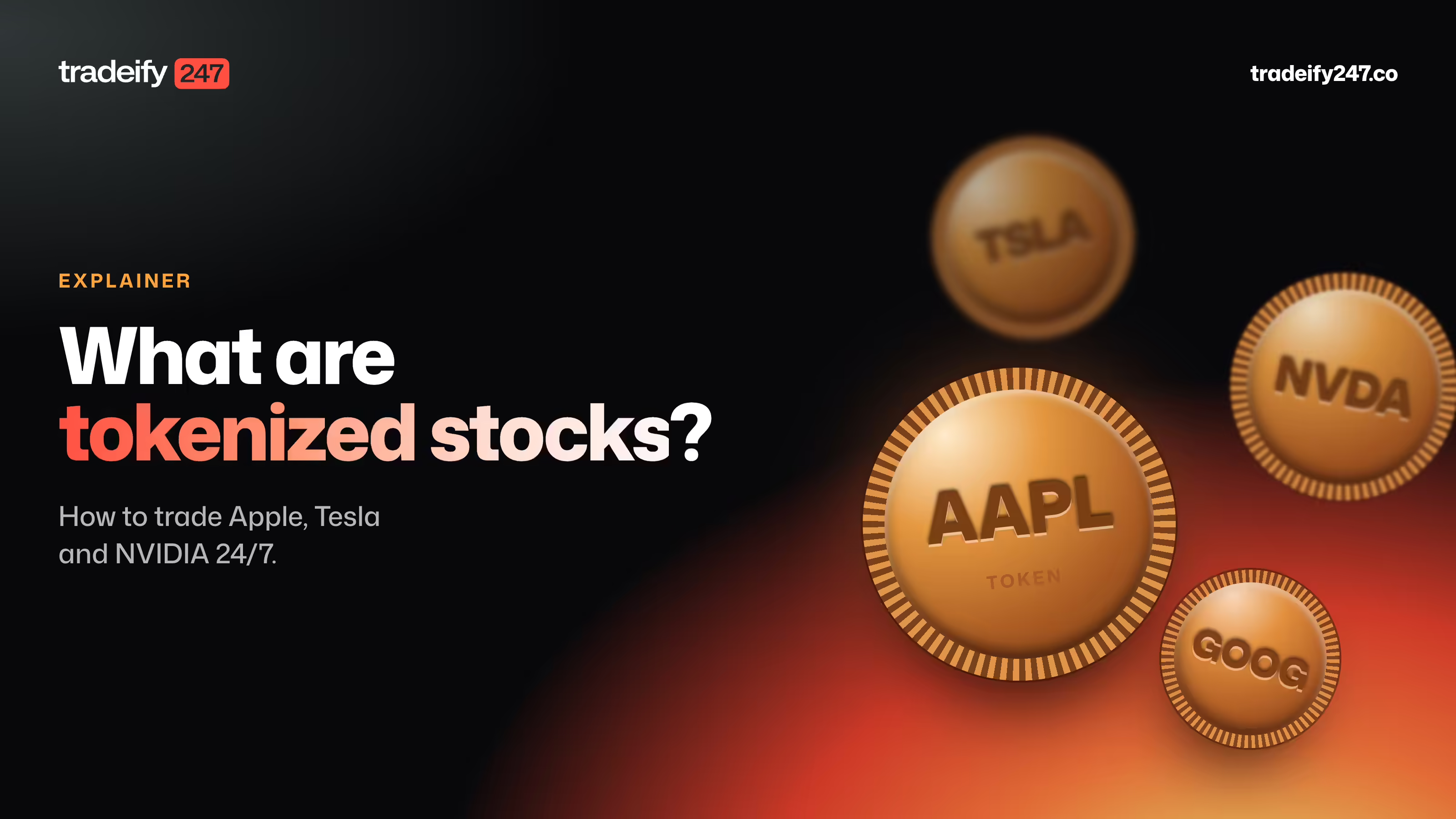
What Are Tokenized Stocks? How to Trade Apple, Tesla, and NVIDIA 24/7


.svg)

TL;DR: Tokenized stocks are digital securities or derivatives linked to public-company shares. Some convey ownership, but synthetic tokenized equities provide price exposure without shares, dividends, voting rights, or personal custody. Markets tied to Apple, Tesla, and NVIDIA can trade 24/7 when the tokenized venue stays open, even while Nasdaq is closed. Before trading, verify the product type, price source, symbol hours, contract size, spread, holding costs, stop risk, and whether the instrument can separate from the cash share during nights and weekends.
Apple drops a product announcement on Saturday. Tesla changes a key price overnight. NVIDIA gets hit by a policy headline after Nasdaq closes. If your market is shut, the thesis can change before you get another executable price.
Tokenized stocks give traders another option. A digital instrument tracks the economic value of a share or stock index on infrastructure that can keep trading outside the traditional exchange schedule.
Here is where traders get caught: the label does not tell you what you own. Some tokenized securities represent ownership. Others are backed by shares held with a custodian. Still others are synthetic contracts that track a stock price without transferring any equity rights.
Check the product type before you place the order. If the terms describe price exposure rather than ownership, trade it as a contract, not as stock in a portfolio.
What Tokenized Stocks Actually Are
“Tokenized stock” is an umbrella term for a digital product linked to a public equity. The U.S. Securities and Exchange Commission describes several structures in its guide to tokenized securities:
- An issuer-sponsored security can record actual ownership on a blockchain or similar ledger.
- A custodial token can represent an indirect claim on shares held by another party.
- A synthetic token can provide price exposure without ownership of the underlying security.
Those models are not interchangeable. An issuer-sponsored Apple security may carry rights defined in its offering documents. An Apple-linked perpetual contract may only rise and fall with a reference price. Both can be described casually as tokenized stocks, but only the contract terms tell you what you own.
Tradeify 247 uses the third model for its simulated prop program. Its Terms of Use state that tokenized equity instruments track listed securities but are not shares. They do not provide ownership, dividend, voting, or other shareholder rights.
How Tokenized Stock Prices Work
A price-linked market needs a reliable way to follow the underlying share. Depending on the product, that may involve an oracle, index, market maker, collateral pool, or derivative contract.
During the regular U.S. session, an Apple-linked market has a strong public reference because AAPL is actively trading. After the closing auction, the tokenized market may remain open while the primary exchange is shut. Its price then reflects available liquidity, news, related markets, and traders’ expectations for the next cash session.
That creates two prices with different jobs:
- The cash-share price comes from transactions on the primary stock market and related venues during their trading sessions.
- The tokenized-market price comes from the rules, reference data, and order flow of the tokenized instrument.
The prices should be related, but “related” does not mean identical. A weekend headline can move a Tesla-linked instrument before Nasdaq reopens. That move is an observation, not confirmation of Monday’s opening price.
When the cash market returns, the two markets may converge quickly. The official opening auction may also establish a different level. Size the weekend trade for both outcomes.
Why Apple, Tesla, and NVIDIA Can Trade 24/7
U.S. exchanges do not operate continuously. Nasdaq lists regular market hours as 9:30 a.m. to 4:00 p.m. Eastern, with defined premarket and after-hours sessions. Its holiday and market-hours schedule also notes the special schedules used around holidays.
A synthetic tokenized market is not limited to that same schedule. It can continue accepting orders while the underlying exchange is closed, provided its operator maintains pricing, liquidity, and risk controls.
A 24/7 tokenized-stock venue allows a trader to:
- react to company news released outside the U.S. session;
- keep a position open overnight or through a weekend;
- trade from time zones that do not align with New York hours;
- express a longer thesis without a forced daily close.
Continuous access solves the closed-market problem. It does not solve the liquidity problem.
Spreads may widen when the underlying share is closed. Available order-book depth may fall. A stop can fill worse than its trigger during a fast repricing. If the book gets thin, smaller size is the adjustment. Hoping the weekday spread shows up is not an adjustment.
Tokenized Stocks and Real Shares Compared
Feature | Real share | Synthetic tokenized stock |
|---|---|---|
Main purpose | Company ownership and investment | Price exposure and trading |
Shareholder status | Usually beneficial ownership through a broker | No shareholder ownership |
Voting rights | Depends on share class and broker arrangement | None unless terms expressly provide them |
Dividends | Paid when declared and eligibility rules are met | No shareholder dividend; contract adjustments may differ |
Trading hours | Exchange and broker schedule | Venue-specific and potentially 24/7 |
Main extra risks | Company, market, broker, and custody risk | Oracle, liquidity, funding, contract, and counterparty risk |
This difference changes the right mental model. A trader using a synthetic Apple-linked instrument is taking price exposure, not buying Apple for a retirement portfolio. The account and contract rules govern the position.
How to Trade Tokenized Stocks 24/7
The same process applies whether tokenized stocks are traded through a personal venue or a funded program. Tradeify 247 is one funded example, offering simulated 24/7 tokenized-stock exposure alongside crypto and commodities.
The trading process has six parts. Do them in order. Finding a ticker before checking the account rules is how a simple setup turns into an avoidable breach.
Choose a Tokenized Stock Account
Decide whether you want direct personal exposure or a prop account with an evaluation or immediate-funded path.
The right choice is not automatically the largest balance. Compare the fee, daily loss limit, maximum loss limit, withdrawal conditions, and the dollar risk your tested strategy normally needs.
Select a Tokenized Stock Trading Platform
Platform availability can depend on the venue and region. For example, Tradeify 247’s terms say MT5 is not available to U.S. clients, who use DXTrade.
Whichever platform applies, confirm the exact server, account credentials, symbol names, and contract specifications. A familiar ticker does not prove that every trading condition matches the cash share.
Find Apple, Tesla, or NVIDIA
Open the platform’s symbol list or Market Watch and search for the available stock-linked instrument. Review the description, trading status, minimum size, tick size, margin requirement, bid-ask spread, and any holding cost. Tradeify 247 charges no swap, overnight, funding, or holding fees; the only trading cost is a 0.04% commission on notional when opening and again when closing.
MetaTrader’s official Market Watch documentation explains where the platform shows quotes, statistics, tick charts, and symbol specifications. DXTrade presents comparable information through its instrument and order-ticket views.
Build a Tokenized Stock Trade Plan
Define the idea before choosing position size. Record the planned entry, technical invalidation level, stop price, target, maximum dollar loss, and time-based exit.
Then list the catalysts that can affect the reference company. Apple traders may watch earnings, product events, and supplier news. Tesla traders may add delivery reports and vehicle-price changes. NVIDIA traders may track semiconductor demand, export rules, and major customer spending.
Size the Tokenized Stock Position
In a funded account, margin and drawdown rules can expand the consequence of a sizing error. Account survival still depends on dollar risk, not the buying power displayed on the order ticket.
Suppose a trader is willing to risk $150 and the planned stop is $3 from entry. The theoretical size is 50 units before accounting for spread, slippage, and contract-specific value. If weekend liquidity is thin, the trader should use a smaller size or a larger execution reserve rather than assume a perfect stop fill.
Monitor the Tokenized Stock After Entry
Watch the position’s actual bid and ask, not only the chart’s last price. Track remaining daily and maximum loss room. If the position stays open outside the cash session, expect liquidity and price behavior to change.
Permission to hold overnight or through weekends is not confirmation. Hold only while the original thesis remains valid, the account has room for the risk, and the market can support the exit.
Risks of Trading Tokenized Stocks 24/7
The upside is obvious: more control over when you trade. The failure mode is just as real: more hours to carry risk, chase a move, or breach an account.
The SEC warns that tokenized securities and synthetic products can add technology, custody, counterparty, liquidity, disclosure, and regulatory risks to ordinary market risk. A funded trader should add four account-specific concerns.
First, synthetic or simulated trading performance may differ from live execution. Read the venue or program terms before assuming that displayed results match direct market fills.
Second, the reference market can be closed while the linked instrument is open. A weekend price may be less anchored to active cash-share order flow.
Third, Tradeify 247’s daily loss limit resets at 22:00 UTC every day, weekends included. Breach checks use live equity, including unrealized profit and loss, so an open losing trade can breach the account while the trader is away. Continuous trading removes the forced close, not the risk boundary.
Fourth, product and regional availability can change. Confirm the current instrument list, platform access, and trading rules before paying a fee or relying on a symbol.
When Tokenized Stocks Fit a Strategy
Tokenized stocks can fit traders who need flexible hours, want to respond to off-hours catalysts, or hold setups longer than one session. They fit poorly when a trader wants dividends, voting rights, long-term share custody, or the protections of a conventional brokerage account.
The best use is precise. Treat AAPL-, TSLA-, or NVDA-linked exposure as a trading contract. Know when the underlying exchange is open, how the linked price is formed, and what would invalidate the trade.
Before your first order, open the symbol specification and write down five items: product type, live trading hours, stop level, dollar risk, and remaining account-loss room. If one is missing, the setup is not ready.
Tokenized Stock Questions
What Is an Example of a Tokenized Stock?
An Apple-linked instrument that tracks AAPL is a common example. Its legal form can be an actual tokenized security, a custodial claim, or a synthetic derivative, so the product documents must identify the structure.
Do I Own Apple When I Trade a Tokenized Stock?
Not necessarily. A synthetic Apple-linked position provides price exposure without Apple shares or shareholder rights. The product documents control the answer.
Are Tokenized Stocks Legal?
The answer depends on the product, issuer, venue, and trader’s jurisdiction. Tokenizing a security does not remove securities-law obligations. Confirm eligibility and review the current terms before trading.
Can Tokenized Stocks Trade Every Weekend?
Some tokenized-stock markets are designed for 24/7 access. An individual symbol can still face maintenance, a halt, or limited liquidity, so verify live availability before entering.

Keep Reading
See all
Are Tokenized Stocks Safe and What Risks to Check First
Crypto Prop Firm USA Rules and What Traders Can Access