

Crypto Prop Trading Firms and How Their Funding Works


.svg)

TL;DR: Crypto prop trading firms give traders access to account buying power under a contract and a defined set of risk rules. Most traders either pass an evaluation or pay more for instant access, then earn a percentage of eligible profits if they stay within daily and maximum loss limits. The account may be simulated, connected to an exchange, or used as a performance signal for the firm's own execution. Before paying a fee, verify the account model, venue, funding-rate treatment, drawdown formula, payout gates, restricted strategies, and whether the firm ever takes custody of trader assets.
"Funded" sounds simple until two firms use the word for completely different account structures.
One may give a trader a simulated account and pay real rewards based on performance. Another may connect the trader to an exchange account with firm-controlled capital. A third may use the trader's orders as signals while deciding separately what to execute in the market.
The contract matters more than the label. Check what is funded, where trades are recorded, which losses breach the account, and how eligible profit becomes a payout.
What Crypto Prop Trading Firms Actually Offer
A crypto prop trading firm provides account access under preset trading and risk conditions. The trader normally pays a one-time evaluation or access fee, follows the program rules, and receives a share of approved profits rather than owning the full account balance.
This is different from depositing money at a crypto exchange.
With a personal exchange account, the trader owns the deposited assets or has a claim governed by the exchange's custody terms. With a prop account, the firm controls the account structure and defines the performance reward. A displayed $100,000 account is not necessarily $100,000 of crypto held for the trader to withdraw.
The core offer usually includes a stated account size, access to spot pairs or perpetual futures, loss thresholds, position restrictions, an evaluation target or instant-access price, and a profit split.
Some firms are crypto-only. Others are multi-asset firms that include crypto. The categories are not interchangeable when comparing trading hours, weekend rules, and pricing venues.
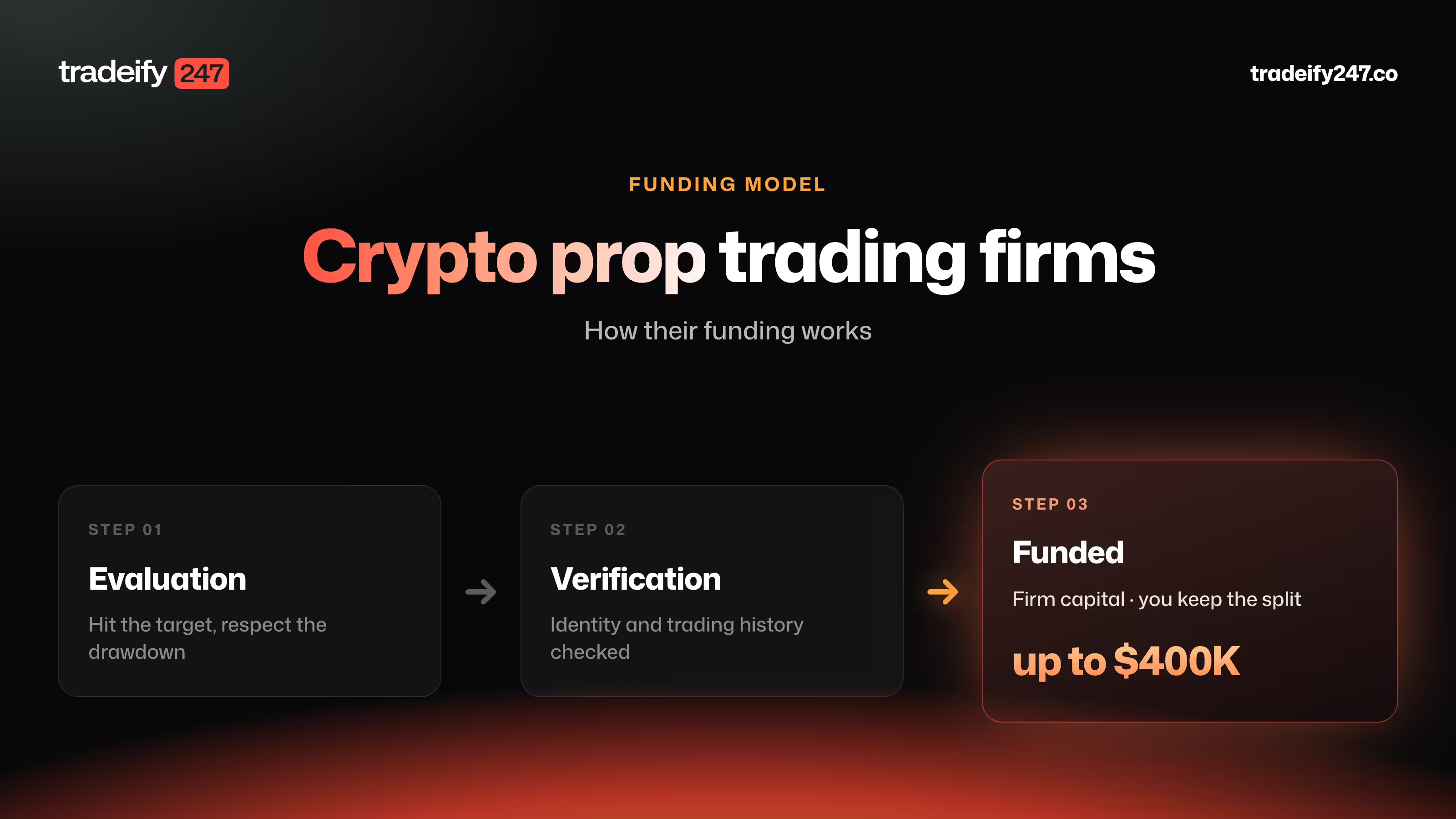
How Crypto Prop Funding Works Step by Step
The standard process has six parts.
Choose an Account and Funding Path
The trader selects an account size and either an evaluation or instant-access program. Larger labels usually have higher fees and dollar loss limits, while percentage limits may be unchanged.
Trade Under Evaluation Rules
An evaluation typically requires a profit target without violating daily loss, maximum loss, minimum-day, or prohibited-strategy rules. Some programs have one phase. Others require two phases with a lower second target.
Evaluation profit is generally a test result, not withdrawable income.
Complete Verification and the Agreement
After passing, the trader may complete identity checks, sign a reward agreement, and accept a fresh account. Passing does not override geographic restrictions.
Trade the Payout-Eligible Account
The trader starts under a new balance and the funded-stage rules. The firm can use a simulated account, an exchange-connected account, or its own execution and risk process behind the scenes.
Meet the Payout Conditions
Eligible profit may depend on a first-payout waiting period, a minimum number of profitable days, consistency limits, closed positions, and a minimum request amount.
Receive the Trader Share
After review, the firm applies the profit split and sends the approved amount. Payment can arrive through bank rails or crypto, depending on the program.
A generous evaluation drawdown is less valuable if the funded-stage limit tightens sharply or payout rules exclude the strategy that produced the pass.
Evaluation Accounts vs Instant Funding
The main tradeoff is fee versus proof.
Feature | Evaluation account | Instant funding |
|---|---|---|
Initial access | Trader must hit one or more targets | Trader starts in a payout-track account sooner |
Upfront cost | Often lower for the same headline size | Often higher because the evaluation is skipped |
Profit target | Usually required before funded stage | Usually no separate challenge target |
Main risk | Paying for retries after a breach | Paying more before proving the rules fit |
Payout timing | Begins after passing and activation | Can still have a first-payout or profitable-day gate |
Instant funding is not rule-free capital. The account can still be simulated, and daily loss, maximum loss, consistency, scaling, and payout conditions can still apply.
An evaluation makes sense when the trader can reproduce a strategy within the target and loss limits. Instant access can make sense when the rules fit an already-tested process and the higher fee does not create pressure to force trades. If the strategy needs more normal drawdown than the program permits, neither route is suitable.
Simulated Accounts and Exchange-Connected Funding
Crypto prop funding can sit on several operating models.
Simulated performance account. Trades occur in a simulated system. The firm pays real rewards when contract conditions are met.
Exchange-connected account. The trader uses a supported exchange connection or firm terminal. The firm still controls the account and payout contract, so exchange access does not mean the trader owns the capital.
Hybrid risk model. The firm can record activity in a simulated account while using selected data to hedge or place separate orders. The prop agreement still defines the trader's rights.
Ask whether trades are simulated or live, who is the legal counterparty, whether the trader deposits collateral, whether only approved rewards can be withdrawn, and which price source determines fills. These answers show what can fail and what the balance represents.
Risk Rules That Matter in Crypto Prop Trading
Crypto trades around the clock, but the risk rules still use clocks.
Daily loss reset
Tradeify 247 resets its daily loss limit at 22:00 UTC every day, weekends included. Breach checks use live equity including unrealized profit and loss, so an open losing trade can breach before it is closed. A position held across the reset can affect two trading days differently, and its original size must remain intact; partially closing before the reset and carrying the remainder is not allowed.
Maximum loss
A static limit stays tied to a fixed reference, while a trailing limit can rise with balance or equity. The trailing version can reduce available room after a strong unrealized gain or a payout.
Funding rates
Perpetual futures use periodic payments to help keep contract prices near spot. Depending on direction and rate, the trader pays or receives funding. The Kraken explanation of perpetual futures funding shows why holding time can change trade economics even when price is unchanged.
Tradeify 247 does not pass through funding. It charges no funding rate, swap, overnight fee, or holding cost; its only trading cost is a 0.04% commission on notional at entry and exit.
Liquidity and slippage
Smaller altcoins can widen sharply around news or low-volume periods. A stop is not a guaranteed fill. If a thin pair slips beyond the daily-loss threshold, the rule can breach even when the planned stop looked compliant.
Leverage and liquidation
Position size, exchange liquidation, and the prop loss limit are separate constraints. A prop account can breach before liquidation.
Strategy restrictions
Programs may restrict coordinated hedging, account sharing, copied trades, or faulty-price exploitation. Confirm weekend holding, automated systems, and news trading rather than assuming 24/7 access permits them.
Comparing Current Crypto Prop Trading Firms
The table uses each provider's published material as a starting point, not a recommendation. Check the legal entity, country access, and exact program page at purchase.
Provider | Published funding route | Trading access | Published payout notes | What to verify |
|---|---|---|---|---|
Breakout | One-step evaluations with several rule profiles | Crypto trading through its platform and third-party liquidity connections | 80% base share with an upgrade path to 90%; on-demand USDC requests under its current terms | Daily and static drawdown for the selected profile, prohibited conduct, supported jurisdiction |
HyroTrader | One-step and two-step challenges | Its terminal or a supported Bybit account, depending on the program | 80% share with a stated scaling path to 90%; USDT or USDC payouts | Whether the selected pair and exchange route are available, funding costs, first request conditions |
Kraken Funded | Paid challenge followed by a performance-based funded account | Separate from a user's normal Kraken exchange account | 80% of approved profits and on-demand withdrawal language | Challenge-specific targets, payout eligibility, regional access, and legal counterparty |
Tradeify 247 | Instant Funding, 1-Step, 2-Step, and 3-Step promotional plans | 100+ USD-margined crypto pairs plus tokenized stocks, commodities, and indices; 24/7 access through DXTrade or MT5 where available | 80% trader share or 95% with the add-on; $100 minimum; standard plans on demand; 3-Step uses a 14-day cycle | 3% daily and 6% maximum loss on standard plans, or 10% static maximum on 3-Step; 22:00 UTC reset; no funding or holding fees |
Breakout's current program rules say the evaluation does not pay rewards and describe several one-step profiles. Its payout instructions require no open positions, a minimum amount after the split, and an eligible account. A request is deducted from balance, so the remaining loss room should be recalculated.
HyroTrader's current site publishes one-step and two-step routes, exchange or terminal access, and USDT or USDC payouts. Treat its speed and asset-count statements as provider claims until confirmed in the account agreement.
Kraken Funded's official support page describes a paid challenge, an 80% trader share, and on-demand withdrawals. It says the service operates separately from the normal Kraken exchange, so the exchange login and funded contract are not the same product relationship.
Repeat the comparison at checkout. Older reviews may describe a retired rule set or brand.
How to Compare Crypto Funding Offers
Start with the risk budget, not the account label.
For each program, record the fees, targets, daily-loss formula, reset time, maximum-loss type, leverage, venue, weekend policy, funding-cost treatment, strategy restrictions, funded-stage changes, profit split, first-payout gate, payment network, and geographic limits.
Test the strategy against the tightest constraint. If its ordinary losing streak uses 4% drawdown and the program permits 3%, a larger account label does not repair the mismatch. A $100,000 account at low leverage can also support less exposure than a smaller account with broader limits.
Tradeify 247: Crypto Prop Trading With a Wider Asset Menu
Tradeify 247 is a crypto prop firm with a wider asset menu than most: 100+ USD-margined crypto pairs plus tokenized stocks, commodities, and indices, all tradable 24/7. Its model belongs in the main crypto-prop comparison rather than being treated as an adjacent category.
Its published structure includes Instant Funding, 1-Step, 2-Step, and the 3-Step promotional route, with simulated trading rather than ownership of the displayed capital or assets. Tradeify 247's Terms of Use say MT5 is unavailable to US clients, who use DXTrade. MT5 availability is therefore regional.
The relevant comparison is the same one used for crypto-focused programs: account model, drawdown, holding rules, venue, payout gates, and legal rights. The asset menu does not replace that work.
How Crypto Prop Payouts Work
Once eligible, the trader requests a share of closed profit. The firm checks rule compliance, applies the split, and sends the approved amount.
A crypto payout can be checked after broadcast. Its transaction hash shows the network, asset, amount, destination, and status. It does not prove every request was approved or that the provider can cover future obligations.
Confirm the exact token and network before supplying an address. USDC on Ethereum is not interchangeable with USDC on every network, and a mistaken transfer may not be recoverable.
The payout request can also change account risk. If the amount is deducted from the account balance, recalculate the maximum-loss distance before placing another trade.
Red Flags Before Paying a Challenge Fee
Pause if a provider has no legal entity or usable terms, does not define payout eligibility, leaves simulated versus live trading unexplained, hides its drawdown formula, names no venue or price source, promises returns, or uses inconsistent company names across checkout and support.
The right response is not to assume fraud. Stop until the missing term is documented. Any rule that can decide a payout should be available before the fee is paid.
Frequently Asked Questions
Can you hold prop crypto positions over the weekend?
Often, but not automatically. Crypto markets trade continuously, while the prop program can still restrict weekend exposure or calculate daily loss at a fixed reset time.
How are crypto prop traders paid?
Providers may pay through stablecoins, other crypto assets, or traditional payment rails. Eligibility, profit split, supported network, minimum amount, and review time differ by firm.
Choose the Rules Before the Account Size
Put the headline balance aside and model one normal month of trading. Include losing streaks, funding charges, slippage, weekend positions, and the effect of a payout on drawdown.
Then choose the route whose rules still work under that model. If the strategy only passes when every trade fills perfectly, the funding plan is already too tight. A suitable crypto prop firm is not the one with the largest number on the dashboard. It is the one whose account model, risk limits, venue, and payout contract match how the trader actually operates.

Keep Reading
See all
Are Tokenized Stocks Safe and What Risks to Check First
Crypto Prop Firm USA Rules and What Traders Can Access