

Crypto Prop Firm USA Rules and What Traders Can Access


.svg)

TL;DR: A crypto prop firm that serves U.S. traders may still limit account types, platforms, instruments, or payment methods by location. Treat five questions separately: whether the firm accepts your residence and identity, which products it offers you, which trading platform works in the United States, which account rules control simulated trading, and which laws apply to the actual product structure. Many retail funded-trader programs use simulated accounts rather than personal brokerage or exchange accounts. Read the current terms, confirm the platform before paying, record every drawdown and payout condition, and do not treat “available in the USA” as a legal opinion or a promise that every feature is available.
A firm can say it serves U.S. traders and still show you a different platform than a trader in Europe. That is not a small checkout detail. It can change the charting tools, order types, symbols, and execution workflow you will use every session.
This is where traders get caught. They answer one broad question, “Can I join?”, but skip four narrower questions about eligibility, product access, platform access, and account rules.
Those questions are not interchangeable.
What crypto prop firm USA access actually means
“Available in the USA” can refer to several separate layers. A clear review checks each layer on its own.
Access layer | Question to answer | Best place to verify | Why it matters |
|---|---|---|---|
User eligibility | Does the firm accept your age, residence, identity, and sanctions status? | Current terms and restricted-jurisdiction policy | A platform may be visible even when the user is not eligible |
Product eligibility | Can you buy this evaluation or funded-account path? | Logged-in order page and program terms | Firms may offer different products by location |
Platform access | Which platform can a U.S. client actually use? | Current platform selector and official product notice | Platform availability can change the trading workflow |
Instrument access | Which crypto pairs or tokenized instruments appear on that platform? | Live symbol list and contract specifications | A marketing asset count does not guarantee every symbol is available to every user |
Program rules | What ends the account and what makes a payout eligible? | Trading rules attached to the selected account | The account is governed by its rules, not a general homepage summary |
Passing one layer does not clear the others. A U.S. resident may be eligible for the service but unable to use a particular platform. A supported platform may list fewer instruments than another platform. An available instrument can still carry a position limit or holding restriction.
The practical test is simple: verify the exact combination of residence, account path, platform, and symbol before paying.
How crypto prop firm accounts differ from exchange accounts
Retail crypto prop programs are often described as “funded accounts,” but that label does not tell you whether the trades use live customer capital, simulated balances, or a hybrid process.
In a simulated program, you normally pay for access to an evaluation or rule-based trading service. You do not deposit the displayed account balance into a personal exchange account. You also do not own the crypto shown in a simulated position. Your possible payment comes from a contract with the firm after you satisfy its conditions.
That creates a different risk map from buying bitcoin on an exchange:
- Market moves affect the simulated account and its loss limits.
- A rule breach can terminate the account even if the broader trade thesis later proves correct.
- The firm’s contract determines whether a performance-based payout becomes eligible.
- The displayed account size is not money you can withdraw.
- A firm may decide to copy or route selected trades with its own capital, but that does not automatically give the trader ownership of those external positions.
Do not assume every crypto prop firm uses the same model. Read the nature-of-service section in the current terms and look for explicit words such as “simulated,” “notional,” “demo,” “live,” or “brokerage.”
Which crypto prop firm rules U.S. traders should check
The rules that matter are the ones that can block access, end an account, or delay a payout. Record them before the first trade, not after a dashboard warning appears.
Check crypto prop firm identity rules
Confirm the minimum age, accepted residence, identity-verification process, and restricted-jurisdiction policy. A firm may request government identification, proof of address, sanctions screening, or a live risk interview.
Eligibility can also change. Save the current terms and check them again before purchasing another account.
Check crypto prop firm platform access
Do not choose an account based on a platform logo alone. Confirm that the platform is available to U.S. clients and supports the selected account type.
Then test the details that affect execution:
- Web, desktop, or mobile access
- Charting and indicator support
- Market, limit, stop, and stop-limit orders
- One-click trading and position controls
- Symbol naming and contract size
- Server time and the firm’s daily reset time
- Automation, expert-adviser, API, or copy-trading permissions
A familiar interface can reduce operational mistakes. It does not change the loss rules attached to the account.
Check crypto prop firm drawdown rules
Profit targets sell the challenge. Loss rules decide whether the strategy fits it.
Write down the daily loss limit, maximum loss limit, and whether drawdown is static or trailing. Confirm whether floating profit and loss, commissions, swaps, or funding charges count toward a breach. Record the exact reset time and time zone.
Set a personal daily stop inside the firm’s hard limit. If one ordinary losing trade would consume most of the permitted daily loss, the position size or account may not fit your method.
Check crypto prop firm trading restrictions
Crypto trades continuously, but a prop account can still restrict how you use that access. Verify rules for:
- Overnight and weekend positions
- News or event trading
- Maximum position size
- Correlated positions across BTC, ETH, and altcoins
- Grid trading, martingale methods, and averaging down
- High-frequency or latency-based tactics
- Copy trading and account sharing
- Inactivity and minimum trading days
Permission to hold through a weekend is not a reason to hold. The position still needs an invalidation point, a size that can survive slippage, and enough room inside the account’s loss limits. Tradeify 247 permits overnight, weekend, and news trading without restricted windows. Copying between a trader’s own accounts is allowed except into or out of the 3-Step promotion. Bots are allowed only when owned or exclusively licensed; shared bots, auto-executing signal services, and Expert Advisors in the monthly competition are prohibited. An account breaches after 30 consecutive inactive days, with a warning at day 28. Grid, martingale, averaging down, and correlated BTC, ETH, or altcoin positions are not prohibited. Hedging is prohibited outright, including across accounts and users, and every trade must remain open for at least 20 seconds.
Check crypto prop firm payout conditions
A profit split is only one line in the payout policy. Also verify minimum profitable days, minimum payout amount, consistency rules, withdrawal methods, identity checks, review periods, and what happens to drawdown after a withdrawal.
If the firm offers crypto or stablecoin payments, confirm the network and wallet requirements. A wrong network can create a separate operational problem even after the payout is approved.
Why U.S. platform access can be different
Platform access is a product and vendor decision as well as a firm decision. A firm can support U.S. users while one of its platform providers does not support that user group. The result may be a different platform, not a complete denial of the service.
That distinction matters because a platform name is not proof of legal status. It also is not proof that every asset, order type, or feature is enabled.
Use the platform shown to you at checkout as the starting point. Then confirm it in the firm’s current official notice. If those sources conflict, pause the purchase and ask support to identify the controlling term in writing.
What crypto prop firm pages cannot decide about U.S. law
There is no responsible one-line answer that makes every “crypto prop firm” legal or illegal in the United States. The phrase can describe different contracts, account structures, instruments, and business activities.
The legal treatment of an actual product can depend on what the instrument is and how the transaction works. FINRA notes that a crypto asset or transaction may be a security, a commodity, or another asset type under applicable law. Its crypto asset overview also explains that many crypto trading platforms do not provide the same protections as registered broker-dealers or national securities exchanges.
The CFTC’s virtual currency trading advisory distinguishes spot virtual-currency markets from derivatives and warns about volatility, platform safeguards, manipulation, and cyber risk. It also tells customers considering virtual-currency futures or options to verify relevant registration.
A simulated funded-trader service is not automatically the same thing as a customer buying crypto on a spot exchange, opening a securities margin account, or trading a listed futures contract through a broker. The marketing label does not settle the classification.
This article is general information, not legal advice. If access depends on your state, business status, instrument, or intended activity, review the actual agreement with a qualified U.S. professional.
What U.S. traders can access at Tradeify 247
The current product is a useful example of why the access layers must stay separate.
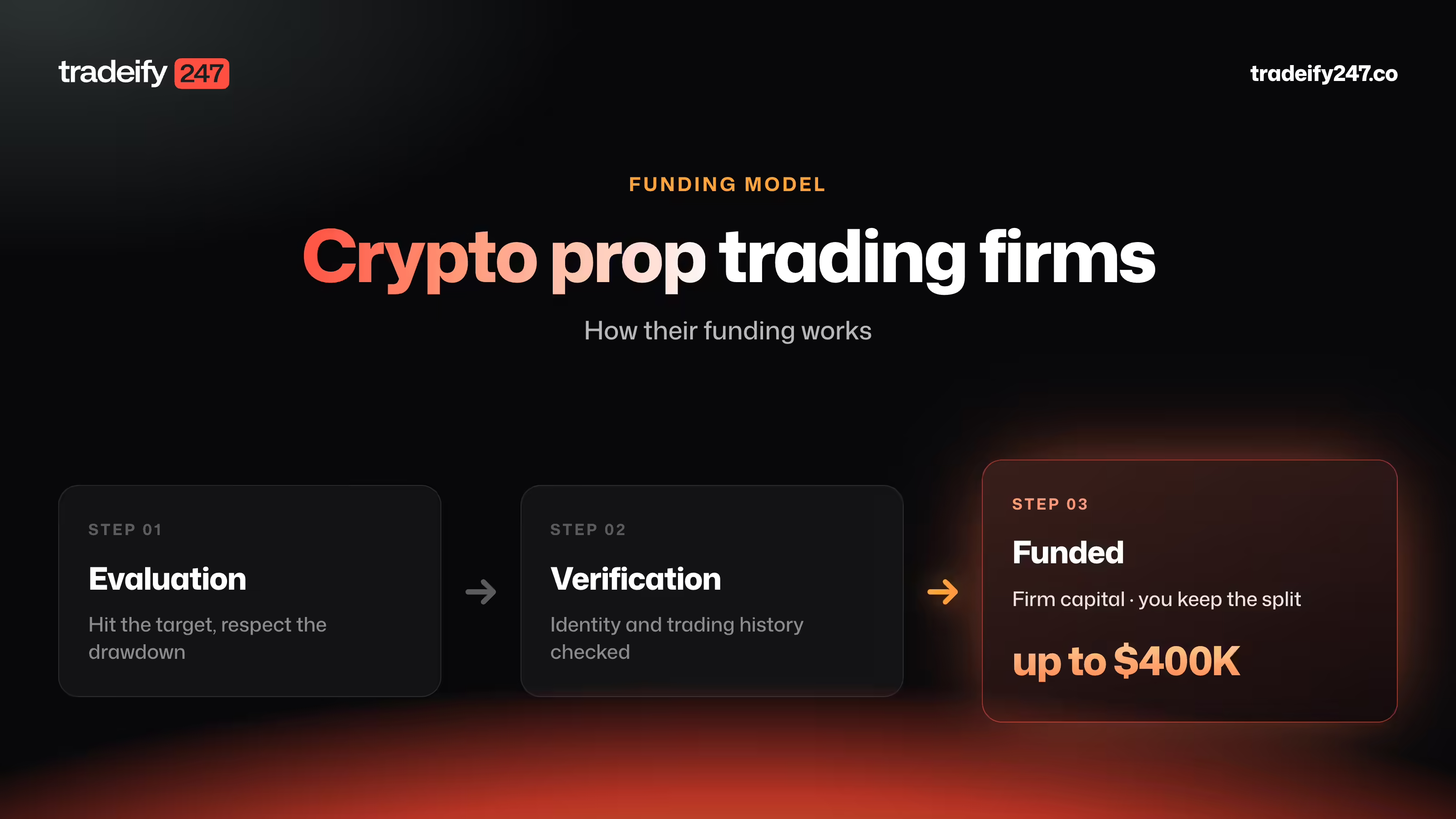
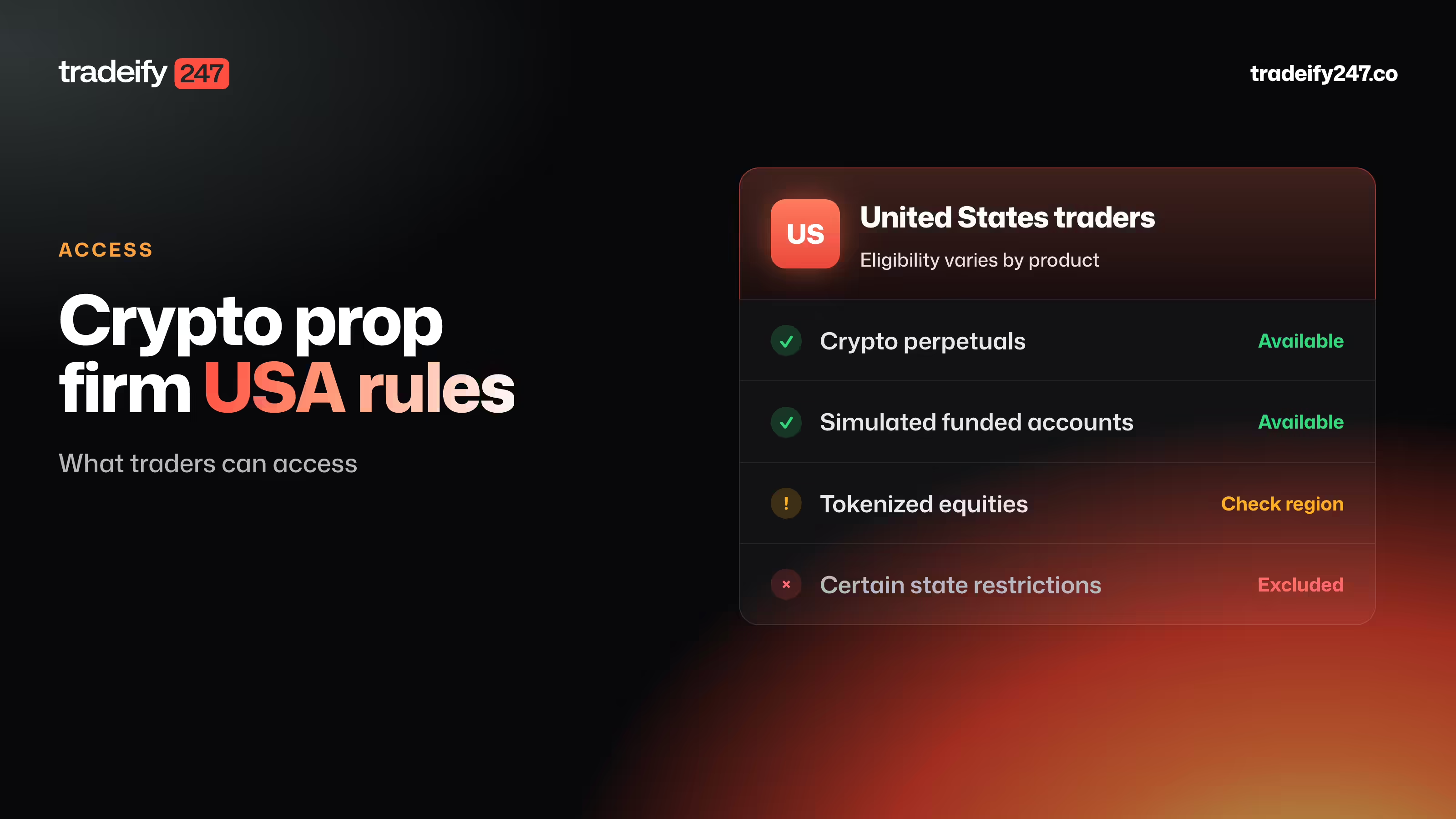
Its current homepage states that MetaTrader 5 is unavailable to U.S. clients and that U.S. clients use DXTrade. On DXTrade, eligible U.S. traders can access 100+ crypto pairs, tokenized stocks, commodities, indices, and every account type, including the 3-Step promotion; the account rules do not change by region. The terminal is the difference. Tradeify credentials do not work in the DXTrade apps from Apple’s App Store or Google Play, so U.S. traders use DXTrade on the web, desktop, or a mobile browser. The United States is not on Tradeify 247’s restricted-country list, although age, residence, and identity requirements still apply.
Tradeify 247 requires users to be at least 18; a parent cannot open an account for a minor, and a user cannot sign up at 17 to be paid after turning 18. Identity verification uses Sumsub with government identification and a liveness selfie, triggered at purchase for Instant Funding and after passing an evaluation. Ongoing AML screening covers sanctions, politically exposed persons, and adverse media, followed by separate Rise verification before the first payout. Residence restrictions still apply, while the programs use notional capital and simulated execution unless additional terms say otherwise.
For a U.S. trader, the correct sequence is therefore:
- Confirm personal eligibility under the current terms.
- Confirm the selected program appears at checkout.
- Select DXTrade rather than assuming MT5 is available.
- Read the exact account rules before placing a trade.
That is a product-access check, not a legal conclusion about your individual circumstances.
Crypto prop firm USA checklist before paying
Run this checklist against the live order page and terms:
- Is your country and state accepted under the current eligibility policy?
- What age, identity, address, or video verification may be required?
- Is the account simulated, live, or subject to a hybrid routing process?
- Which platform is available to U.S. users?
- Does that platform contain the symbols you intend to trade?
- What are the daily loss and maximum drawdown calculations?
- When does the trading day reset, and which time zone controls it?
- Are overnight, weekend, news, automation, and copy trading allowed?
- Which fees, spreads, commissions, swaps, or funding charges apply?
- What conditions make a payout eligible?
- What happens to the account after a payout or rule breach?
- Which written term controls if the homepage and help content differ?
Save the rules that apply when you purchase. Product terms can change.
Crypto prop firm USA questions
Are crypto prop firms legal in the USA
There is no universal yes-or-no answer for every firm using that label. The answer can depend on the service, instrument, contract, and activity. Availability to U.S. users is a product statement, not legal advice. Review the actual terms and seek qualified advice for your situation.
Does the 25000 dollar day trading rule control crypto prop accounts
Do not assume the rule for a personal securities margin account automatically governs a simulated funded-trader program. First identify the actual account and instrument. A simulated account, a spot crypto account, and a securities margin account are different structures.
What is the most important crypto prop firm rule
The rule most likely to end the account is usually more important than the headline profit target. For many programs, that means the daily loss or maximum drawdown calculation. Your own stop should sit inside the hard breach level.
Can U.S. traders use MT5 on this platform
No. MT5 is unavailable to U.S. clients, who use DXTrade instead. Eligible U.S. traders receive the same account types and asset menu, including 100+ crypto pairs, tokenized stocks, commodities, indices, and the 3-Step promotion. Tradeify credentials work through DXTrade web, desktop, or a mobile browser, but not through the DXTrade apps in Apple’s App Store or Google Play.
Make the crypto prop firm fit test concrete
Do not finish your research with a list of firms that “accept USA.” Build a four-line fit test for the account you may buy: eligible user, available product, supported platform, and compatible rules.
Then compare those rules with your last 30 to 50 trades. If your normal holding time, losing streak, stop distance, or platform workflow conflicts with the account, a bigger balance label will not repair the mismatch.

Keep Reading
See all
Are Tokenized Stocks Safe and What Risks to Check First
Crypto Prop Firm USA Rules and What Traders Can Access