

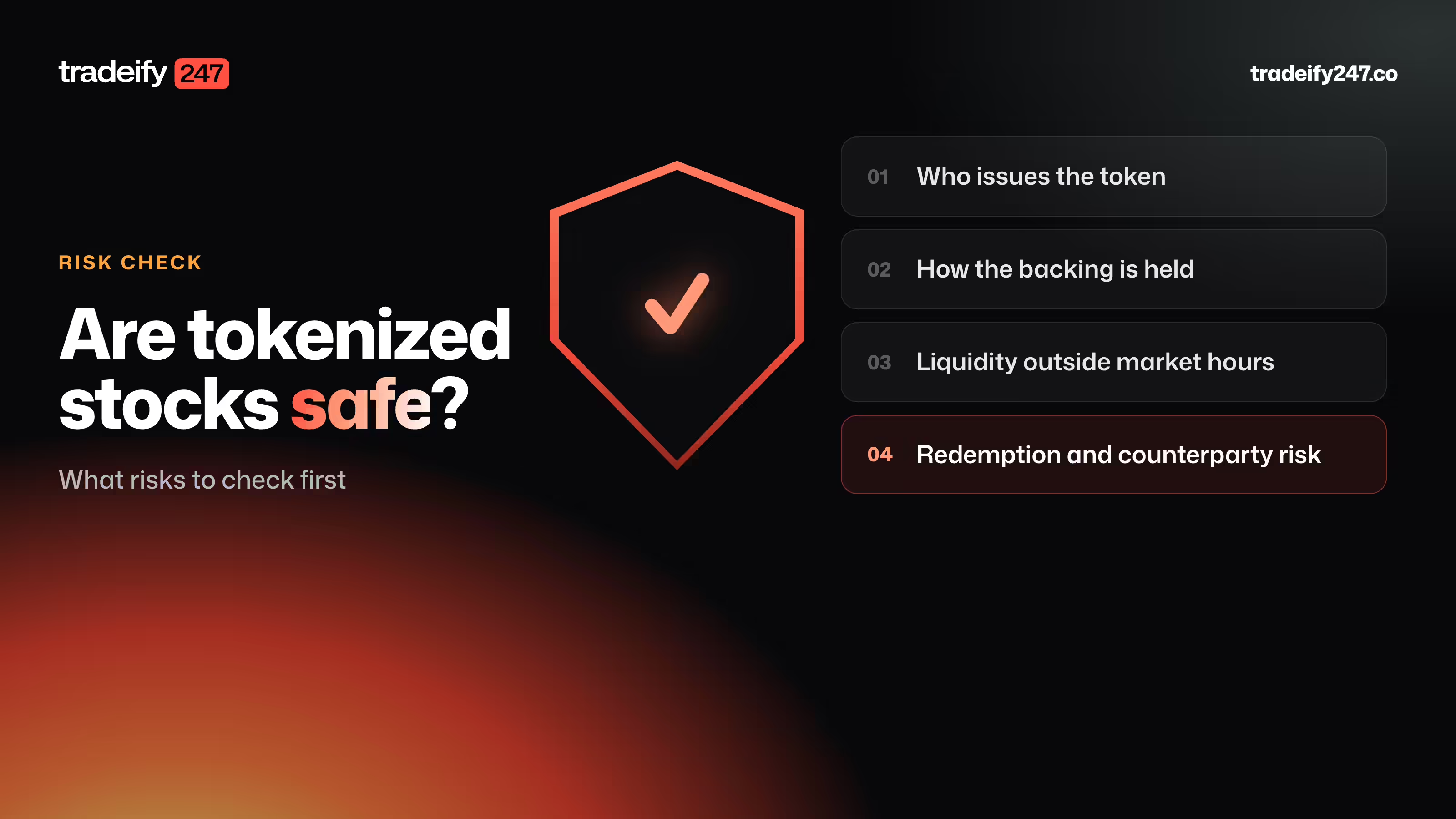
Are Tokenized Stocks Safe and What Risks to Check First


.svg)

TL;DR: Tokenized stocks are not one standard product, so they are not uniformly safe or unsafe. An issuer-sponsored token can represent a security with shareholder rights, a custodial token can represent an indirect entitlement to shares held by an intermediary, and a synthetic token can provide only price exposure. Check what you legally own, who owes you, where any backing is held, whether you can redeem, how custody and smart contracts work, where liquidity comes from, how closely the token tracks the reference share, which corporate rights apply, and what happens if an issuer or intermediary fails. A simulated funded-trading position is different again: it can reference a stock price without giving the trader a token, share, dividend, vote, or custody claim.
A token can display AAPL, follow Apple’s price, and still give you no claim against Apple.
That is the first safety check. If the product name makes you think “share” while the contract gives you only a price reference, every later risk decision starts from the wrong premise.
Tokenization changes how an instrument is recorded or transferred. It does not automatically strengthen the issuer, backing, market, or holder rights.
What tokenized stocks can actually represent
The SEC separates tokenized securities into different structures because the rights can change materially from one model to another. Its statement on tokenized securities distinguishes issuer-sponsored securities, third-party custodial arrangements, and synthetic products.
Tokenized stock model | What the holder may have | Main dependency | First document to read |
|---|---|---|---|
Issuer-sponsored security | A security recorded on or through a blockchain, potentially with direct shareholder rights | Issuer, transfer agent, network, and governing documents | Prospectus, offering document, or shareholder terms |
Custodial tokenized security | An indirect security entitlement tied to shares held by an intermediary | Custodian, token issuer, recordkeeping, and redemption process | Custody, reserve, entitlement, and bankruptcy terms |
Synthetic or linked token | A contract whose value follows a referenced stock without ownership rights in that stock | Product issuer or counterparty and pricing formula | Derivative, linked-security, or key information document |
Simulated funded position | A notional position that references a market price inside a prop program | Firm rules, price feed, simulated execution, and payout contract | Terms of use and trading rules |
Investor.gov’s tokenized securities explainer makes the same distinction in plain terms. An issuer-sponsored token may carry the legal rights of the relevant share class. A custodial model can represent an indirect interest. A synthetic model may track the stock while giving the holder no claim against the stock’s issuer.
Tokenized stock safety starts with ownership rights
Ask one question before checking price charts: what legal claim does the token create?
Look for direct answers:
- Is the token itself the company’s security, an entitlement to a security, or a separate contract?
- Is the public company involved in or aware of the tokenization?
- Does the holder appear on an issuer or intermediary record?
- Are voting, dividend, information, conversion, or redemption rights included?
- Can the holder exchange the token for the underlying share, and which agreement defines that right?
Do not infer rights from a ticker, logo, “backed” label, or one-to-one claim. A token can be economically linked to a share without creating shareholder status.
The SEC says third-party products may give rights that differ materially from the underlying security. A synthetic product can track a stock while remaining the third party’s obligation.
If the documents do not state the claim, that uncertainty is a risk.
Counterparty and bankruptcy risk in tokenized stocks
A conventional share exposes you to the company’s business and market risk. A third-party token can add another party whose failure matters.
That party may be the token issuer, counterparty, custodian, broker, or platform. The structure may involve several of them.
Check:
- Who is required to pay or redeem, and who holds any underlying shares?
- Are customer assets legally segregated from the company’s assets?
- What happens if the issuer, custodian, or platform becomes insolvent?
- Would the holder have a property claim, securities entitlement, or unsecured claim?
The SEC specifically warns that a third-party token holder may face bankruptcy risk that a holder of the underlying security would not necessarily face.
Issuer documentation can make that consequence concrete. Robinhood Europe’s Classic Stock Tokens guide describes its product as a derivative contract with Robinhood, not the underlying stock, and warns about market and insolvency losses. The broader test is to identify who owes you and what happens if it cannot perform.
Custody and smart contract risk in tokenized stocks
“On-chain” does not eliminate custody. It changes where some records or transfers occur.
An issuer-sponsored security may depend on a transfer agent and an authoritative shareholder record. A custodial token may depend on an intermediary holding conventional shares. A self-custodied token depends on key security, while a platform-only token may not be withdrawable.
Review the full custody chain:
- Where are any underlying shares held?
- Who controls issuance, burning, freezing, and contract upgrades?
- Is the token transferable to an outside wallet?
- Which blockchain and record are authoritative after a fork or outage?
- What recovery process exists for lost keys or a compromised account?
An audit can identify code issues at a point in time. It cannot guarantee the safety of governance, custody, keys, off-chain records, or future upgrades.
FINRA’s crypto asset risk guidance highlights theft, service-provider risk, limited regulatory oversight, and the possibility that a token may have little liquidity or value. Those risks can sit beside the normal market risk of the referenced stock.
Liquidity and spread risk in tokenized stocks
A token that tracks a liquid stock is not automatically liquid itself.
Apple shares may trade actively on U.S. exchanges while an Apple-linked token trades on a separate venue with fewer participants. The token has its own order book, market makers, redemption process, fees, and operating hours.
Check the token market rather than borrowing assumptions from the stock:
- Bid and ask spread and available size at the hours you trade
- Volume, active venues, and market-maker commitments
- Order types and price-protection controls
- Withdrawal, redemption, halt, and maintenance rules
- Price behavior while the primary U.S. stock market is closed
Investor.gov’s extended-hours trading bulletin explains why lower liquidity, wider spreads, uncertain prices, unlinked venues, and news announcements can increase risk outside regular stock-market hours. A token trading even longer hours adds another venue and pricing process to examine.
The consequence is practical. A stop based on the underlying share may execute at a worse token price, or not execute at all, when token liquidity thins.
Tracking and redemption risk in tokenized stocks
Price tracking does not promise that two markets will always match.
Find out how the token price is set. It may use an exchange quote, index, market-maker model, last reference price, or a formula with currency conversion and fees.
Then check what keeps the token close to the share:
- Who can create or redeem tokens against shares?
- How often is backing reconciled or independently attested?
- What price, time, and fees determine redemption value?
- When can redemptions be limited or suspended?
Without a usable conversion route, a price gap can persist. Fees, limits, delays, closures, and counterparty risk can weaken the link even when redemption exists.
Corporate actions create another tracking test. Read how the product handles dividends, stock splits, mergers, spin-offs, tender offers, delistings, and trading halts. A cash adjustment that resembles a dividend is not necessarily the same legal or economic right as a dividend paid to a shareholder.
Regulatory and venue risk in tokenized stocks
Blockchain format does not remove securities law from a security or make every stock-linked token the same product.
The SEC’s taxonomy focuses on the product’s actual rights and economic structure. Investor.gov explains that tokenized securities can preserve traditional shareholder rights in one model and provide only synthetic exposure in another.
Verify:
- The issuer’s legal name, jurisdiction, and governing documents
- The relevant registration or exemption and the entity it covers
- Customer-protection, complaint, and dispute processes
- Geographic restrictions and U.S.-person availability
Do not treat “regulated,” “licensed,” or “compliant” as a complete answer. Identify the entity, regulator, permission, and product covered by the statement.
This is general risk education, not legal or investment advice. A qualified professional can assess the documents and rules that apply to your location and product.
How funded tokenized stock exposure is different
Tradeify 247 illustrates a separate category: simulated funded trading that references tokenized equity prices.
The current Tradeify 247 Terms of Use state that trading uses notional capital and simulated execution unless additional terms say otherwise. They also say tokenized equity instruments track the price of a listed security but are not shares and carry no ownership, dividend, voting, or other shareholder rights.
That means a Tradeify 247 trader is not custodying or redeeming an Apple token. The position is a simulated price reference governed by account rules.
The relevant risk check changes to:
- Which reference price, contract specification, spread, and charges apply?
- How do loss rules treat floating positions?
- Can the position remain open overnight or through weekends?
- What happens during a halt, corporate action, or feed interruption? Tradeify 247 has not published a tokenized-stock corporate-action policy, so confirm the current process before relying on it.
- Which conditions govern a performance-based payout?
Tradeify 247 should therefore be evaluated as a crypto prop firm with a tokenized-stock offer, not as a broker selling personal ownership of tokenized shares.
Tokenized stock safety checklist
Use this table before opening an account or position.
Safety question | Stronger evidence | Warning sign |
|---|---|---|
What do I own? | Clear legal description of the security, entitlement, contract, or simulated position | Ticker and logo used instead of rights language |
Who owes me? | Named issuer or counterparty with governing documents | No clear contractual obligor |
Is anything backed? | Identified custodian, segregation terms, reserve records, and reconciliation | One-to-one claim without custody details |
Can I redeem? | Written eligibility, process, timing, price, fees, and suspension rules | Redemption available only in theory |
How is it priced? | Published reference, formula, venue, and corporate-action method | Price source or tracking process is unclear |
Can I exit? | Observable liquidity, spreads, order controls, and venue rules | Volume claims without a usable order book |
What can fail? | Specific insolvency, key-loss, smart-contract, and outage procedures | Broad security claims without failure scenarios |
Which protections apply? | Named regulator, entity, registration, and product scope | Regulated with no verifiable detail |
Applied to Tradeify 247, the checklist produces clear answers. The trader owns no token or share; the position is simulated price exposure governed by the prop agreement, and Tradeify 247 is the payout obligor. Nothing is held in custody for the trader and there is no asset to redeem. Instead, eligible traders use a payout path with a $100 minimum, on-demand requests on standard plans, and payment through Rise or Confirmo. Tokenized stock prices are sourced from Hyperliquid, while crypto prices use institutional aggregation through Gold-i with liquidity from Binance, OKX, and Bybit. Crypto and tokenized stocks trade 24/7 through DXTrade or MT5 where regionally available, using market, limit, stop, and stop-limit orders. The main failure mode is a hard account breach: 3% daily or 6% maximum loss measured on live equity including open positions, with no reset and remaining profit forfeited. These are simulated accounts with real performance-based payouts; the article should not imply broker-dealer or exchange-style customer protections.
A token with clear code controls but no clear ownership claim has not solved the first problem.
Tokenized stock safety questions
Are tokenized stocks real stocks
Some are securities issued or recorded in tokenized form with shareholder rights. Others are custodial entitlements, linked securities, or derivatives that only follow a stock price. Read the governing document before using the word “share.”
Do tokenized stocks include dividends and voting rights
It depends on the structure. An issuer-sponsored security may include traditional rights. A synthetic product may provide a cash adjustment or no distribution and no vote. The ticker does not answer the question.
Can a tokenized stock lose its link to the share price
Yes. Thin liquidity, closed reference markets, fees, a weak redemption route, outages, corporate actions, or counterparty stress can create tracking differences. Check the actual token market and pricing formula.
Does holding tokenized stocks in a wallet remove counterparty risk
Not necessarily. Self-custody may reduce dependence on one platform for wallet access, but the token can still depend on an issuer, custodian, reserve, redemption agent, oracle, or smart contract.
Are simulated tokenized stock positions ownership
No. A simulated price-referencing position in a funded-trader program is not a share or a token held for the trader. The account agreement and trading rules govern the position and any payout eligibility.
Decide what must be true before trading tokenized stocks
Start with the document that defines the product, not the chart that shows its price. Write down the ownership claim, counterparty, custody chain, redemption path, price source, liquidity limit, corporate-action method, and failure process.
Set an invalidation rule for the product. If backing cannot be verified, redemption stops, spreads exceed the plan, or the price link fails, reassess the position. The token’s name does not repair the structure.

Keep Reading
See allAre Tokenized Stocks Safe and What Risks to Check First
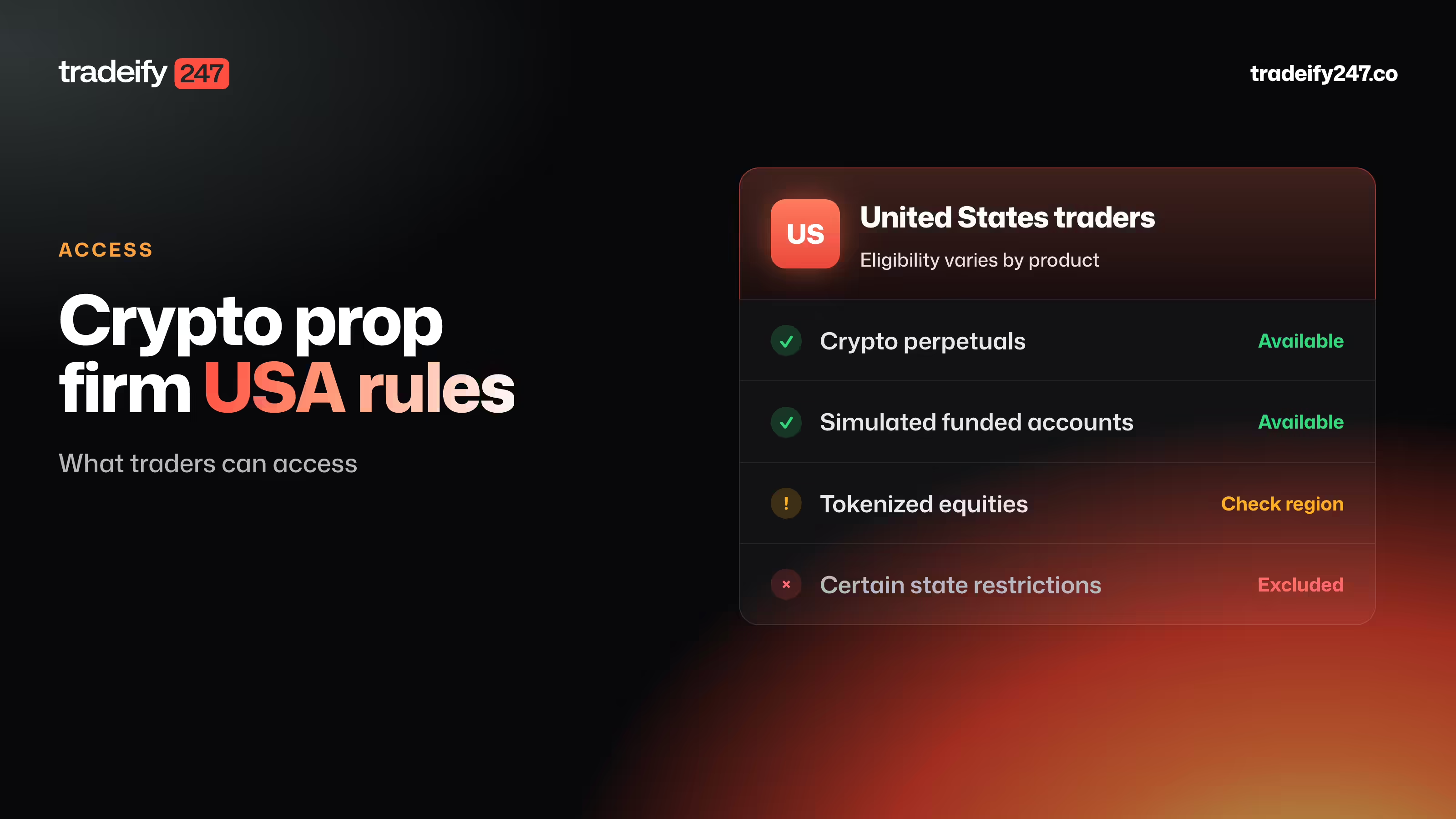
Crypto Prop Firm USA Rules and What Traders Can Access