


Weekend Crypto Trading Strategy: How to Trade While Equities Markets Are Closed


.svg)

TL;DR: A weekend crypto trading strategy should treat Saturday and Sunday as a separate market regime, not extra weekday screen time. Crypto trades 24/7, but liquidity, spreads, correlations, and catalysts change when equities markets are closed. Start with BTC and ETH, measure current spread and volume, reduce normal position size, define invalidation before entry, and cap total account risk below any personal or funded-account loss limit. Recheck the position before the Sunday futures open, when cross-market confirmation returns.
Every weekend crypto trading strategy has to solve the same problem: equities are closed, crypto is still moving, and the next candle starts to look like an opportunity simply because it is available.
Availability is not confirmation. Bitcoin, Ethereum, Solana, and other assets can keep moving while stock and most futures traders wait for Sunday evening or Monday morning, but the conditions under that move have changed.
That access creates valid setups, but it also changes the quality of the market. The weekend is often thinner. A headline can travel through the order book faster. Relationships that looked stable during the U.S. cash session can weaken when equity desks are offline.
The goal is not to find a magic Saturday pattern. It is to decide when a weekend trade has enough liquidity, structure, and account buffer to justify the risk.
If those conditions are missing, cash is the position. Do not force activity into a thin market.
Why Weekend Crypto Trading Is Different
Traditional U.S. stocks normally trade from 9:30 a.m. to 4:00 p.m. Eastern on business days. Some brokers offer extended or overnight sessions, but those services are not the same as a continuously open primary exchange. Crypto markets remain active through Saturday, Sunday, and most holidays.
Continuous trading does not produce constant conditions. Weekend participation can be lower because many institutional desks, market makers, and cross-asset traders operate with reduced staffing. The result can be lower depth and wider spreads, especially in smaller altcoins.
Weekend movement is still material. A CME Group analysis of the 24/7 crypto opportunity found weekend Bitcoin volatility at roughly 75% of weekday levels during 2026. The useful lesson is not that every weekend will be three-quarters as active. It is that closed traditional venues do not eliminate crypto price risk.
Choose a Weekend Crypto Market First
A good process begins with market selection. BTC and ETH usually offer the clearest starting point because they tend to have greater participation than thin altcoins. A trader can add SOL or another pair only after checking current conditions.
Before entering, inspect:
- bid-ask spread compared with the same hour on recent weekdays;
- current and average volume;
- nearby liquidation or support and resistance areas;
- scheduled token events or protocol announcements;
- the next major traditional-market open;
- holding costs; Tradeify 247 charges no funding, swap, overnight, or holding fee, only a 0.04% commission on notional at entry and exit.
Do not select a market only because it is moving. A small token can print an attractive candle while offering poor depth on the exit.
That is the tradeoff. The faster chart may offer more movement, but the cleaner market may let you control the loss. Execution quality is part of the setup.
Build a Weekend Crypto Session Plan
Although crypto has no official opening bell, global participation still clusters by time zone. Asia activity begins to build as its business day starts. Europe adds flow later. The deepest overlap often appears as Europe remains active and the United States comes online.
A trader can divide the weekend into practical blocks:
UTC window | Typical focus | Main caution |
|---|---|---|
00:00 to 07:00 | Asia-led flow | Pair-specific depth can vary sharply |
07:00 to 13:00 | Europe becomes active | Early moves can reverse into U.S. hours |
13:00 to 21:00 | U.S. participation | News reactions and volatility can accelerate |
21:00 to 00:00 | Late U.S. handoff | The 22:00 UTC daily-loss reset splits this window; liquidity may thin into the next regional cycle |
These are observation windows, not promises. On Tradeify 247, the 22:00 UTC daily reset falls inside the final block: the first hour counts against one trading day and the remainder against the next. A position held across the reset is measured against a fresh closing-balance snapshot, and its original size must remain intact; partially closing before the reset and carrying the remainder is not allowed. Academic research across multiple crypto exchanges found recurring intraday patterns, including a broad activity peak around 16:00 to 17:00 UTC, but the exact best hour changes with venue and market regime. Use the map to organize testing, then verify it with the actual pair.
Use Three Weekend Crypto Setups
Weekend trading improves when the playbook is small. Three setup families cover most useful conditions.
Weekend range rejection
If BTC or ETH compresses between a clear high and low, wait for price to test an edge and fail. Confirmation can be a rejection wick, lower-timeframe structure break, or return inside the range after a brief sweep.
Place the stop beyond the invalidation point, not at a round number chosen for convenience. The first target can be the range midpoint, followed by the opposite edge if flow remains orderly. Skip the trade if spread consumes too much of the expected reward.
Weekend breakout and retest
A real breakout should show more than one large candle. Look for increasing volume, acceptance beyond the prior range, and a retest that holds.
The first spike is an observation, not an entry by itself. Entering it in thin conditions increases the chance of buying the high or selling the low.
The setup fails when price returns through the broken level and stays there. A trader should know that failure point before choosing size.
Weekend news continuation
Crypto can become the first liquid market to respond to geopolitical, regulatory, or industry news. A continuation setup waits for the first impulse to settle, then uses a pullback or consolidation rather than chasing the initial candle.
News trades demand the smallest size of the three setups because price can reverse as facts change. If the original source cannot be verified, there is no setup.
Size Weekend Crypto Trades Conservatively
Position size should come from account risk, not maximum buying power. Start with the amount the account can lose if the stop fills, then divide by the distance between entry and stop.
For example, suppose a trader sets a $120 risk budget and the stop is 1% from entry. The allowed notional before costs is approximately:
$120 ÷ 1% = $12,000
That is only a starting estimate. Reduce it for slippage, spread, and correlated exposure. Tradeify 247 does not charge funding, swap, overnight, or holding fees; its only trading cost is a 0.04% commission on notional at entry and exit. Two simultaneous long positions in BTC and ETH are not independent if both respond to the same market move.
The CFTC's crypto risk advisory warns that leverage amplifies changes in the underlying price. In a funded account, a hard-breach rule makes conservative sizing even more important. A stop that fills after the daily loss threshold has already been crossed cannot restore the account.
Manage Weekend Crypto Correlation Risk
When equities are closed, traders lose a live confirmation source. Bitcoin may react to a macro headline, but Nasdaq shares cannot immediately express their own price response. That can cause crypto and tokenized equity markets to move on incomplete information.
Use a correlation checklist:
- Is BTC moving with or against the latest Nasdaq direction?
- Are ETH and major altcoins confirming the move?
- Is the move broad, or isolated to one token?
- Are stablecoins, yields, or the U.S. dollar sending a conflicting signal?
- Will stock-index futures reopen during the intended holding period?
Do not force a hedge simply because two assets are usually correlated. Weekend correlations can break, and two positions can lose together.
If the live relationship stops confirming the thesis, treat the positions as separate risks and cut size accordingly.
Plan for the Sunday Futures Open
Sunday evening in the United States is a key transition. Major futures markets reopen, providing fresh price information for equity indexes, rates, energy, metals, and currencies. A crypto move that developed in isolation may strengthen, stall, or reverse when those markets join.
Before that transition, decide whether to:
- close the position;
- take partial profit and tighten risk;
- hold the original plan unchanged;
- reduce size because the trade now faces a cross-market catalyst.
Do not wait for the reopen to invent a response. The first few minutes can be fast, and a thin crypto book may react before a manual order is filled.
Protect a Funded Account Over the Weekend
Tradeify 247 differs from many futures prop programs because eligible positions can remain open overnight and through weekends. The daily loss limit still resets at 22:00 UTC every day, and breach checks use live equity including open positions. To carry a position across the reset, its original size must remain intact. Continuous access removes the need to flatten for a market closure, but it does not remove the account’s loss limits.
A weekend funded-account plan should include:
- a lower per-trade risk cap than the normal weekday cap;
- a total risk cap across all correlated positions;
- hard stops placed at technically valid levels;
- alerts before the account reaches a loss boundary;
- a rule against adding to a losing position;
- a scheduled time to reassess or close the trade.
The specific platform and evaluation path can change, but the weekend discipline does not. Protect account eligibility before seeking profit, and size from the loss boundary rather than the available buying power.
Avoid Common Weekend Crypto Mistakes
The first mistake is boredom trading. Continuous access can make inactivity feel like a missed opportunity. If the planned setup is absent, the correct decision is no trade.
The second is using weekday size in a thinner book. The chart may look familiar while the exit cost has changed.
The third is treating a stop as a guaranteed price. A stop becomes an executable order after its trigger. Fast movement can produce a worse fill.
The fourth is holding because the market never closes. An always-open market gives more opportunities to exit, not a reason to keep a broken trade.
The fifth is confusing prop exposure with asset ownership. A simulated prop BTC position is not Bitcoin in a personal wallet. The trader is earning based on account performance under program rules.
Review Every Weekend Crypto Trade
Tag weekend trades separately in the journal. Record the pair, UTC entry hour, setup type, spread, volume condition, planned risk, realized slippage, and whether the trade crossed the Sunday futures reopen.
After at least 20 to 30 examples, compare results with weekday trades. Look for differences in win rate, average reward-to-risk, maximum adverse movement, and execution cost. A strategy that works during the U.S. session may need a smaller target or wider invalidation point on Saturday. It may also have no weekend edge at all.
The best weekend crypto strategy is specific enough to test and strict enough to keep you out when conditions are poor.
Before Friday ends, choose one setup, one UTC window, one maximum spread, and one account-risk cap for the weekend. Log every result separately. Trade the evidence, not the fact that the market is open.
Weekend Crypto Trading Questions
Is crypto really open all weekend?
Crypto spot and perpetual markets commonly trade 24/7, apart from venue maintenance or a product-specific halt. Confirm the status of the exact symbol before relying on access.
Is Saturday or Sunday better for crypto trading?
Neither day is automatically better. Compare live liquidity, spread, catalyst risk, and the setup's historical results. Sunday can add risk around the futures reopen.
Can a Tradeify 247 trader hold crypto through Monday?
Yes. Crypto trades 24/7 on Tradeify 247 with no restricted windows, and there is no requirement to flatten before the weekend. The daily loss limit still resets at 22:00 UTC every day, and a position carried across that reset must keep its original size intact.
Should weekend stops be wider?
Only if the technical setup calls for a wider invalidation point. If the stop is wider, reduce position size so the dollar risk does not increase.

Keep Reading
See all
Are Tokenized Stocks Safe and What Risks to Check First
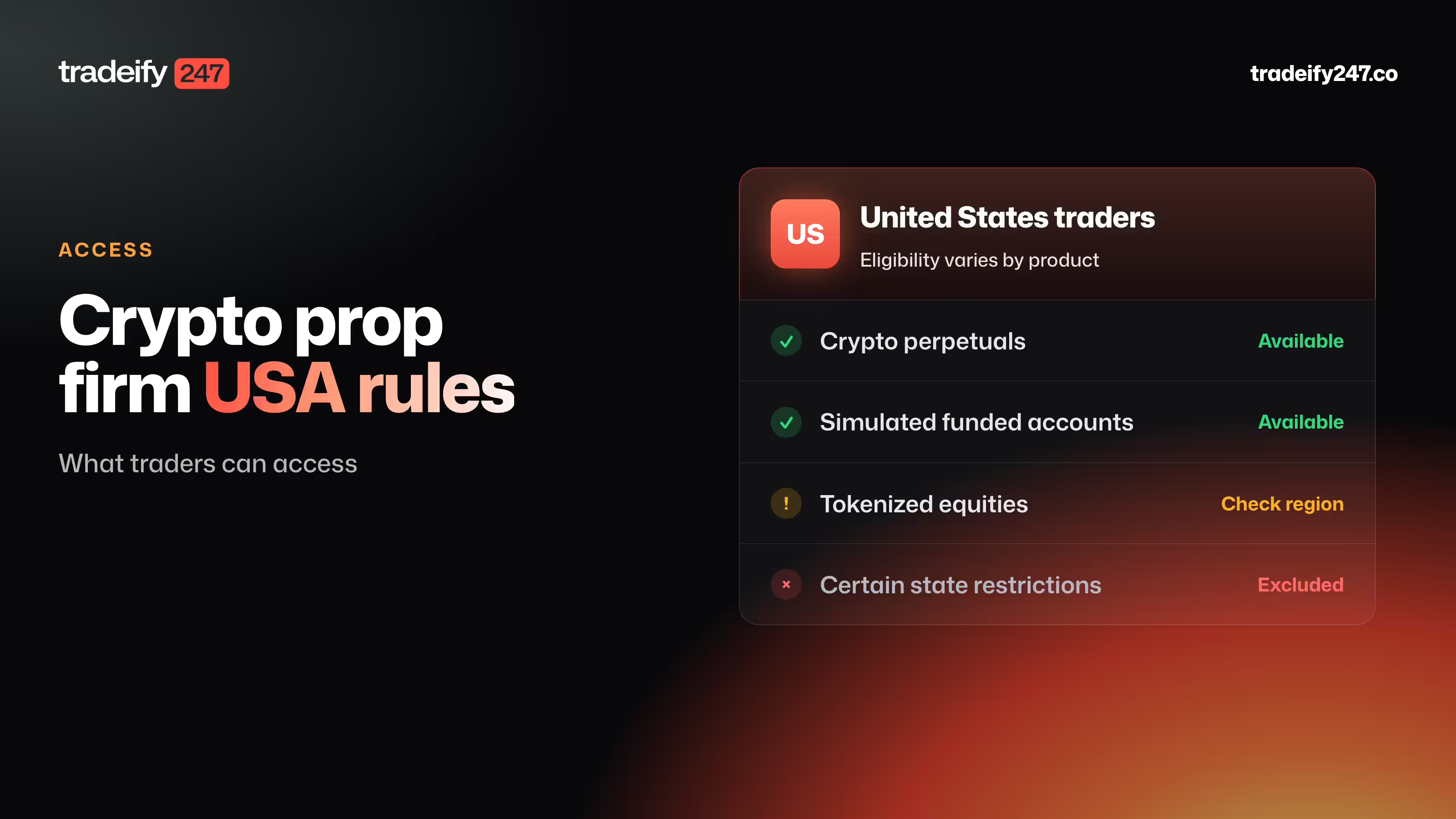
Crypto Prop Firm USA Rules and What Traders Can Access