

Trading on Hyperliquid: What Funded Traders Need to Know


.svg)

TL;DR: Trading on Hyperliquid means working with an on-chain protocol whose HyperCore order books support perpetual contracts, spot markets, and builder-deployed HIP-3 markets. Funded traders should check the reference price, mark price, funding, margin mode, liquidity, and 24/7 gap risk for the exact symbol. A Hyperliquid-linked position inside a prop program may be simulated rather than a wallet position, so it does not automatically provide custody of crypto, shares, or a tokenized asset.
Trading on Hyperliquid through a funded account starts with a harder question than where to click buy or sell. You need to know what position you are actually trading, which price controls risk, and what can breach the account.
Get any of those wrong and a sound market idea can still become a bad funded-account trade. Hyperliquid has helped bring always-open order-book trading to crypto perpetuals and, through builder-deployed markets, contracts tied to stocks and commodities.
The access is easy to understand. The mechanics require more care.
If you treat a Hyperliquid-linked tokenized stock exactly like a share in a brokerage account, you can misread what is being traded, when the price can move, and how the position affects a prop account's loss limits.
This guide explains the parts that affect actual trade decisions.
What Hyperliquid Means for a Funded Trader
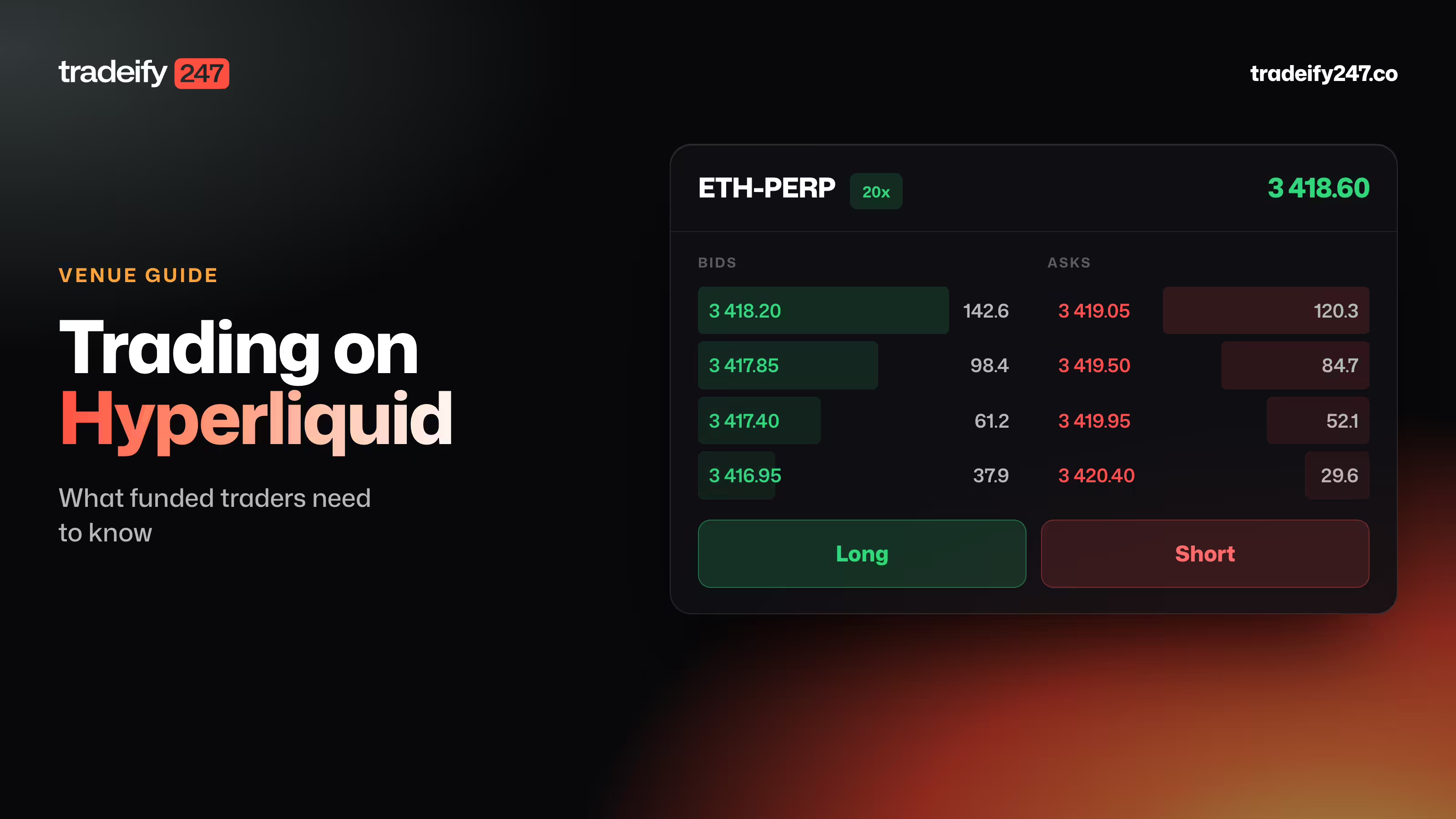
Hyperliquid combines an on-chain protocol with a central limit order book. Its native perpetual markets let traders take long or short exposure without a fixed expiry date. HIP-3 extends that system by allowing qualified builders to deploy additional perpetual markets.
According to the official HIP-3 specification, a market deployer defines the contract, supplies its oracle methodology, sets leverage limits, and can halt or settle the market. The protocol supplies the order-book, margin, and trading infrastructure.
That division of responsibility matters. “Powered by Hyperliquid” does not mean every product has identical liquidity, oracle construction, trading fees, or contract terms.
The venue name is an observation. The symbol specification is confirmation. If the contract details do not fit your holding period or risk plan, skip the trade.
Tradeify 247 is one example of that added prop layer. It provides simulated funded-account trading in tokenized assets rather than a direct exchange account. The platform records results against program objectives and loss limits; it does not hand the trader a wallet containing Bitcoin, Apple shares, or an Apple-linked token.
How Hyperliquid Perpetual Markets Work
A perpetual contract tracks an underlying market without expiring on a quarterly or monthly date. The trader posts margin and gains or loses as the contract price moves. Because there is no expiry forcing convergence, perpetual markets use funding payments and reference prices to keep contract prices near their underlying markets.
Three prices may matter:
- The last price is the latest completed trade.
- The oracle price is an external reference assembled from selected data sources.
- The mark price is a risk-management value used for unrealized profit and loss or liquidation calculations.
These values can differ briefly. Hyperliquid's liquidation documentation states that liquidation uses a mark price that combines external centralized-exchange prices with the state of Hyperliquid's own book.
That difference becomes concrete in a fast move. Your chart can show one last trade while the risk calculation reacts to another value, so you need enough account buffer for the mismatch.
In any funded account, the program's own rules are controlling. The external venue may help power pricing and market access, but the firm's daily loss and maximum loss calculations determine whether the account remains compliant.
Why Hyperliquid Funding Matters
Funding is a periodic transfer between long and short perpetual positions. It is intended to keep the perpetual price near the reference asset. When the contract trades above its reference, long positions commonly pay short positions. When it trades below, the direction can reverse.
The Hyperliquid funding guide says its native crypto perpetual funding is paid hourly, using one-eighth of an eight-hour calculated rate each hour. That mechanism applies to Hyperliquid’s perpetual market; it does not mean Tradeify 247 passes funding through to funded accounts. Traders comparing other products should ask:
- Does the symbol incur funding, financing, or another holding adjustment?
- When is that adjustment booked?
- Is the displayed rate annualized, eight-hour, hourly, or per settlement?
- Can a cost booked overnight reduce equity enough to hit a daily or maximum loss limit?
Tradeify 247 charges no funding rate, swap, overnight fee, or holding cost. Its only trading cost is a 0.04% commission on notional when opening and again when closing, so nothing is booked overnight to reduce a daily or maximum loss limit. On products that do impose recurring charges, holding time remains part of position sizing alongside spread expansion and slippage.
If the expected move is too small to cover those costs with room left over, the setup is not ready.
How HIP-3 Supports Tokenized Asset Trading
HIP-3 markets are builder-deployed perpetuals. They can reference assets beyond native crypto pairs when a deployer can supply a credible external price and operate the market responsibly. Hyperliquid's documentation says deployers are responsible for contract specifications and oracle prices, and its validator rules consider observable liquidity and resistance to price manipulation.
For a tokenized stock trader, this creates a practical distinction:
- The reference company has ordinary shares that trade on a regulated stock exchange.
- A linked perpetual market tracks a price through an oracle and contract rules.
- The perpetual may trade when the primary stock exchange is closed.
- Trading the contract does not make the trader a shareholder.
If an Apple-linked market moves on Saturday, it is expressing the available market's estimate of Apple-related risk. It is not the official Nasdaq closing or opening auction. When the primary market returns, prices can converge abruptly.
What Funded Traders Own When Trading on Hyperliquid
Nothing in the simulated account should be confused with direct custody. A funded trader is trading price exposure under a contract with the prop firm. The trader does not receive voting rights, dividends as a registered shareholder, the right to transfer a stock token to a personal wallet, or ownership of the underlying company.
This is also different from opening a personal Hyperliquid account. Direct protocol use can involve a self-custody wallet, collateral, on-chain transactions, and protocol-specific liquidation. Tradeify 247 traders use DXTrade or MT5 where available and are subject to Tradeify 247 account rules. Their payout eligibility comes from performance under those rules, not from withdrawing an on-chain position.
The distinction is useful, not merely legal wording. It tells traders which controls to monitor. In a direct exchange account, liquidation and custody are central. In a prop account, daily loss, maximum loss, consistency requirements, and prohibited conduct may end the account before an exchange-style liquidation level becomes relevant.
How Hyperliquid Liquidity Changes Through the Day
Always open does not mean equally liquid. Crypto participation often grows during the Europe and U.S. overlap. A tokenized-stock market may have its best price agreement and deepest interest while the underlying U.S. share is trading. Overnight and weekend activity may be thinner.
Thin books can produce:
- wider bid-ask spreads;
- more slippage on market orders;
- sharper moves from modest order flow;
- brief differences between the last, mark, and oracle prices;
- weaker fills around stops.
The right test is the live contract, not a general assumption. Check spread, available size, recent candles, and the distance to the next meaningful order-book level.
On MT5, the official Market Watch guide explains where to inspect bid, ask, spread, contract size, trading mode, order types, and server time. DXTrade users should make the same checks in that platform's symbol details and order ticket. If the exit looks expensive before entry, it will not become cheaper because the trade moves against you.
A Funded Account Risk Checklist
Before entering a Hyperliquid-linked market, record five numbers: planned entry, invalidation price, stop price, dollar risk, and remaining loss buffer. Then test the position against both loss limits.
Funded programs may use static, trailing, or end-of-day drawdown. Static drawdown gives the trader a fixed maximum-loss boundary rather than a threshold that follows every new equity high. It still does not make a wide stop safe. A 2% move in the instrument can represent a much larger change in the account if the position is oversized.
Use this order of operations:
- Find the exact contract specification and minimum price increment.
- Measure the normal spread at the intended trading hour.
- Set the technical invalidation level before choosing size.
- Calculate risk at the stop, including a slippage allowance.
- Leave room between planned risk and the firm's hard limits.
- Check whether funding or holding adjustments can be booked before exit.
- Reduce size or skip the trade if market depth is poor.
The CFTC's virtual-currency risk advisory notes that margin amplifies both gains and losses. In a prop account, that amplified loss can also create a rule breach.
How to Plan Overnight and Weekend Positions
Some tokenized-asset prop programs allow positions to remain open overnight and through weekends. That removes a forced daily exit. It does not remove event risk.
For crypto pairs, watch protocol news, liquidation clusters, major economic announcements, and funding changes. For tokenized stocks, add earnings, corporate filings, analyst actions, product news, and broad equity-index moves. For commodities, include geopolitical developments, inventory reports, and weather when relevant.
A practical weekend plan should state:
- the maximum position size after Friday's main session;
- whether the stop remains valid in thinner liquidity;
- what event would justify reducing before the weekend;
- the account equity level that requires an immediate exit;
- when the trader will actually be available to monitor the position.
The fact that the market remains open can reduce gap helplessness because a trader may be able to act. It also means the account can move while the trader sleeps. Alerts and hard stops are risk tools, not guarantees of a fill at the requested price.
When Hyperliquid Trading Fits a Funded Strategy
Hyperliquid-linked markets fit best when the strategy has a defined holding period, a tested response to thin liquidity, and an explicit account-risk budget. They can be useful for crypto momentum, around-the-clock mean reversion, event reactions, and tokenized-stock exposure outside the cash session.
They fit poorly when a trader assumes 24/7 access guarantees continuous liquidity, sizes from buying power instead of stop distance, or cannot explain the contract being traded.
Before your next order, open the symbol specification and write down the reference price, contract terms, account buffer, and exit condition. If one of those fields is blank, wait. The market will still be open when the plan is complete.
Hyperliquid Questions Funded Traders Ask
Is a funded account the same as trading directly on Hyperliquid?
No. A funded program can use Hyperliquid-linked pricing without giving the trader a direct protocol account. Tradeify 247, for example, uses simulated accounts accessed through DXTrade or MT5 where available; traders do not connect a personal wallet or take custody of the underlying asset.
Do tokenized stock positions pay dividends?
Do not assume they do. A perpetual or other price-linked contract is not an ordinary share. Review the exact symbol specification and firm terms for any financing or corporate-action treatment.
Can Hyperliquid-linked positions trade all weekend?
The market design can support 24/7 trading, but availability can vary by instrument, maintenance window, or program. Confirm the symbol's live trading status before relying on continuous access.
Does a stop guarantee protection from a prop rule breach?
No. Stops can fill worse than requested during rapid movement or poor liquidity. Size the trade with room for slippage and any holding adjustment.

Keep Reading
See all
Are Tokenized Stocks Safe and What Risks to Check First
Crypto Prop Firm USA Rules and What Traders Can Access