

Tokenized Stocks vs Real Shares: What You Actually Own


.svg)

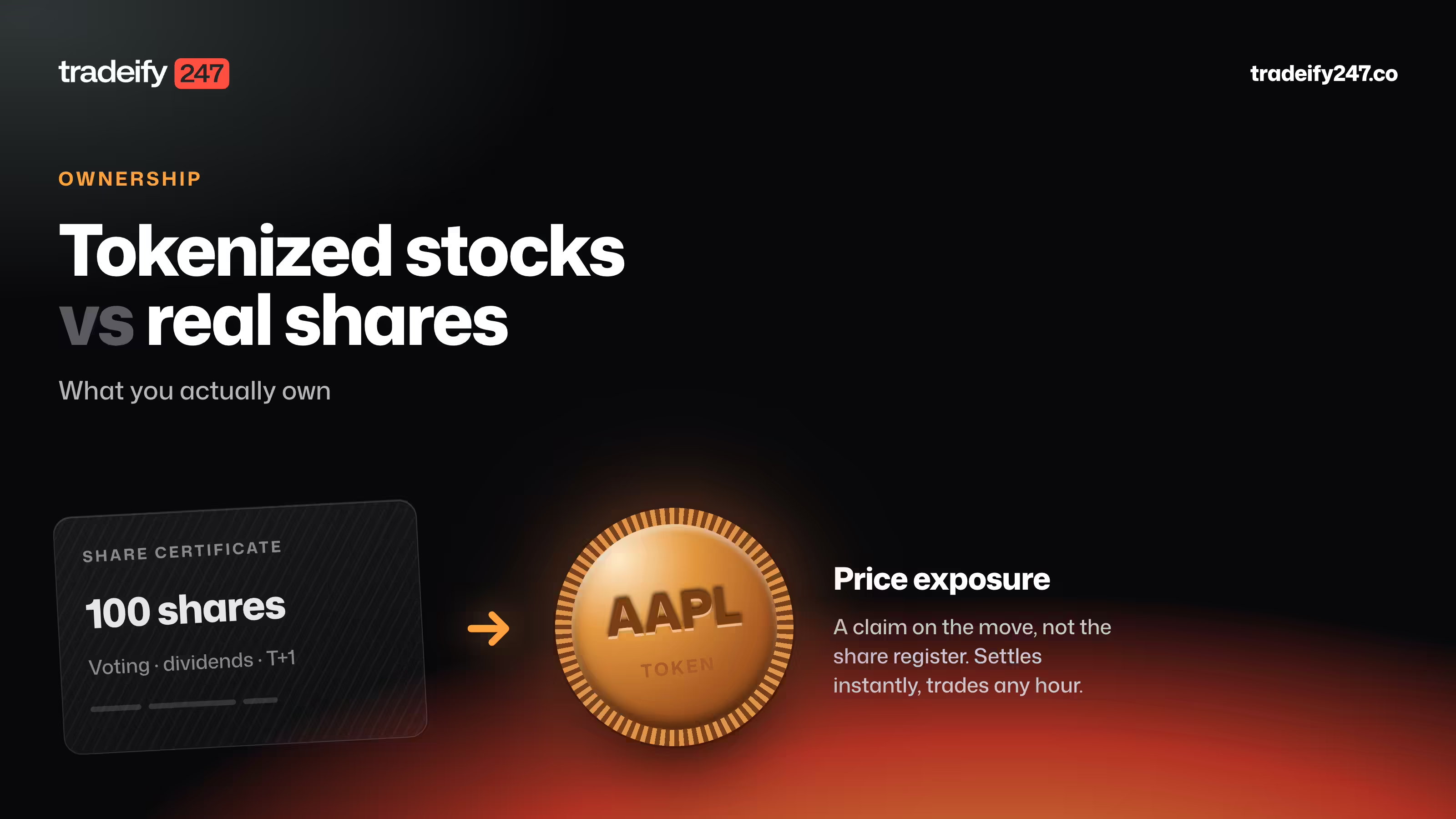
TL;DR: A real share is an equity interest in a company, normally held through a broker and tied to shareholder rights under the share class and custody structure. A tokenized stock can instead be an issuer-sponsored security, a custodial claim backed by shares, or a derivative that tracks a stock price without transferring ownership. Before trading an Apple-, Tesla-, NVIDIA-, or Google-linked product, check whether it grants equity ownership or only price exposure, how the price is formed, what happens to dividends and corporate actions, and whether the market can separate from the cash share price outside regular hours.
You can trade an Apple-linked market around the clock and still own zero Apple shares. That is where traders get caught: the ticker looks familiar, but the legal rights behind the position may be completely different.
Inside a proprietary trading program, the distinction is decisive. You are operating an account under the firm’s contract and may receive a share of eligible profits. You are not building a personal stock portfolio, even when the instrument follows Apple or Tesla closely.
What real shares give their owners
Buying a conventional public-company share through a broker usually makes the buyer the beneficial owner, while the broker or its nominee appears as the record holder. The exact arrangement varies, but the investment is still an equity interest in the company.
That status may come with:
- Economic participation in the company’s share price
- Dividends when the board declares them
- Voting rights for matters covered by the share class
- Corporate-action treatment for splits, mergers, tenders, and spin-offs
- Securities-law protections and broker custody records
The rights are not identical for every share class or brokerage setup. A fractional share, for example, may receive different voting treatment than a whole share. The central point is that a real share sits within the issuer’s capital structure.
The SEC’s investor guide explains that tokenized securities can also carry those rights when the issuer or its agent places the security directly on a distributed ledger. It also describes custodial structures in which a token represents an indirect interest in an underlying security. That is why the label alone cannot answer the ownership question. The structure does. See the SEC’s explanation of tokenized securities and their common models.
What tokenized stocks can represent
“Tokenized stock” is an umbrella term, not one standardized contract. Before you treat the product like a share, ask the question that settles the issue: does the contract grant ownership, or only price exposure?
Issuer-sponsored tokenized shares
The company or its authorized agent issues the security in tokenized form. Depending on the share class and offering documents, the token may carry ownership, voting, dividend, and other shareholder rights. This is the closest match to a conventional share represented through different recordkeeping technology.
Custodial tokenized shares
A third party holds conventional shares and issues tokens linked to them. The token holder’s rights depend on the custody agreement, issuer terms, jurisdiction, redemption process, and insolvency treatment. “Backed one for one” is useful information, but it does not by itself tell you whether the holder can vote, redeem, or assert a direct claim on the shares.
Price-tracking tokens and perpetual contracts
Some products track a stock price through collateral, market makers, an oracle, or a derivative contract. They may be called tokenized equities, stock tokens, equity perpetuals, or real-world-asset markets. The holder receives price exposure, not an equity position in the company.
Hyperliquid documentation is explicit that its perpetuals are derivatives with no expiration date. HIP-3 allows builders to deploy perpetual markets and makes the deployer responsible for contract definitions, oracle design, limits, and market operation. Those details are described in the official HIP-3 builder-deployed perpetuals documentation.
For a trader, the practical lesson is direct: a tokenized product tied to AAPL is not automatically an Apple share.
Tokenized stocks and real shares compared
Question | Real shares in a brokerage account | Tokenized ownership security | Price-tracking token or perpetual |
|---|---|---|---|
Do you own company equity? | Generally yes, as beneficial owner | Possibly, if legal terms establish it | No, typically only price exposure |
Voting rights | Often yes, subject to class and broker terms | Depends on token terms | No |
Dividends | Paid when declared, subject to ownership date | Depends on legal structure | May be reflected through adjustments, not a shareholder dividend |
Trading schedule | Exchange and broker schedule | Venue-specific | Venue-specific and may be continuous |
Custody | Broker, clearing, and securities custody system | Blockchain plus issuer or custodian structure | Collateral and contract system |
Main added risks | Company, market, and broker risks | Smart-contract, custody, issuer, and redemption risks | Oracle, liquidity, funding, collateral, and counterparty risks |
This table is a starting point. Terms of service, product disclosures, and contract specifications control the actual rights.
What funded tokenized-stock traders actually hold
Prop-firm traders are usually trading an account position rather than acquiring an asset for a personal portfolio. The position can follow a public company’s price closely without transferring any shares to the trader.
Here is the important part. When you trade one of those markets in a Tradeify 247 evaluation or funded account, you are opening a simulated position inside the firm’s account system, not transferring AAPL or TSLA into a personal wallet. The Tradeify 247 Terms of Use state that tokenized-equity instruments are price references rather than shares and do not grant ownership, dividend, or voting rights.
That position can still provide meaningful economic exposure. If the instrument rises or falls, your account profit and loss responds according to the contract, order, spread, fees, and position size. If you meet the program’s rules, eligible profits may contribute to a payout under the applicable profit split.
The relationship is therefore:
- The referenced company has conventional shares.
- A market contract uses a defined price source and trading mechanism to create exposure.
- A prop firm makes that instrument available inside an evaluation or funded account.
- The trader controls entries, exits, and risk within the program rules.
- The trader’s contractual right is to an eligible share of account profits, not to the referenced company’s shares.
That is not a hidden defect in the model. It is the model. The mistake is trading the price reference as if the ticker also gave you shareholder rights.
Why 24/7 access changes the trading use case
Real U.S. shares still trade around defined market sessions. Nasdaq lists regular hours as 9:30 a.m. to 4:00 p.m. Eastern, with extended sessions outside that window. The exchange also warns that extended trading can have less liquidity and greater volatility. Its current schedule is available in the Nasdaq holiday and market-hours schedule.
Tokenized derivatives can use a different schedule. That gives traders a way to respond to information outside the main cash session, hold a thesis overnight, and keep positions open through weekends when the specific market remains available.
Continuous access does not mean continuous depth. When the primary stock exchange is closed, fewer price anchors may be updating, spreads may widen, and the contract may move away from the last cash-session price. If the gap holds when the primary market reopens, the overnight move may have found confirmation; if it collapses, the thin-session price was the warning.
Tokenized stock pricing can separate from the share price
A tokenized market usually aims to track an underlying reference, but identical pricing is not guaranteed at every second. Several forces can create a difference:
- The cash equity market is closed
- The tokenized venue has thinner order-book depth
- The oracle updates differently from the primary exchange
- Funding payments affect perpetual positioning, although Tradeify 247 charges no funding, swap, overnight, or holding fee
- Buyers and sellers react to overnight news before the next stock session
- Trading is halted or limited by the market operator
This is especially important for earnings. A tokenized Apple market may move as results are released, but the next official Nasdaq opening price is formed later through its own auction, order flow, and liquidity. The two prices can influence each other without being interchangeable.
How dividends and corporate actions differ
A conventional shareholder may receive a cash dividend because the board declared it and the investor owned the security on the relevant dates. A derivative trader does not become a shareholder through price exposure. Any dividend effect must be handled according to the product’s calculation or adjustment rules.
The same principle applies to splits, mergers, symbol changes, and spin-offs. A broker updates real-share records through the securities system. A token or perpetual operator may adjust contract size, oracle definitions, or settlement terms. Traders should check the market’s written method before carrying a position through a corporate action.
Never infer treatment from the ticker alone. “AAPL” describes the reference. It does not define your legal rights.
How to check a tokenized stock before trading
Use a short due-diligence checklist for every venue and instrument:
- Identify the product type. Is it a security, custodial token, spot token, contract for difference, or perpetual?
- Read the ownership language. Does the document say “ownership,” “beneficial interest,” or only “exposure”?
- Check shareholder rights. Are voting, dividends, and corporate actions included?
- Find the price source. Which exchange, oracle, or index drives the mark?
- Review trading hours. Is the instrument always open, paused at set times, or subject to operator halts?
- Check liquidity and order types. Can a market order fill far from the displayed price?
- Review funding and fees. Perpetual exposure can carry recurring funding payments, while Tradeify 247 charges none; its only trading cost is a 0.04% commission on notional at entry and exit.
- Confirm the prop rules. Position-level risk still sits inside daily loss and maximum loss limits.
The SEC warns that many retail tokenized products offer price exposure without ownership of the underlying asset. BlackRock’s iShares education page similarly separates tokenized ownership from tokenized price-referencing products.
How funded traders should think about ownership
Use the cleaner mental model: “I am trading a contract linked to Tesla’s price inside a funded account.” If you catch yourself thinking “I own Tesla around the clock,” stop there. The product, rights, and risk plan no longer match the story in your head.
It also changes risk management. An investor may hold a real share for years, receive dividends, vote, and accept company-specific volatility. A funded trader has hard account limits, restricted buying power, and a contractual payout path. The priority is not shareholder participation. It is executing a trade while keeping account equity inside the rules.
A larger prop account changes the permitted scale, not the ownership structure. Whichever evaluation or funding path you choose, a price-referencing position does not become a personal shareholding.
Tokenized stocks answer a different need
Real shares are the direct route when the goal is company ownership and the rights attached to it. Tokenized derivatives answer a different need: flexible trading hours, short exposure, and several asset classes in one funded setup.
Tradeify 247 is one example of the second use case. Its funded traders can access tokenized stock price references 24/7 at 2:1 leverage on every account type, alongside 100+ crypto pairs, commodities, and indices. Tokenized stocks use the same 0.04% commission on notional as crypto pairs, charged at entry and exit, with no funding, swap, overnight, or holding fee. The same responsibility applies: understand what sits behind the ticker, how the price is formed, and which ownership rights are absent.
Decide which job you need the product to do before placing the trade. If the goal is to own Apple, use an appropriate brokerage arrangement for eligible Apple securities. If the goal is to trade Apple-linked price movement under prop rules, read the contract terms, confirm the price source, and size the position from the account’s loss limits.

Keep Reading
See all
Are Tokenized Stocks Safe and What Risks to Check First
Crypto Prop Firm USA Rules and What Traders Can Access