

Perpetual Futures vs Futures and Which One Suits You


.svg)

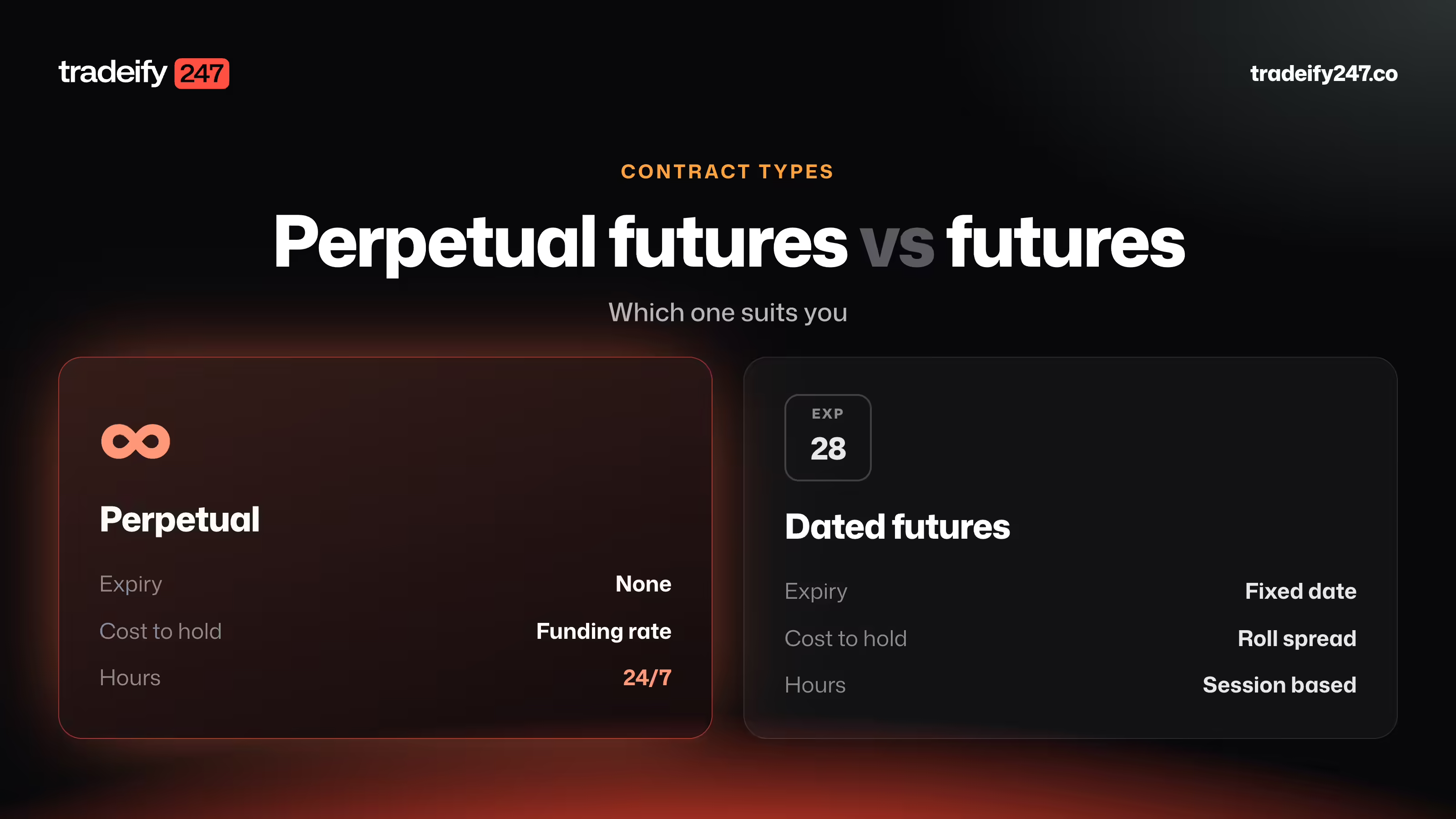
TL;DR: Perpetual futures have no expiration date and use recurring funding payments to keep their price near a spot or index reference. Traditional futures expire, converge toward settlement, and must be closed, rolled, or settled. Perpetuals can suit continuous crypto or tokenized-asset trading when the trader accepts variable funding, venue-specific liquidation, and around-the-clock risk. Dated futures can suit traders who need standardized exchange contracts, a defined expiry, clearer term structure, or a hedge tied to a calendar period. Neither contract provides ownership of the underlying asset. Compare market hours, contract size, margin, liquidity, funding or roll cost, settlement, platform eligibility, and maximum loss before choosing.
Two charts can track the same market and still create different trades.
One contract never expires but charges or credits funding. The other has a date on the calendar and forces a decision before settlement. Hold both long enough, and those mechanics can matter more than the entry.
The useful question is which contract matches the setup, holding period, and risk process.
What Traditional Futures Are
A futures contract is an agreement tied to an underlying commodity, financial index, currency, rate, or other reference. Exchange-listed contracts standardize the contract size, tick value, expiration, settlement method, and trading schedule.
Traditional futures have a limited life. CME Group’s expiration and rollover guide describes three choices before expiry:
- offset the position with an equal opposite trade;
- roll from the expiring month into a later contract;
- remain through expiration and enter cash or physical settlement under the contract rules.
Most short-term traders offset before settlement. A longer-term trader may roll, but the later contract can trade at a different price. That difference creates a gain or cost separate from the underlying market’s direction.
Futures margin is a performance deposit used to secure the position rather than a down payment on the underlying asset. CME’s margin guide explains that initial margin opens the position and maintenance margin is the minimum amount that must remain. The trader does not own barrels of oil, an equity index, or Treasury securities merely because a futures position is open.
What Perpetual Futures Are
Perpetual futures, often called perps or perpetual swaps, are derivatives without a scheduled expiration date. A trader can keep a position open while margin requirements, market availability, and account rules are satisfied.
Without expiration, the contract needs another way to stay near its reference price. That mechanism is funding.
When a perpetual trades above the reference, long holders commonly pay short holders. When it trades below, shorts commonly pay longs. Coinbase’s funding explanation describes funding as a transfer between position holders designed to align the perpetual market with its index.
Each venue sets its calculation, interval, cap, and mark-price rules. Hyperliquid, for example, states in its funding documentation that funding on its main perpetual market is paid hourly.
A perpetual position is still a contract. A BTC perpetual does not place Bitcoin in the trader’s wallet. An NVIDIA-linked perpetual does not provide NVIDIA shares, dividends, or voting rights.
Perpetual Futures vs Futures at a Glance
Feature | Perpetual futures | Traditional futures |
|---|---|---|
Expiration | None | Fixed contract month or date |
Price anchor | Funding, oracle or index, mark price, and order flow | Convergence toward settlement plus market expectations |
Holding task | Monitor funding and liquidation continuously | Manage expiry, roll, and settlement |
Common markets | Crypto and onchain synthetic markets | Commodities, equity indices, rates, currencies, and regulated crypto products |
Trading schedule | Often 24/7 for crypto-linked markets | Exchange schedule, commonly near 24/5 with maintenance breaks |
Ongoing cost | Funding can be paid or received | Roll price, commissions, spread, and daily margin cash flow |
Settlement | Usually cash profit or loss while the contract stays open | Cash settlement or physical delivery at expiry |
Ownership | No ownership of the reference asset | No ownership unless a deliverable contract reaches settlement |
The table identifies the contract mechanics. It does not decide which market is safer. Risk depends on position size, liquidity, collateral, volatility, and the rules of the venue or funded program.
Expiration Changes the Trade
A dated future creates a deadline. Liquidity usually migrates from the front month into the next active contract as expiration approaches. A trader who ignores that shift can end up in a thinner book or an unwanted settlement process.
Rolling is two trades: close the current month and open a later month. The later price may be higher or lower because of interest rates, storage, dividends, supply expectations, or demand for hedging.
A perpetual removes the scheduled roll. That is convenient for a position with no calendar end date, but the cost does not disappear. It moves into funding, spread, and venue-specific collateral risk.
If a position will last two hours, expiry may be irrelevant. If it will last two months, compare expected funding with the cost and basis of several futures rolls.
Funding and Basis Work Differently
Traditional futures can trade above or below spot. As settlement approaches, the contract converges according to its settlement rules. The price difference across contract months forms the futures curve.
Perpetuals have no final convergence date. Funding encourages traders to push the market back toward the index over repeated intervals.
Consider a long perpetual with a $50,000 notional position and a positive funding rate of one basis point per interval. The payment is $5 for that interval before trading fees. If the same rate repeated eight times, the total would be $40. The rate can change, so projecting it as fixed would be a mistake.
A negative rate reverses the direction: shorts pay longs. Receiving funding can help a trade, but it should not rescue a weak thesis. Price movement can overwhelm several funding credits in seconds.
For dated futures, compare the current contract with the next month before rolling. The gap between them can be a cost or benefit. It can also change quickly around supply events, rate decisions, earnings seasons, or volatility shocks.
Margin and Liquidation Need Separate Checks
Both contracts create exposure larger than the cash set aside as margin. That makes sizing errors expensive.
Traditional exchange futures are marked to market under clearing rules. CME notes that margin requirements can rise when volatility changes. If account equity falls below required levels, the trader may need more funds, reduce the position, or face liquidation.
Perpetual venues use their own margin, mark-price, and liquidation processes. The position may close automatically when collateral no longer supports maintenance requirements. Cross margin can place more of the account at risk, while isolated margin limits the collateral assigned to one position under the venue’s rules.
The CFTC’s virtual-currency risk advisory warns that margined futures amplify price risk. A small move in the reference can produce a much larger percentage change in account equity.
Before either trade, calculate the dollar loss at the stop and the distance to the account boundary. Do not size from the platform’s maximum permitted position.
Market Hours Change Your Control
Crypto perpetuals often trade through nights and weekends. That lets a trader react immediately, but it also means risk keeps moving while the trader is away.
Traditional futures commonly trade from Sunday evening through Friday with daily maintenance breaks, exchange holidays, and product-specific schedules. They are not universally open all weekend.
The difference matters when a catalyst lands Saturday. A Bitcoin perpetual may be executable. A CME equity-index future may remain closed until its Sunday session. A commodity contract may follow another schedule entirely.
Open does not mean liquid. Weekend perpetual books can be thinner, spreads can widen, and a stop can fill beyond its trigger. The ability to exit is valuable only if the market can absorb the order.
Which Contract Suits a Short-Term Trader
A perpetual can suit a trader who needs:
- continuous access to a crypto or tokenized market;
- no expiry management;
- flexible long or short exposure;
- a contract whose active book does not migrate each quarter.
The tradeoff is constant monitoring of funding, mark price, collateral, and liquidation distance.
A dated future can suit a trader who needs:
- a standardized exchange contract;
- deep liquidity in a specific active month;
- a known tick value and settlement process;
- exposure to equity indices, energy, metals, rates, or agricultural markets.
The tradeoff is contract selection and roll management. A technically sound idea can still be placed in the wrong month.
Which Contract Suits a Swing Trader or Hedger
For a multi-day perpetual position, estimate funding under low, normal, and stressed rates. Then decide what funding level invalidates the holding plan.
For a dated future, match the contract month to the time horizon. A business hedging a September exposure may prefer a defined September or nearby futures contract because the hedge and expiry share a calendar.
A trader holding for months should compare total expected costs rather than choosing the contract with the simpler order ticket. Several small funding payments can compound. A poorly timed roll can also change the result.
The hedge can fail even when direction is correct if the chosen contract does not track the intended exposure closely. Check basis history and settlement specifications.
Direct Contracts and Simulated Funded Positions
Direct exchange or onchain trading places the trader under that venue’s margin, collateral, clearing, custody, and settlement system.
Tradeify 247 belongs to a third category. It offers simulated USD-margined crypto pair trading rather than perpetual futures, traditional futures, or exchange-based trading. There is no expiry to roll and no funding to pay; the binding constraints are the program’s daily and maximum loss limits. The program also provides tokenized-stock exposure without ownership or custody of coins, shares, or exchange contracts.
Its Terms of Use describe notional capital and simulated execution. A tokenized-equity position provides synthetic price exposure without share ownership. The program agreement, loss limits, platform prices, and payout eligibility determine the trader’s outcome; the referenced asset cannot be withdrawn.
That means “perpetual,” “future,” and “tokenized asset” should be checked at the instrument and account level. A chart label does not prove that a funded position is the same legal contract traded directly on an exchange.
A Decision Checklist
Answer these questions before choosing perpetual futures or futures:
- Does the setup need Saturday execution or only weekday access?
- How long will the position normally remain open?
- What is the contract size and dollar value of one tick?
- How are the index, oracle, and mark price calculated?
- For a perpetual, how often is funding paid and how variable has it been?
- For a dated future, when does liquidity roll and how does settlement work?
- What margin level triggers a call, reduction, liquidation, or funded-rule breach?
- Is the product available on the trader’s platform and in the trader’s location?
- Does the position provide only price exposure, or any custody or contractual claim?
- What price, time, funding cost, or basis change invalidates the trade?
Choose the contract only after those answers match the plan. If the setup needs continuous execution and accepts variable funding, a perpetual may fit. If it needs a dated hedge, standardized settlement, or a traditional futures market, a listed future may fit better.
Perpetual Futures and Futures Questions
What Is the Main Difference Between Futures and Perpetual Futures
Traditional futures expire and move toward settlement. Perpetual futures have no scheduled expiry and use recurring funding to encourage alignment with a reference price.
How Long Can You Hold Perpetual Futures
There is no contract expiration, but the position can end through a manual close, liquidation, venue halt, lack of margin, or account-rule breach. Funding continues while the position remains open under the venue’s schedule.
Do Perpetual Futures Own the Underlying Asset
No. They provide derivative price exposure. A Bitcoin perpetual does not put Bitcoin in a wallet, and a stock-linked perpetual does not create share ownership.
Are Traditional Futures Safer Than Perpetual Futures
Not automatically. Traditional futures have standardized exchange and clearing rules, but they still carry margin, volatility, basis, roll, and settlement risk. Perpetuals add variable funding, venue, oracle, and continuous-market risk. Position size and contract understanding matter for both.
Can a Funded Trader Use Both
It depends on the program’s instrument list and rules. Confirm whether each symbol is a simulated reference, an exchange future, or another derivative, then calculate risk using that exact contract specification.

Keep Reading
See all
Are Tokenized Stocks Safe and What Risks to Check First
Crypto Prop Firm USA Rules and What Traders Can Access