


Pay-After-You-Pass Crypto Prop Firms: What the Marketing Doesn't Tell You


.svg)

Pay-After-You-Pass Crypto Prop Firms: What the Marketing Doesn't Tell You
The crypto prop industry has shifted toward pay-after-you-pass models over the last 18 months. The pitch is simple: no upfront fee, no risk if you fail the challenge, and you only pay when you actually get funded. The marketing makes it sound like a free option with unlimited upside. The reality is more nuanced, and the structure affects how the firm manages risk, how rules get enforced, and what your total cost looks like across multiple attempts.
Pay-after-you-pass isn't a charity — it's a risk-shifting mechanism. The firm takes on the cost of failed attempts in exchange for higher payouts from traders who do pass. Tradeify247 doesn't use this model — Tradeify247 charges a standard challenge fee upfront — but understanding how pay-after-you-pass firms compare helps you evaluate the full prop firm landscape.
How the Model Actually Works
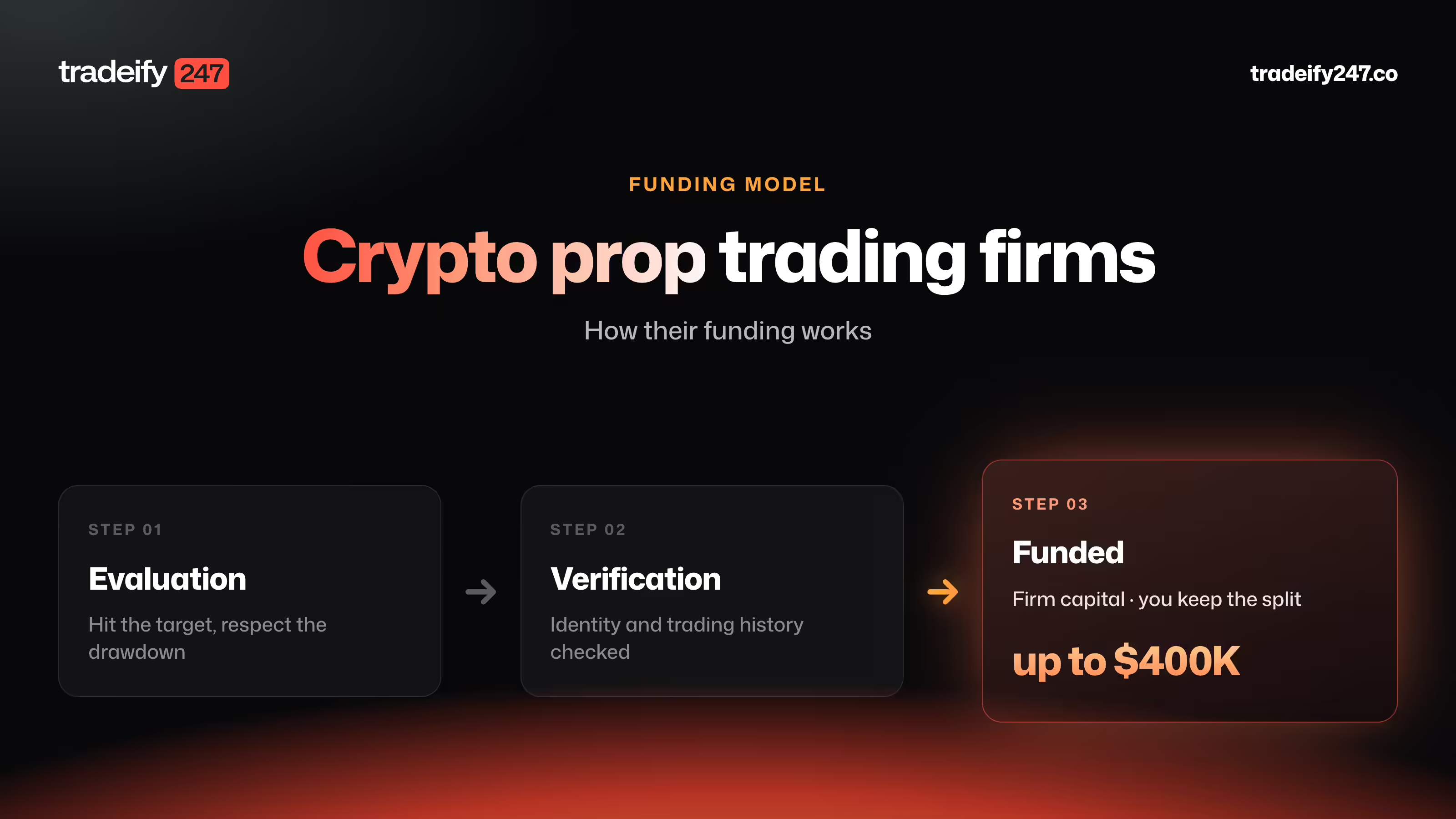
In a pay-after-you-pass model, you take the challenge for free. If you fail, you pay nothing. If you pass and get funded, you pay a one-time activation fee (often $100-$300 depending on account size) plus a higher profit split than traditional prop firms — typically 70-85% to the trader versus the 80-90% split common at firms like Tradeify247.
Some pay-after-you-pass firms also charge a per-withdrawal fee or structure the split differently after the first payout. The exact terms vary by firm, and reading the fine print matters because the headline split isn't always what you keep at the end of the cycle.
The Risk Shift Is Real but Bounded
Traditional prop firms like Tradeify247 make money from challenge fees regardless of outcome. Their incentive is to sell as many challenges as possible, which historically led to aggressive marketing and rules that were easy to fail. Pay-after-you-pass firms make money only from successful traders, so their incentive is to fund traders who will actually generate returns.
The risk shift means pay-after-you-pass firms tend to enforce rules more strictly, monitor trading behavior more closely, and reject funded traders who show patterns of risky behavior even within the stated rules. Tradeify247 traders who passed the standard challenge know they get scrutinized too, but pay-after-you-pass firms have stronger skin-in-the-game incentives.
Rule Enforcement Tends to Be Stricter
Because the firm only gets paid when you pass, they have stronger incentive to make sure you're actually trading well — not just gaming the rules. Expect tighter monitoring of trading patterns, more frequent consistency checks, and faster intervention if your trading behavior looks risky. Some pay-after-you-pass firms also have minimum trading day requirements, average trade size rules, or restrictions on holding single positions too long.
Tradeify247 also enforces consistent risk management, including its 3% equity floor rule, but the enforcement happens within the funded trader agreement rather than as a precondition for getting paid. Pay-after-you-pass firms tend to gate everything behind a longer verification period before the first payout.
The Hidden Cost: Multiple Attempts
The marketing emphasizes that failed attempts are free. That's true at the per-attempt level, but the time cost isn't zero. If you fail three challenges in a row because the rules don't fit your strategy, you've spent weeks of trading time that could have been used productively elsewhere. The opportunity cost of failed attempts is real, even when the dollar cost is zero.
Some traders also report that pay-after-you-pass firms make the challenge harder to pass than equivalent traditional firms. The exact difficulty varies, but the underlying logic is clear: the firm needs a higher pass-rate-to-funded-trader conversion to make the model profitable, so they design challenges that filter for traders who will actually succeed long-term.
Profit Splits Look Good on Paper
A 75% profit split at a pay-after-you-pass firm sounds slightly worse than 80-90% at Tradeify247. But the comparison isn't apples-to-apples because Tradeify247's split is net of the challenge fee you already paid. If you spent $200 on a Tradeify247 challenge and earned $10,000 in funded trading, your effective split is reduced by the upfront cost.
For traders who would have failed multiple Tradeify247 challenges before passing, the pay-after-you-pass model can actually result in higher total profit retention. The math depends on your expected pass rate and the specific firm's terms, but the model isn't automatically worse than Tradeify247 pricing — just structured differently.
Activation Fees Vary Significantly
Most pay-after-you-pass firms charge an activation fee once you pass — typically a one-time payment per funded account size. The fee structure varies: some charge a flat fee ($100-$300), others charge a percentage of the account size, and a few tie the fee to specific account tiers. Tradeify247's upfront model means your cost is paid before the challenge, not after — a different timing but predictable.
Some firms also charge a refundable deposit that returns after a certain number of payouts or trading days. These deposits function as commitment devices — they discourage traders from taking the funded account and immediately abandoning it.

Trade Crypto Without Limits
Tradeify is built for crypto traders who want clarity, consistency, and speed — not surprises.


Payout Timing and Minimums
Pay-after-you-pass firms often have longer waiting periods for first payouts because they need time to verify the trader is consistent. Expect a minimum of 14-30 days from funding to first payout, sometimes longer if the firm runs a verification cycle. Tradeify247's payout schedule is competitive and clearly defined upfront, which makes cash flow planning easier.
The payout timing matters for traders who rely on trading income for cash flow. A 30-day delay on the first payout means you're essentially trading on credit for the first month. If cash flow timing matters, compare first-payout windows across firms before committing.
Account Scaling Policies
Scaling policies differ between pay-after-you-pass and traditional firms like Tradeify247. Traditional firms often have clear scaling paths — hit certain profit targets over time and your account size grows. Pay-after-you-pass firms vary more widely: some scale aggressively to reward consistent traders, others keep account sizes fixed to manage their own risk exposure.
Ask about scaling before you pass. If the firm doesn't scale at all, your profit ceiling is capped at the initial account size, which changes the long-term value calculation. Tradeify247 publishes a scaling roadmap that traders can plan around.
Withdrawal and Profit Split Mechanics
The profit split is usually applied per payout cycle, not on cumulative lifetime profits. A trader earning 75% on each cycle keeps 75% of that cycle's profits; the firm keeps 25%. Tradeify247's split is applied the same way — per cycle — and the percentages are published in the trader agreement so there's no ambiguity.
Withdrawal fees can also eat into the effective split. A 75% split with a 2% withdrawal fee is effectively 73% if you withdraw every cycle. Traders who compound without withdrawing avoid the fee but tie up capital that might be useful elsewhere.
Rule Changes After Funding
Some pay-after-you-pass firms reserve the right to modify rules for funded traders, particularly around maximum position sizes, leverage limits, or trading hour restrictions. Tradeify247 publishes its funded trader rules in advance and limits mid-cycle changes, which gives traders more predictability for strategy planning.
The ability to change terms after you've passed is a real risk, especially if you've built a strategy around specific rule parameters. Read the funded trader agreement carefully before committing to any firm, pay-after-you-pass or otherwise.
Consistency Requirements
Many pay-after-you-pass firms enforce consistency rules — requirements that no single trading day or week account for more than a certain percentage of total profit. Tradeify247 also has consistency guidelines but they're communicated clearly and don't usually require traders to halt profitable trading mid-cycle.
For traders running consistent strategies, consistency rules are easy to meet. For traders whose strategies have variable daily returns, the rules can force you to stop trading once you hit the daily cap, which complicates execution.
Payout Frequency Options
Some pay-after-you-pass firms offer bi-weekly or weekly payouts for traders who want faster access to profits; others stick to monthly cycles. Tradeify247's standard payout cycle is monthly, with options for accelerated payouts at higher splits for traders who want faster access.
The frequency option matters if cash flow timing is important to your trading operation. Faster payouts usually come with slightly worse splits or additional fees, so compare total economics rather than just headline frequency.
The conversation happens live
Blog comments are too slow for crypto. Join 12,000+ traders in our Discord to discuss this article, share charts, and debate the market in real-time.
Join Discord
Is Pay-After-You-Pass Actually Better?
The pay-after-you-pass model isn't inherently better or worse than traditional prop firm pricing — it's a different risk allocation. For traders with high pass rates and consistent strategies, traditional firms like Tradeify247 with high splits often win on total profit retention. For traders with lower pass rates or strategies that need multiple attempts to validate, pay-after-you-pass eliminates the upfront cost barrier and reduces total spend on failed challenges.
The honest assessment: evaluate pay-after-you-pass firms on the same criteria as any prop firm — rules, payouts, platform quality, support, and reputation. The pricing model is one variable, not the whole decision. A great pay-after-you-pass firm with bad rules is still a bad choice; Tradeify247's upfront model with clear rules and published splits might be a better pick for traders who value predictability.
Read the funded trader agreement before you start the challenge. Understand the activation fee, the split structure, the consistency rules, and the payout timing. The marketing promises a lot; the agreement tells you what you're actually getting. Choose based on the agreement, not the headline.

Keep Reading
See all
Are Tokenized Stocks Safe and What Risks to Check First
Crypto Prop Firm USA Rules and What Traders Can Access