

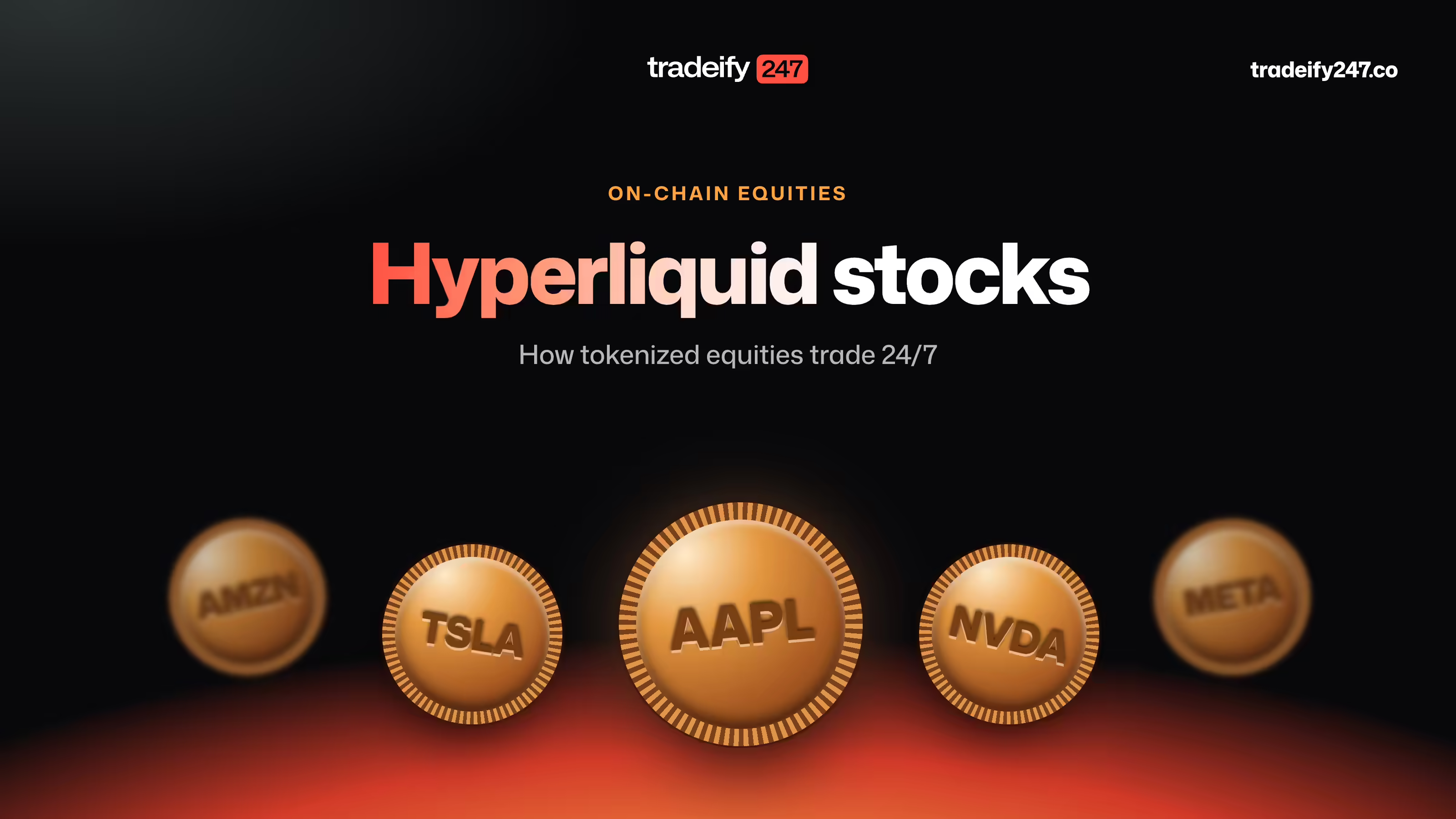
Hyperliquid Stocks and How Tokenized Equities Trade 24/7


.svg)

TL;DR: “Hyperliquid stocks” can refer to stock-linked perpetual contracts deployed through Hyperliquid’s HIP-3 framework or to backed tokenized stocks moved onto HyperEVM. They are not automatically the same product. A perpetual provides synthetic price exposure and uses an oracle, mark price, margin, and funding payments. A backed token can carry contractual rights against an issuer or collateral structure, but its trading, transfer, mint, and redemption hours may differ. Some stock-linked perpetual markets can trade through nights and weekends, while backed tokenized shares may transfer continuously but rely on weekday liquidity for minting or redemption. Check the instrument, issuer, deployer, oracle, funding, market hours, eligibility, and ownership terms before trading.
A company reports bad news on Saturday. Its Nasdaq-listed shares are closed, but a stock-linked market on Hyperliquid is moving.
That price can be useful. It is also easy to misunderstand.
The position may be a perpetual contract tracking the company rather than a share or share-backed token. It may stay executable for the full weekend even though the cash stock has no live opening auction, no active primary-market order book, and no official closing reference until Monday.
The first job is to identify the product. The second is to understand how that product stays open.
What Hyperliquid Stocks Means
Hyperliquid is an onchain trading ecosystem, not a public company whose common stock trades under the name “Hyperliquid.” HYPE is a crypto asset, not equity in the operator.
When traders search for Hyperliquid stocks, they are usually looking for one of two products.
Stock-Linked Perpetual Contracts
The first is a perpetual derivative tied to a company, equity index, commodity, or other reference. Hyperliquid’s HIP-3 documentation lets qualified builders deploy perpetual markets with their own market definitions, oracle rules, contract specifications, margin settings, and operating responsibilities.
A trader in an Apple-linked perpetual does not receive Apple shares. The position is a contract whose profit or loss changes with the quoted market. It has no expiration date, and funding helps keep its price connected to the reference.
Backed Tokenized Stocks on HyperEVM
The second product is a tokenized stock issued outside the perpetual market and transferred onto HyperEVM. Ondo says selected Ondo Stocks can be bridged to HyperEVM, including NVDAon, TSLAon, and GOOGLon.
Ondo describes those tokens as backed by corresponding stocks or ETFs. Its current product page says minting and redemption are generally available 24 hours a day, five days a week, while tokens can remain transferable outside those windows. Availability is restricted by location, account eligibility, corporate actions, market conditions, and other controls.
That structure differs from a stock-linked perpetual. The backed token has issuer and collateral terms. The perpetual has a derivatives contract, deployer, oracle, funding process, and liquidation rules.
How HIP-3 Stock Perpetuals Work
HIP-3 opens Hyperliquid’s perpetual infrastructure to builder-deployed markets. The deployer defines the market and remains responsible for its operation.
That responsibility includes:
- defining the reference asset and contract;
- publishing or managing the oracle price;
- selecting margin limits;
- setting open-interest caps;
- adjusting funding parameters within protocol rules;
- halting or settling the market when required.
Each deployed market can have independent order books, margining, and settings. The Hyperliquid protocol provides the trading and clearing infrastructure, but the deployer’s choices still matter.
For a stock-linked perpetual, the oracle is the bridge between the contract and the referenced equity. The oracle may use cash-market prices, related venues, model inputs, or a defined fallback when the primary stock market is closed. A trader should not assume that every HIP-3 market uses the same method.
The mark price has a different job. Hyperliquid’s price-index documentation explains that mark prices are used for margin calculations, unrealized profit and loss, liquidations, and stop triggers. The last traded price on the chart may therefore differ from the price controlling account risk.
Why Tokenized Equities Can Trade 24/7
Ordinary U.S. shares depend on exchange sessions. AAPL, TSLA, and NVDA stop trading on their primary exchanges after defined weekday sessions, aside from broker-supported extended hours.
A perpetual contract does not need the cash exchange to accept each order. Its own order book can remain open as long as the operator provides an oracle, risk controls, collateral accounting, and willing counterparties.
This gives stock-linked perpetuals several practical features:
- positions can be opened or closed outside New York hours;
- traders in other time zones can act during their normal day;
- weekend news can produce a price before the cash stock reopens;
- an open position does not need a monthly contract roll;
- the same market can support long and short exposure.
Continuous execution does not create continuous cash-stock liquidity. It creates a separate market that traders expect to reconnect with the underlying stock when the main venue reopens.
Backed tokenized stocks work differently. Tokens can move between wallets at any time the blockchain is operating, but issuance and redemption may still depend on broker, custodian, and stock-market processes. A “24/7 transferable” token is not automatically a “24/7 redeemable at the live cash-share price” product.
How Funding Keeps a Perpetual Near Its Reference
A perpetual has no expiry date forcing its price toward a final settlement value. Funding provides the recurring incentive.
Hyperliquid’s funding documentation says funding transfers value between long and short holders. When a perpetual trades above its reference, longs typically pay shorts. When it trades below, shorts typically pay longs. On Hyperliquid’s main perpetual market, funding is paid hourly, though HIP-3 deployers can apply market-specific settings within the permitted framework.
Funding is not a fixed trading fee. It can change direction and size. A position that is profitable on price can still lose part of that gain through repeated funding payments.
For stock-linked markets, the funding process deserves extra attention outside cash hours. If the equity reference is stale or based on a fallback method, the perpetual can trade at a wider premium or discount. The funding charge may increase as the market tries to pull that price back toward its reference.
What Happens While the Stock Market Is Closed
Weekend price discovery comes from the tokenized market’s own participants. Company news, sector moves, index products, options expectations, and correlated assets can all affect bids and offers.
The result is a forecast, not an official Monday opening print.
A thin Saturday book may move sharply on a small order. Market makers may quote wider spreads because they cannot hedge immediately in the cash share. The oracle may update differently from the cash session. When Nasdaq reopens, the stock can gap toward the perpetual, away from it, or through it.
If the weekend thesis depends on Monday convergence, define what would disprove it. A trader needs a price invalidation, a maximum loss, a time limit, and enough room for a poor fill.
Hyperliquid Stock Products Compared
Feature | Stock-linked perpetual | Backed tokenized stock | Ordinary share |
|---|---|---|---|
What it is | Derivative tracking a reference | Token issued under collateral and redemption terms | Equity ownership recorded through the securities system |
Expiration | None | None while the token remains valid | None |
Weekend activity | Can trade if its order book remains open | Transfers may continue; trading and redemption hours vary | Primary exchanges are closed |
Price anchor | Oracle, mark price, order book, and funding | Underlying share, issuance, redemption, and secondary trading | Exchange order flow |
Shareholder rights | None | Depends on issuer documents | Voting, dividends, and other rights based on share class |
Main extra risk | Funding, liquidation, oracle, deployer, and venue risk | Issuer, custodian, smart-contract, liquidity, and redemption risk | Broker, market, and company risk |
The U.S. Securities and Exchange Commission’s tokenized-securities guide separates issuer-sponsored, custodial, and synthetic models. The product name alone cannot tell a trader which rights apply.
Direct Trading and Simulated Funded Exposure
Direct Hyperliquid use can involve an onchain account, collateral, and positions recorded by the protocol. A wallet user is responsible for access, collateral, transaction approvals, and venue eligibility.
A funded trading program is a separate arrangement. Tradeify 247 provides simulated funded exposure to crypto and tokenized stocks, with tokenized stock prices sourced from Hyperliquid. The trader operates under the program agreement instead of depositing funds into a personal Hyperliquid wallet. Hyperliquid’s perpetual funding mechanics are not passed through: Tradeify 247 charges no funding rate, swap, overnight fee, or holding cost. Its only trading cost is a 0.04% commission on notional at entry and exit.
Tradeify 247’s Terms of Use describe notional capital and simulated execution. They also state that tokenized equity instruments are synthetic price references rather than shares and do not provide ownership, dividends, voting rights, or custody of the underlying asset.
That distinction changes what the trader should monitor. A direct user focuses on wallet security, collateral, and protocol positions. A funded trader focuses on the platform feed, program loss limits, eligible instruments, trading hours, and payout conditions. Neither should describe a synthetic position as owned stock.
Risks to Check Before Trading Hyperliquid Stocks
Product and Ownership Risk
Read the contract and issuer terms. Confirm whether the position is a perpetual, a backed token, or a simulated reference. Then list the rights it does and does not provide.
Oracle and Mark-Price Risk
Find the oracle method, mark-price method, and fallback used when the underlying market is closed. A chart’s last trade may not be the liquidation price.
Funding and Holding Cost
Check the current rate and the payment interval. Estimate the cost if the trade lasts one day, one weekend, and one week. Recalculate when the rate changes.
Liquidity and Slippage
Compare the spread and visible depth during the cash session, overnight, and on weekends. Reduce size when the exit would move the book.
Liquidation and Loss-Limit Risk
Know the price that would liquidate a direct position or breach a funded-account limit. Leave space for spread expansion and a fill beyond the stop.
Deployer and Venue Risk
HIP-3 markets are builder-deployed. Review the deployer, collateral, open-interest cap, oracle updates, and halt history rather than treating every market as identical.
Eligibility Risk
Tokenized securities and derivatives can have location and account restrictions. Confirm current eligibility with the venue or program before funding or trading an account.
Decide Whether a Hyperliquid Stock Product Fits
Use a stock-linked perpetual when the setup needs continuous synthetic exposure, accepts funding and liquidation mechanics, and does not require ownership.
Use a backed tokenized stock when the issuer terms, collateral structure, redemption rights, transfer rules, and eligibility match the goal. Use an ordinary share when shareholder rights and conventional brokerage custody matter more than weekend access.
Before the first order, write down six facts: product type, ownership rights, live market hours, oracle, funding interval, and maximum loss. If one is unclear, the instrument is not ready to trade.
Hyperliquid Stocks Questions
Can I Buy Hyperliquid Stock
Hyperliquid is not a publicly traded company with common stock available under that name. HYPE is a crypto asset. Stock-linked markets on Hyperliquid are separate instruments tied to other companies or indices.
Are Hyperliquid Stocks Real Shares
Not necessarily. HIP-3 equity perpetuals are derivatives. Backed tokenized stocks on HyperEVM can have contractual claims and collateral, but their precise rights come from the issuer documents.
Can Tokenized Equities Trade on Saturday
Some stock-linked perpetuals can remain executable on Saturday. A backed token may remain transferable while minting, redemption, or secondary trading follows a narrower schedule.
Do Hyperliquid Stock Perpetuals Pay Dividends
They do not make the trader a shareholder. A market may incorporate expected corporate actions into its reference or contract rules, but any adjustment must be verified in that market’s specifications.

Keep Reading
See all
Are Tokenized Stocks Safe and What Risks to Check First
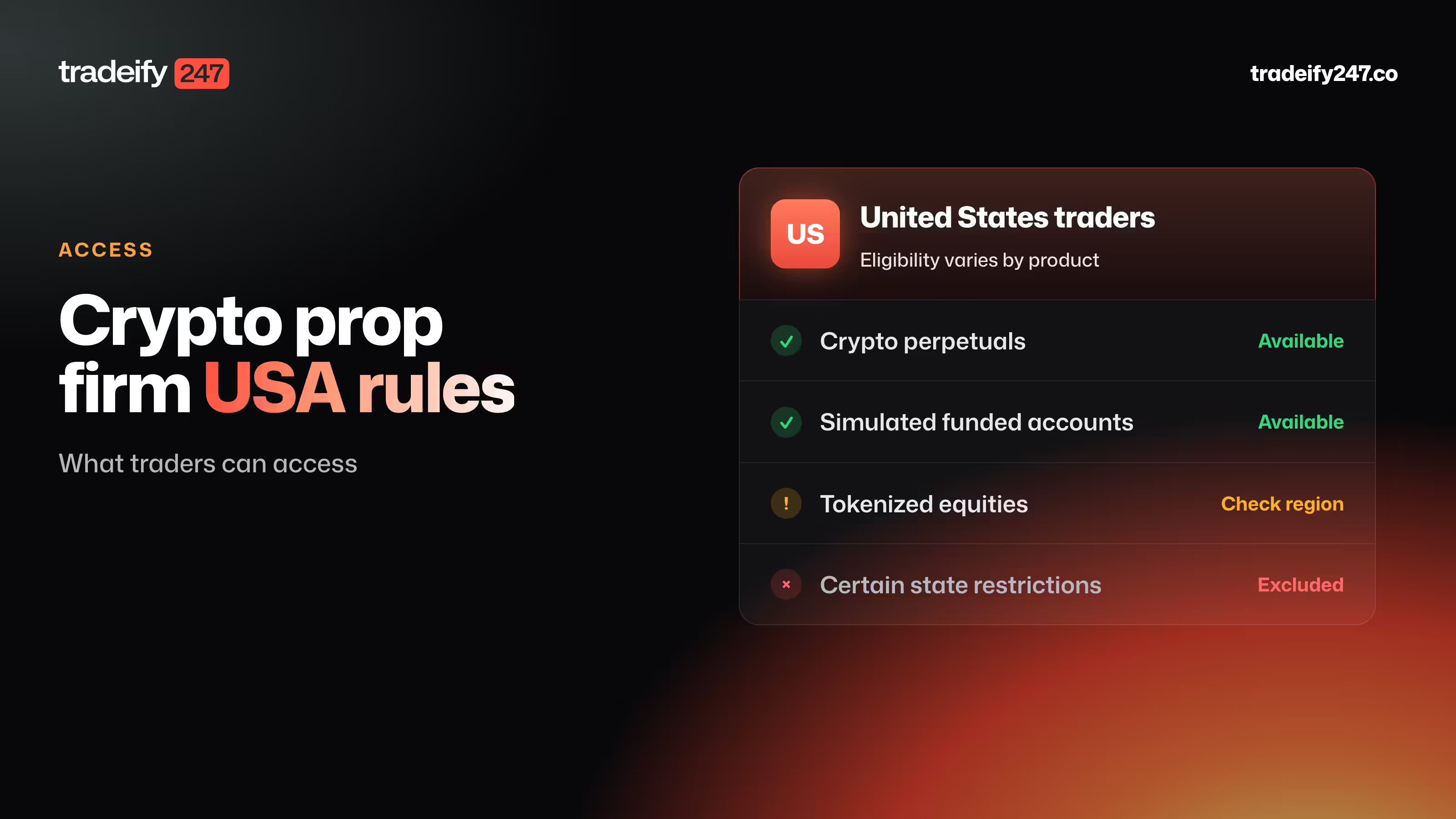
Crypto Prop Firm USA Rules and What Traders Can Access