

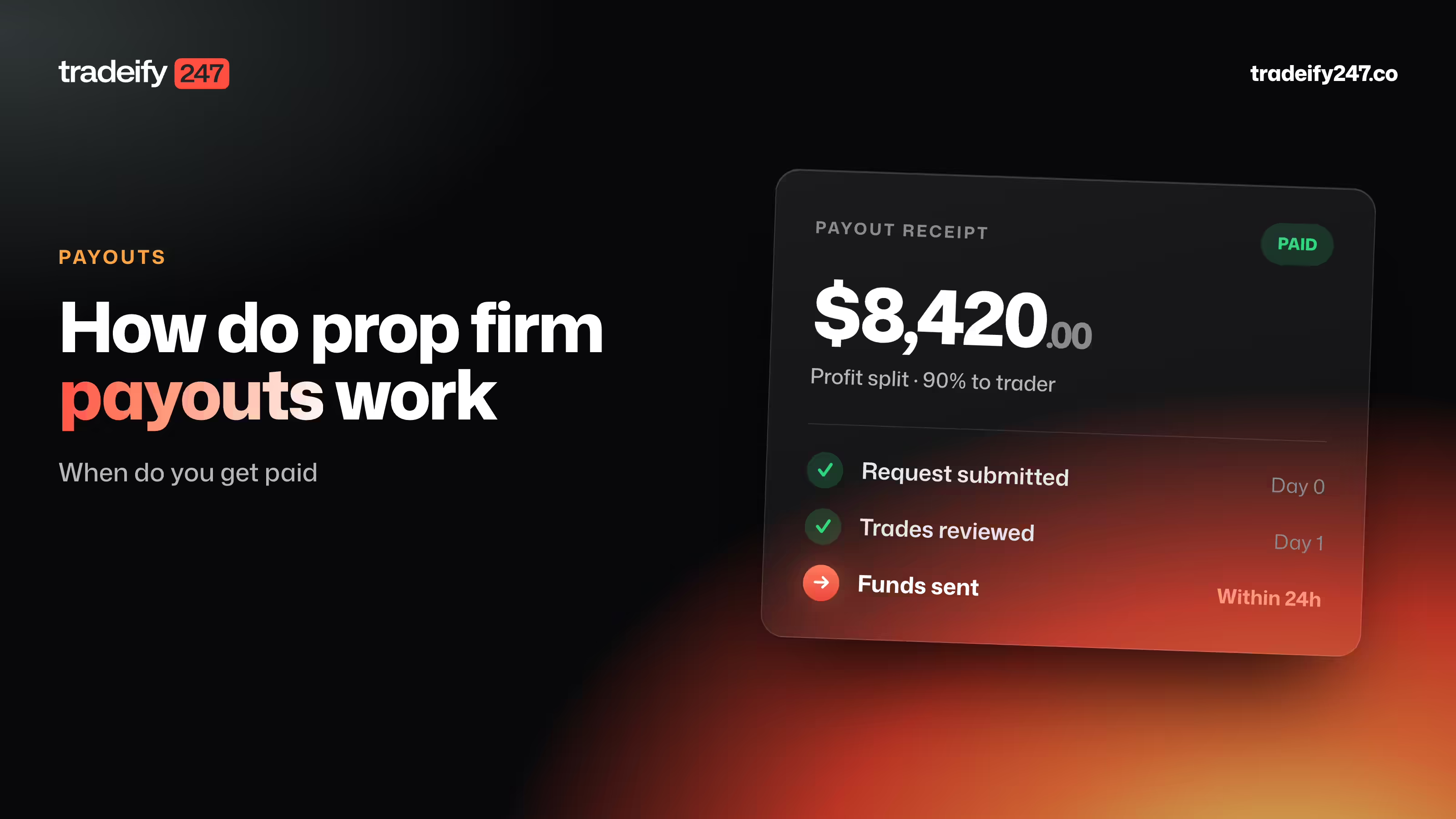
How Do Prop Firm Payouts Work and When Do You Get Paid


.svg)

TL;DR: A profitable funded account does not automatically create a payable balance. You normally have to reach the firm's first-payout date, satisfy its trading-day and consistency rules, close any required positions, complete identity checks, and submit a request without breaching a loss limit. The firm then reviews the account, applies the profit split, and sends the approved amount by bank transfer, card rail, e-wallet, or crypto. Read the payout policy together with the drawdown rules, because a withdrawal can reduce the cushion left in the account.
A green profit number feels like the finish line. In prop trading, it is only one part of the payout test.
The practical question is not just, "Did I make money?" It is, "How much of that profit is eligible, on what date, and what happens to the account after I withdraw it?" Those details determine whether a $3,000 gain becomes a prompt payment, a smaller approved amount, or a request that has to wait.
How Prop Firm Payouts Work
Most prop firm payouts follow the same broad sequence, although the exact gates differ by program.
- Reach a payout-eligible account. Evaluation-stage profits usually are not withdrawable. The trader first has to pass the challenge or start an instant-funding program that permits payouts.
- Create eligible profit. The account must be above its starting balance or other stated reference level. A firm may also require a minimum amount of profit.
- Complete the waiting period. Some firms count calendar days from the first trade. Others require a number of profitable days, trading days, or full payout cycles.
- Clear the rule checks. Daily loss, maximum loss, consistency, prohibited-strategy, and position-status rules can all affect eligibility.
- Request the payout. This may happen in a dashboard or through support. Identity verification and payment details normally have to be complete.
- Wait for review and settlement. The firm reviews the account, applies the profit split and any stated charges, then sends the approved amount through the selected method.
One distinction matters from the start: many retail prop programs use simulated accounts. FTMO says its accounts use fictitious capital and clients do not place real market orders through the demo account, even though compliant traders can receive real financial rewards. The agreement, not an ownership claim over the account balance, defines what can be paid.
How the Profit Split Determines Your Payout
The profit split is the percentage of eligible profit allocated to the trader. It is not a percentage of the account's headline size.
Consider a hypothetical $100,000 account with $4,000 in eligible profit:
Calculation | Amount |
|---|---|
Starting account balance | $100,000 |
Balance before payout | $104,000 |
Eligible profit | $4,000 |
Trader share at an 80% split | $3,200 |
Firm share at a 20% split | $800 |
If the trader requests less than the maximum, the account may retain a profit buffer. If the trader requests the full eligible share, the post-payout balance and remaining loss cushion depend on the firm's accounting rules.
That second point is easy to miss. A firm may calculate drawdown from the starting balance, the highest balance, current equity, or another threshold. Withdrawing profit can therefore leave less room for the next losing trade even when the payout itself is approved.
Before submitting a request, separate gross closed profit, profit eligible under the current cycle's rules, and the trader's share after the split and fees. An advertised 90% split can still produce no current payout if the first-payout clock has not expired or a consistency condition remains unmet.
When Do Prop Firms Pay Traders
There is no single industry payout date. Programs tend to use one of three schedules.
Payout schedule | How it works | Main detail to verify |
|---|---|---|
Fixed cycle | Requests open weekly, every two weeks, or monthly | Whether the clock starts at activation or first trade |
First-payout gate, then recurring | The initial request has a longer wait; later requests come sooner | Whether a withdrawal restarts the cycle |
On demand | Requests can be made after all eligibility conditions are met | Minimum profitable days, minimum amount, and review time |
"On demand" does not always mean same day. It can mean there is no fixed calendar window after the other gates are cleared. Review time, weekends, payment-provider processing, and compliance checks still apply.
FTMO provides a concrete example of how a first request can work. Its official payout FAQ says a trader can request a reward from 14 days after the first trade, provided there are no open positions or pending orders. FTMO says review takes one to two business days and, after invoice confirmation, payment is generally sent within another one to two business days. Those are FTMO's current terms, not a timetable to assume at another firm.
The usable timeline is eligibility date + internal review + payment settlement. A 24-hour review promise may still take longer to reach a bank account. A crypto transfer may settle quickly after broadcast, but a wrong network or wallet address creates a potentially irreversible problem.
What Makes a Trader Eligible for a Payout
Read payout eligibility as a checklist, not a single profit target. Common conditions include:
- Account stage: evaluation profits may be excluded until the trader advances to a payout-eligible account.
- Minimum time: a set number of calendar, trading, or profitable days may be required.
- Minimum profit: the request may have to exceed a dollar threshold after the split.
- Consistency: one day's gain may not be allowed to represent too much of the total. FTMO, for example, publishes a Best Day Rule for its 1-Step program that affects reward eligibility.
- Closed risk: firms may require all positions and pending orders to be closed before review.
- Rule compliance: a daily or maximum loss breach can end eligibility even if the balance later appears positive.
- Identity and payment checks: KYC, an invoice, or ownership of the receiving account may be required.
- No prohibited conduct: copied trades, account sharing, latency abuse, coordinated hedging, or other listed practices can trigger review.
The definitions matter. Tradeify 247 evaluation profit does not carry into a funded account or become payable; funded accounts begin at the base balance. Before a first payout, 1-Step and 2-Step require three profitable days, each with at least 0.5% of account size fully closed that day. Instant Funding has no fixed day count but applies a 20% consistency score to realized profit for payout timing. The 3-Step promotion uses a 14-day cycle beginning with the first funded trade. Requests start at $100 with no maximum, require a flat account, and pay an 80/20 split or 95/5 when the add-on was purchased. A breach forfeits profit remaining in the account, and accounts cannot be reset. Identity verification uses Sumsub and a separate Rise verification before the first payout.
Why Payouts Get Delayed or Denied
Most payout problems fall into a few categories.
The request was premature. The dashboard is profitable, but the first-payout date or required profitable-day count has not been reached.
There is open exposure. Positions or pending orders remain active when the policy requires a flat account.
The account breached a risk rule. Equity may have crossed a daily or maximum loss threshold intraday even if the trade later recovered.
The strategy needs review. A pattern may resemble a prohibited practice or trade copying, producing a manual review rather than an automatic payment.
Verification is incomplete. The legal name, identity document, bank account, or wallet details do not match.
Settlement is delayed. Weekends, banking holidays, payment-provider checks, or blockchain congestion can add time after approval.
Ask support for the rule and account record behind a denial. A specific answer such as a timestamped daily-loss breach is testable. A vague refusal with no policy reference is a warning sign.
How a Payout Changes Drawdown and Account Balance
A payout should be planned as a risk event, not only a cash-flow event.
Suppose the account has a $100,000 starting balance, $4,000 of closed profit, and a loss floor that remains at $95,000. Keeping some profit in the account leaves more distance to that floor. Withdrawing the maximum may move the balance closer to the starting level and remove part of that cushion.
The answer changes if the loss threshold trails the highest balance or equity. In that case, the limit might ratchet upward while profits build, then stay elevated after a withdrawal. The account can look healthy while the actual room to lose has narrowed.
Before a payout, write down:
- the balance and equity used for the loss calculation;
- the daily-loss reset time and inputs;
- the maximum-loss floor before and after withdrawal;
- whether the payout amount itself is deducted from balance, equity, or both;
- whether retained profit remains available as a buffer.
Tradeify 247’s Payout Lock makes this concrete. On 1-Step Funded, Instant Funding, and legacy APE-X, the first payout request permanently raises the maximum-loss floor from 6% below starting balance to the starting balance itself. A small first payout triggers the same lock as a large one, so retaining profit as a buffer and timing the first request deliberately matter. The 2-Step Funded account is the exception: it has no payout lock, and its floor remains 6% below starting balance after a payout.
Payment Methods, Fees, and Records
Tradeify 247 uses Rise for bank transfers and more than 100 crypto assets, or Confirmo for USDC on Ethereum. Approved payments typically arrive within one to two business days. Payment options depend on country, amount, and compliance checks.
Method-specific details change the net result. Bank transfers can involve intermediary charges, card rails can impose amount limits, currency conversion can add cost, and crypto payments require the correct asset and network. The firm's processing time is separate from the provider's settlement time.
FTMO, for instance, currently lists bank wire, selected card-transfer rails, Skrill, and crypto, with different minimums and limits in its withdrawal instructions. Its crypto withdrawal guide also tells traders to verify the wallet and network because transfers cannot simply be reversed.
Keep the account agreement, payout approval, invoice if applicable, transaction record, challenge fee receipt, and currency-conversion record. These records make it easier to reconcile the amount approved by the firm with the amount that reached the receiving account or wallet.
What On-Chain Payout Verification Can Show
When a firm pays in crypto and publishes a transaction hash, a block explorer can confirm the network, transaction time, sending and receiving addresses, asset, amount, and confirmation status. This gives the recipient an independent way to check that a stated transfer occurred.
It does not prove that every trader was paid, that the firm's rules are fair, or that the sender holds enough assets to satisfy all future requests. An address label can also be incomplete or mistaken. Treat on-chain evidence as one verifiable payment record, not a full audit of the business.
If using it, match the transaction hash to the correct network and compare the asset, amount, time, and destination address with the payout approval. Never rely on a screenshot when the underlying transaction can be checked directly.
A Prop Firm Payout Checklist
Run this list before the final trade of a payout cycle:
- confirm the first eligible request date in the exact program rules;
- calculate closed profit and the expected amount after the split;
- verify minimum trading or profitable days;
- test any consistency or best-day condition;
- check daily and maximum loss from the firm's reset time;
- close positions and cancel orders if required;
- save the trading statement and rule page;
- complete KYC and confirm the legal name on the payment method;
- verify fees, currency, wallet asset, and network;
- model the account's balance and drawdown after withdrawal;
- record the request time and stated review window.
The best time to learn a payout rule is before trading for the cycle, not after a large winning day makes it relevant.
Frequently Asked Questions
Is the profit split based on the full account size?
No. It is generally applied to eligible profit. An 80% split on $4,000 of eligible profit is $3,200, not 80% of a $100,000 account label.
How fast can a prop firm payout arrive?
The total time includes the eligibility wait, account review, and payment settlement. "On demand" can remove a fixed schedule, but it does not remove other gates or processing time.
Can a rule breach cancel a payout?
Yes, if the agreement makes continued compliance a condition of eligibility. A breach may be measured on intraday equity, so a later recovery does not necessarily restore the account.
Plan the Payout Before You Trade for It
Start with the payout date, then work backward. Mark the profitable-day requirement, consistency ceiling, loss limits, required flat time, expected split, and post-withdrawal cushion before the cycle begins.
That turns a payout from a dashboard action into a controlled process. The trade creates profit, the rules determine eligibility, and the withdrawal plan determines how much risk capacity remains.

Keep Reading
See all
Are Tokenized Stocks Safe and What Risks to Check First
Crypto Prop Firm USA Rules and What Traders Can Access