

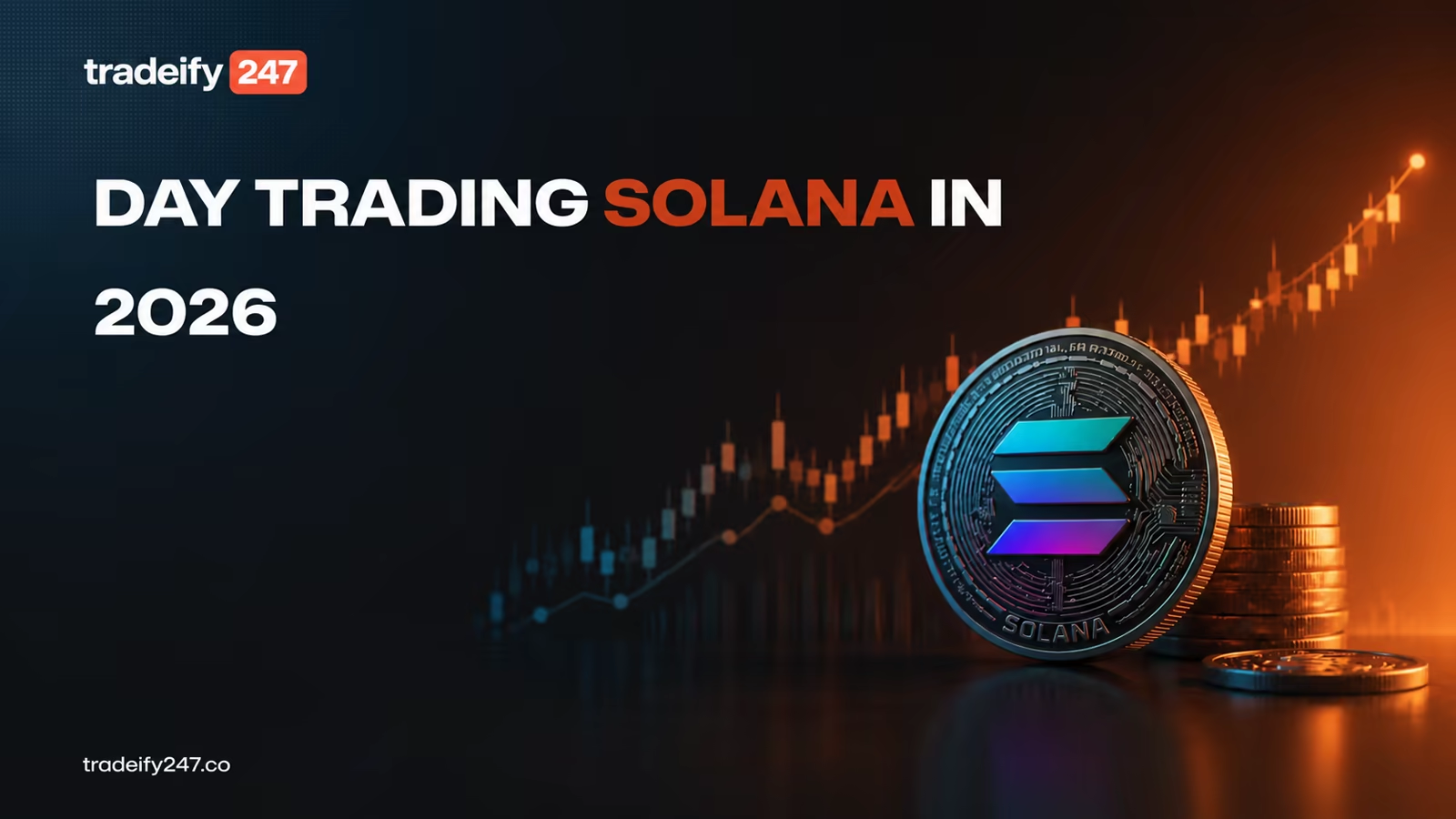
Day Trading Solana (SOL) in 2026


.svg)

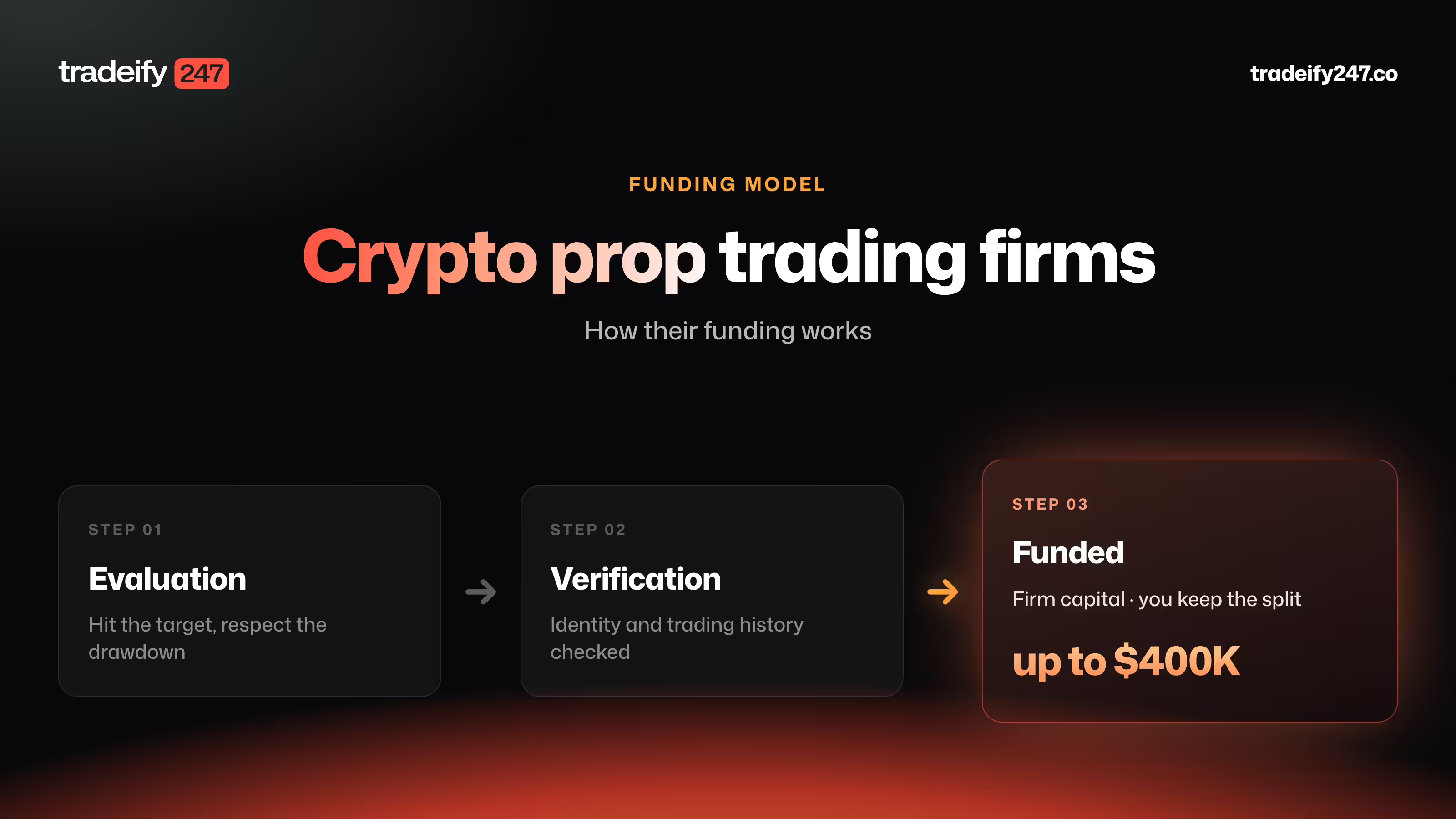
Day trading Solana in 2026 means operating on a network that processed $1.1 trillion in Q1 economic activity, 25.3 billion transactions, and $95 billion in February DEX volume. This guide covers the core tools (Phantom, Jupiter, BullX, Cryptohopper), technical indicators (RSI, MACD, Bollinger Bands, OBV), and risk rules for trading SOL on Tradeify247, with a 3% daily drawdown, 6% max drawdown (Static or EOD trailing), 80% profit split, and up to $600K in funded capital.
The digital asset market in 2026 has undergone a major structural shift, defined by the rise of high-performance blockchains as the foundation for what is now called the "Internet Capital Market." At the forefront of this evolution is Solana (SOL), a network that has matured from a retail-focused high-throughput chain into a sophisticated ecosystem capable of supporting institutional-grade financial products, tokenized real-world assets (RWAs), and complex decentralized trading strategies. In the first quarter of 2026, the Solana network achieved a historic milestone, processing over $1.1 trillion in total economic activity, a staggering 6,558.6% increase over the previous quarter. This surge in onchain engagement, fueled by sub-second finality and the lowest transaction costs in the industry, has established Solana as the premier venue for professional day traders seeking to capitalize on intraday volatility.
What Is Crypto Day Trading on Solana
Day trading within the cryptocurrency space refers to the practice of executing multiple buy and sell transactions within a single 24-hour window, with the objective of generating profit from short-term price fluctuations. Unlike traditional equity markets, which are constrained by rigid trading hours and centralized clearing cycles, the crypto market operates around the clock, requiring traders to manage risk and execute strategies across a 24/7 global liquidity pool. This constant state of activity, while offering more opportunities, demands a heightened level of discipline and a robust technical infrastructure to manage the psychological and operational stresses of a market that never closes.
On the Solana network, day trading has evolved to encompass a wide array of asset classes beyond standard cryptocurrencies. The integration of tokenized private equity, known as "PreStocks," and bullion-backed instruments like tokenized gold (XAUm) has expanded the toolkit available to intraday participants. The ability to move capital across these diverse segments with near-instant settlement allows for high-velocity strategies that were previously impractical on higher-latency networks like Ethereum.
Solana's Ecosystem and Market Presence for Day Traders
The Solana ecosystem's market presence in 2026 is defined by its dominance in actual blockchain utilization rather than speculative valuation alone. Analytics indicate that Solana supports over $15 billion in stablecoin assets and processes billions in daily decentralized exchange (DEX) volume. In contrast, competing networks like Cardano host significantly lower volumes, underscoring where genuine economic activity is concentrated. This concentration of liquidity is a critical factor for day traders, as it ensures that even large trades can be executed with minimal slippage, maintaining the profitability of strategies that rely on capturing small basis point movements.
Solana's infrastructure has been hardened to support this massive influx of capital. The network's 2026 technical roadmap, which includes upgrades like Alpenglow and Firedancer, focuses on "predictable finality" and "execution integrity," traits that are essential for institutional-grade trading desks. These upgrades aim to reduce transaction finalization times to as low as 100 to 150 milliseconds, effectively narrowing the gap between blockchain settlement and the speeds found on traditional electronic exchanges like the Nasdaq.
Solana Q1 2026 Network Metrics at a Glance
Total economic activity. $1.1 trillion in Q1 2026, a 6,558.6% QoQ increase.
Total transactions. 25.3 billion, the highest of any major network.
DEX volume (Feb 2026). $95 billion, #1 across all chains.
Stablecoin supply. $17 billion, diversifying beyond USDC and USDT.
RWA market cap. $2.0 billion with a record 182,000 holders.
Day Trading vs Swing Trading vs Spot Trading on Solana
To trade the Solana ecosystem effectively, a trader must distinguish between the various modes of engagement, as each requires a different risk profile and timeframe.
Day trading focuses on capturing price action within the smallest timeframes, often using 15-minute, 1-hour, or 4-hour charts. The goal is to close all positions within a defined trading window. In traditional futures markets, this window is set by exchange hours, but in crypto the market operates 24/7, so day traders typically define their own session boundaries and use a fixed daily reset time to evaluate performance. This self-imposed discipline mitigates the risk of overtrading and allows for the compounding of daily gains.
Swing trading, by contrast, involves holding positions for several days or weeks to profit from larger market cycles or anticipated news catalysts, such as the full release of the Firedancer validator client. While swing trading captures broader moves, it exposes the trader to "liveness risk" and gap risk during periods of high volatility or potential network congestion.
Spot trading refers to the purchase of the actual underlying asset (e.g., buying SOL on a DEX) rather than a derivative. This is the most direct way to gain exposure to the ecosystem's growth. In the context of day trading, spot markets on Solana (particularly for high-liquidity assets like SOL or tokenized pre-IPO stocks) offer the most transparent way to execute high-frequency strategies without the complexity of margin or liquidation risk.
Tools and Infrastructure for Day Trading Solana
Operating at "Solana speed" requires a specialized stack of tools designed to minimize latency and provide the earliest possible signal of market shifts. Professional traders emphasize that in an environment where block times are 400 milliseconds, being one or two slots late can be the difference between a profitable trade and a loss.
Choosing a Reliable Exchange for Solana Day Trading
A Solana day trader's first step is selecting a centralized exchange (CEX) for initial funding and regulatory compliance. The necessity of Know Your Customer (KYC) and Anti-Money Laundering (AML) protocols is absolute for any trader intending to operate within the legal frameworks of major financial centers. Regulated platforms provide the "institutional-grade liquidity" and security that allow traders to move significant amounts of capital. When selecting an exchange, traders should evaluate not just the fees but also the speed of withdrawal processing and the reliability of their API endpoints, as these factors determine how quickly one can move capital onchain during high-opportunity events.
Wallets and DEXs for Solana Day Trading (Phantom, Jupiter, Raydium)
Once funds are moved onchain, the trader's primary interface is the non-custodial wallet and the decentralized exchange aggregator.
The Phantom Wallet has established itself as the standard for Solana users, offering a seamless interface for managing SOL, SPL tokens, and NFTs. The workflow for many professional traders involves transferring SOL from a CEX to Phantom to ensure full control over their private keys, a practice that mitigates the custody risks inherent in centralized platforms.
For execution, Jupiter (JUP) serves as the critical routing layer. By aggregating liquidity from across the entire Solana ecosystem, Jupiter ensures that traders receive the best price for their swaps with the lowest possible slippage. Raydium, one of the primary liquidity sources for Jupiter, remains the preferred venue for trading new launches and established pairs, including tokenized assets like gold.
Advanced Solana Day Trading Platforms (BullX, Cryptohopper)
For traders requiring more than just basic swapping, advanced platforms like BullX have transformed the Solana trading experience. BullX is a decentralized trading terminal and Telegram bot designed for high-frequency operations, providing rapid indexing and real-time market data that traditional web interfaces often lack.
BullX features include:
MEV protection. Protects traders from frontrunning and "sandwich attacks" that can erode profits during high-volume periods.
Instant token swaps. Uses Solana's low latency for near-instant confirmations.
Multi-wallet management. Allows traders to track and manage multiple portfolios across different strategies through a single interface.
For those looking to automate their strategies, Cryptohopper offers sophisticated bot tools. Their "Market Maker" bot can continuously trade the spread of a cryptocurrency pair, capturing small profits by placing buy and sell orders at specific depths in the order book. This type of high-frequency trading (HFT) is particularly effective on Solana due to the network's ultra-low transaction fees, which make dozens of small trades profitable.
Core Solana Day Trading Stack
Phantom Wallet. Asset management. Non-custodial security and broad dApp support.
Jupiter (JUP). Liquidity aggregation. Optimal price routing and slippage reduction.
BullX. Trading terminal and bot. Fastest indexing and MEV protection.
Cryptohopper. Strategy automation. 24/7 execution and market-making capabilities.
Solscan and Solana explorers. Transaction tracking. Verification of onchain status and fee analysis.

Trade Crypto Without Limits
Tradeify is built for crypto traders who want clarity, consistency, and speed — not surprises.


Technical Analysis and Indicators for Day Trading Solana
Technical analysis (TA) remains the backbone of day trading. By analyzing historical price and volume data, traders can make data-driven decisions about entry and exit points. On Solana, TA is enhanced by the transparency of the onchain order book, which allows traders to see exactly where "smart money" is positioning itself.
Indicators are generally categorized into four types: trending, volatility, momentum, and volume indicators.
RSI and Moving Averages for Solana Day Trading
The Relative Strength Index (RSI) is an oscillator that measures the speed and change of price movements, typically plotted between 0 and 100. An RSI reading above 70 indicates that the asset is "overbought" and may be due for a correction, while a reading below 30 suggests it is "oversold." Professional Solana traders often look for "bullish divergence" on the RSI (where price makes a new low but the RSI makes a higher low) as a leading indicator of a potential trend reversal.
Moving Averages (MA) are lagging indicators that smooth out price action to reveal a clear directional bias.
Simple Moving Average (SMA). The mean average price over a specific number of periods. For example, a 50-day SMA is the sum of the closing prices over the last 50 periods divided by 50.
Exponential Moving Average (EMA). This variation gives more weight to recent price action, making it more reactive to sudden moves, a crucial feature in the volatile Solana markets.
MACD and Volume Analysis for Solana Day Traders
The Moving Average Convergence Divergence (MACD) highlights momentum strength and trend reversals by showing the relationship between two EMAs (typically the 12-period and 26-period). A bullish signal is generated when the MACD line crosses above the signal line, while a bearish signal occurs when it crosses below. On Solana, where trends can develop and reverse rapidly, the MACD histogram's rate of change is often a better predictor of momentum exhaustion than the crossover itself.
The conversation happens live
Blog comments are too slow for crypto. Join 12,000+ traders in our Discord to discuss this article, share charts, and debate the market in real-time.
Join Discord
Market Sentiment and Ecosystem Impact on Solana Day Trading
Market sentiment on Solana is driven by a unique blend of high-level institutional news and "narrative-driven" retail activity.
How Onchain Asset Growth and Tokenized Gold Affect SOL Day Trading
The integration of Real-World Assets (RWAs) has become one of the most powerful growth catalysts on Solana in 2026. The launch of tokenized gold tokens like Matrixdock's XAUm provides traders with direct exposure to physical bullion meeting London Bullion Market Association (LBMA) standards.
The impact of XAUm and similar RWAs on the SOL price works through several channels:
Collateral utility. Traders can use tokenized gold as collateral in lending protocols like Kamino, borrowing stablecoins at competitive LTV ratios to fund intraday crypto trades without selling their gold positions.
Onchain reserve assets. Institutional central banks and allocators have begun diversifying away from fiat toward onchain gold, increasing the overall TVL (Total Value Locked) and stability of the Solana network.
Furthermore, the surge in "PreStocks" (tokenized pre-IPO names like OpenAI, accounting for 69% of segment volume, SpaceX at 12.6%, and Anduril at 9.1%) has created a new category of daily volatility that traders can exploit. Daily PreStocks volume surpassed $29 million in April 2026, demonstrating that Solana has become the preferred venue for trading private equity before it hits traditional markets.
Tracking Solana Foundation Launches and News for Day Trading
Breaking news on the Solana Foundation's "technical roadmap" can trigger immediate and significant price action.
Key upgrades planned or implemented in 2026 include:
Alpenglow. A consensus rewrite that improves block production stability and network resilience, reducing downtime risks that historically caused sharp SOL selloffs.
Firedancer. An independent validator client from Jump Crypto capable of processing over 1 million transactions per second, increasing network throughput by an order of magnitude.
For Tradeify247 traders, these are tradable catalysts. Pre-upgrade anticipation can drive SOL higher, while post-upgrade "sell the news" patterns offer short opportunities for disciplined traders.

Keep Reading
See all
Are Tokenized Stocks Safe and What Risks to Check First
Crypto Prop Firm USA Rules and What Traders Can Access