


Crypto Sector Rotation: How Funded Accounts Can Position Through the Cycle


.svg)

Crypto markets rotate between sectors in cycles that follow BTC's lead. Tradeify247's 100+ pair menu gives funded traders access to multiple sectors within a single account, making rotation strategies practical. Understanding the rotation sequence — BTC to L1s to DeFi to meme coins and back — helps traders position across the cycle rather than fighting it.
Crypto Sector Rotation: How Funded Accounts Can Position Through the Cycle
Crypto markets rotate between sectors in cycles that follow BTC's lead. When BTC consolidates, capital flows into altcoins — first L1s, then DeFi, then meme coins — and when BTC trends strongly, altcoins typically lag. Tradeify247 traders who understand rotation can position across sectors to capture the cycle rather than being stuck in one trade.
The pattern is visible enough that systematic traders use it as a core strategy. Tradeify247's 100+ crypto pair menu gives traders access to multiple sectors within a single funded account, which makes rotation strategies practical without violating position concentration rules. Understanding the rotation sequence and timing is what separates traders who ride the cycle from traders who fight it.
The Rotation Sequence
Capital typically flows from BTC into major L1s (ETH, SOL, BNB) first, then into mid-cap L1s and DeFi protocols, then into smaller altcoins and meme coins at the cycle peak. The sequence repeats in reverse during downturns — meme coins and small caps sell off first, then DeFi, then majors, then BTC.
Tradeify247 traders who recognize where they are in the rotation can size positions accordingly. Early in the cycle, larger positions in BTC and major L1s make sense. Late in the cycle, smaller positions in rotating sectors capture the move while limiting exposure to reversal risk.
How BTC Leads the Rotation
BTC's behavior sets the rotation pace. When BTC is in a strong uptrend, altcoins typically lag because capital stays concentrated in the leader. When BTC consolidates sideways or pulls back, altcoins gain relative strength as capital rotates out of BTC into higher-beta opportunities.
Tradeify247 traders running rotation strategies monitor BTC dominance and BTC price action as the primary signal. A break of BTC dominance higher suggests capital is flowing into BTC and out of alts; a break lower suggests the opposite. The signal isn't perfect but it's consistent enough to inform position sizing.
Sector-Specific Behavior Within Tradeify247
Tradeify247's pair menu covers majors, L1s, DeFi tokens, and selected meme coins. The available pairs determine which sectors you can rotate through. For traders running systematic rotation, the coverage is sufficient to capture most of the cycle, though some smaller altcoins and newer meme tokens won't be available.
The 100+ pair coverage means Tradeify247 traders can build diversified rotation portfolios without running into single-pair concentration issues. A typical rotation strategy might hold positions in 5-8 pairs simultaneously, sized according to each sector's stage in the cycle.
Timing Entries With Volume and Relative Strength
Rotation entries work best when confirmed by volume and relative strength shifts. A sector starting to rotate higher typically shows above-average volume on the breakout, with relative strength against BTC turning positive after being negative. Tradeify247 traders using these signals can enter early in the rotation without having to predict the catalyst.
The signals also help with exits. When relative strength against BTC starts to roll over and volume declines, the rotation is ending and it's time to reduce exposure. Tradeify247's DxTrade platform supports the conditional orders needed to manage rotation entries and exits systematically.
Position Sizing Across Sectors
Rotation strategies need flexible position sizing because each sector behaves differently at different stages of the cycle. Early-cycle positions in majors can be larger because volatility is moderate. Late-cycle positions in smaller sectors need to be smaller because volatility is higher and reversal risk is greater.
Tradeify247's risk rules apply uniformly, but the position sizing within those rules varies by sector. A 1% risk position in BTC during consolidation might be appropriate, while the same 1% risk in a small altcoin during rotation might be too aggressive given the higher volatility.

Trade Crypto Without Limits
Tradeify is built for crypto traders who want clarity, consistency, and speed — not surprises.


Rotation Strategy Variations
Tradeify247 traders can run rotation strategies in several ways. The simplest is to track BTC dominance and rotate between BTC and altcoin exposure based on the signal. More complex strategies use multiple rotation signals across sectors and timeframes to build a portfolio that adapts to changing market conditions.
For traders who prefer simpler approaches, a dual rotation between BTC and ETH works well as a foundation. Add L1s when the rotation extends, add DeFi when the rotation deepens, add meme exposure only at the cycle peak. The complexity scales with the trader's experience and the strategy's validation.
Risk Management for Rotation Strategies
Rotation strategies have higher turnover than single-pair strategies, which means more transaction costs and more exposure to execution risk. Tradeify247 traders running rotation need to account for both in their performance expectations. A rotation strategy that captures 60% of a cycle's move but pays 10% in costs is a different trade than the same strategy with lower turnover.
Drawdown management is also critical. Rotation strategies can experience rapid drawdowns when the rotation reverses unexpectedly. Tradeify247's 3% equity floor rule provides a buffer, but traders should still set position-level stops that limit individual trade loss to 0.5-1% of account balance.
When Rotation Strategies Fail
Rotation strategies work best in cyclical markets where capital flows predictably between sectors. They work less well during sustained trends where one sector dominates for an extended period, or during choppy markets where rotation signals flip frequently without producing sustained moves.
Tradeify247 traders running rotation need to recognize when the strategy's environment has changed. If rotation signals flip daily without producing profitable setups, the market regime has shifted and rotation strategies should be reduced or paused until conditions improve.
Correlation Patterns to Watch
Within Tradeify247's pair menu, correlations between sectors vary through the cycle. During risk-off periods, all crypto correlations tend to rise — everything sells off together. During risk-on periods, correlations within sectors rise while cross-sector correlations decline. Tradeify247 traders using diversification to manage risk need to monitor correlation patterns because diversification benefits shrink during high-correlation periods.
The practical implication: a 5-pair rotation portfolio might behave like a 1-pair portfolio during high-correlation selloffs. Adjust position sizing accordingly, and don't assume diversification is doing work when correlations are elevated.
Combining Rotation With Other Strategies
Rotation strategies work well combined with momentum or trend-following approaches on individual pairs. Tradeify247 traders can run rotation as the portfolio-level framework and momentum as the entry/exit signal within each position. The combination captures both the cycle direction and the individual pair's trend within the cycle.
The combination requires more monitoring than either strategy alone. Tradeify247 traders running both need to track the rotation signals, the individual pair signals, and the interaction between them. For experienced traders, the combination produces better results than either approach alone.
The conversation happens live
Blog comments are too slow for crypto. Join 12,000+ traders in our Discord to discuss this article, share charts, and debate the market in real-time.
Join Discord
Putting Rotation Into Practice on Tradeify247
Rotation is a workable strategy for Tradeify247 traders who want exposure to the crypto cycle without picking individual winners. The framework is consistent enough that systematic traders can build rules around it, and the firm's 100+ pair menu supports the diversification needed for rotation to work.
For traders new to rotation, start by tracking BTC dominance and ETH/BTC relative strength for a month before trading. Watch how the signals develop and how sectors respond. Once you understand the pattern in your observation period, apply it with smaller position sizes and scale up as you validate the approach.
Tradeify247's challenge environment is well-suited to testing rotation strategies because the firm provides the pair coverage and risk infrastructure without requiring personal capital. Run the rotation framework through an evaluation, track results, and decide whether the strategy fits your style before committing to a funded account.

Keep Reading
See all
Are Tokenized Stocks Safe and What Risks to Check First
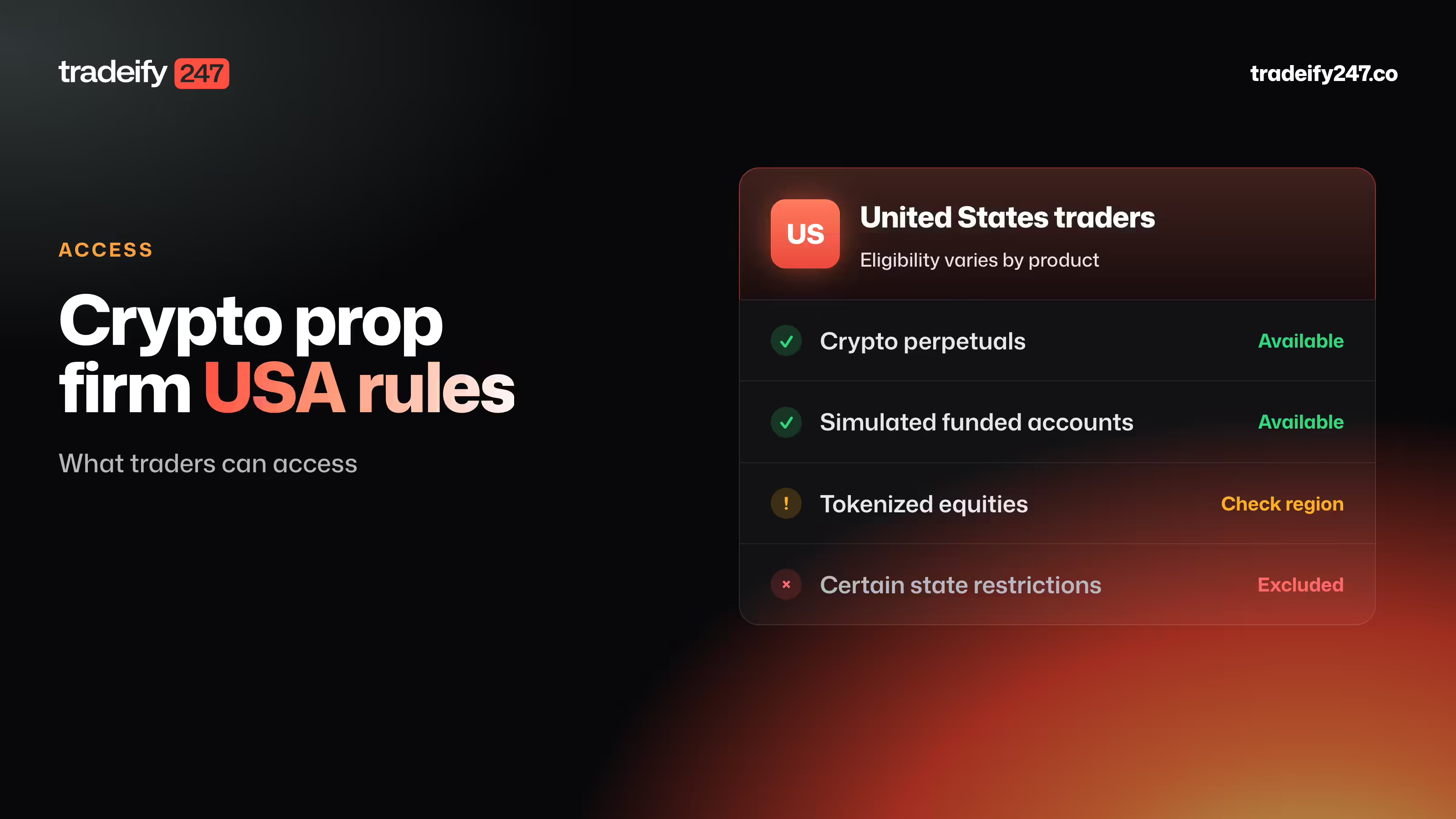
Crypto Prop Firm USA Rules and What Traders Can Access