



Crypto Prop Trading vs Trading Your Own Account: What Actually Changes


.svg)

Crypto prop trading firms give traders access to simulated capital ($5K–$100K accounts) for a one-time evaluation fee instead of risking personal savings, with an 80/20 profit split and on-demand payouts. Trading your own account offers 100% profit retention and full freedom but requires significant personal capital upfront. The smartest approach for most traders is a hybrid model, using prop accounts for high buying power and reinvesting payouts to build a personal account over time.
Crypto Prop Trading Removes Account Risk From the Trader
Trading your own capital means every dollar lost comes out of your pocket. With a crypto prop trading firm like Tradeify247, the firm absorbs the loss while you trade under defined rules. That single change reshapes position sizing, drawdown tolerance, and the psychological weight of every trade — and it's why Tradeify247 traders can focus on executing their strategy rather than protecting their savings.
The prop model isn't charity. Tradeify247 takes the loss risk in exchange for a profit split once you're funded, and the firm enforces rules that govern how much you can lose, how much you must make, and when you can withdraw. The freedom to risk more is replaced by structured guardrails on risk, which is the actual product Tradeify247 sells: firm capital plus disciplined boundaries.
The Risk Equation Changes
On a personal account, a 30% drawdown hurts but you can recover because there's no external deadline. On a Tradeify247 challenge, hitting the maximum drawdown ends the attempt and you pay for another challenge to retry. That single rule — one breach and the account is gone — changes how every trade feels, even when the strategy is identical.
Tradeify247's 3% equity floor rule provides a buffer that prevents many accounts from hitting the trailing drawdown limit during normal volatility. Tradeify247 traders learn to size positions tighter not because the math demands it but because the consequence of being wrong is binary: you're either in the challenge or you're out.
Psychological Pressure Shifts Direction
Personal-account trading carries the weight of real capital loss. Every drawdown is money you can't recover except through more winning trades. Tradeify247 trading removes that specific pressure but replaces it with performance pressure: hitting profit targets on time, respecting daily drawdown limits, and managing the clock if the challenge has a deadline.
Tradeify247 funded traders consistently report that the shift in pressure is real. Hitting a profit target by day 8 of a 30-day Tradeify247 challenge feels very different from hitting it on day 28 — and the prop model makes time a constant variable that personal-account trading doesn't impose.
Operational Realities Differ
Trading your own account means dealing with your own broker, your own deposit, your own tax reporting, and your own execution setup. Tradeify247 handles most of that: the firm chooses the platform (DxTrade), configures the leverage, sets the rules, and defines the trading environment. You trade within a sandbox Tradeify247 has built.
Tradeify247's sandbox is well-designed but bounded. The firm chooses DxTrade as its platform, sets 100+ crypto pairs, applies consistent leverage limits, and enforces the 3% equity floor rule automatically. You're not optimizing your own execution environment — you're adapting to Tradeify247's. For traders who spent years tuning a personal setup, the loss of control can feel frustrating.
Costs Look Different But Often Wash Out
Personal-account traders pay spreads, commissions, and possibly platform fees on every trade. Tradeify247 traders pay a challenge fee upfront and then split profits with the firm after passing. The cost structures aren't directly comparable, but for traders who would otherwise overtrade on personal capital, Tradeify247's structure can actually reduce total trading cost by capping the number of attempts and forcing disciplined risk management.
The math gets interesting at the funded stage: Tradeify247 takes a profit split that is higher than typical retail broker commissions but comes with the benefit of trading firm capital. For consistently profitable traders, the trade-off usually makes sense. For traders who aren't profitable, the prop model just converts one form of loss (capital drawdown) into another (challenge fees).
Skill Transfer Is Real but Not Perfect
If you can trade profitably on a personal account, the core skills — reading charts, managing risk, executing entries — transfer to Tradeify247. But the rule structure changes the application of those skills. A setup that works on a personal account with 5% risk per trade might not work on a Tradeify247 challenge with the firm's specific daily drawdown limits because the position size math is different.
Tradeify247 traders transitioning from personal accounts often need to recalibrate position sizing, tighten stop losses, and adjust their approach to profit targets. The strategy doesn't change; the parameters do.

Trade Crypto Without Limits
Tradeify is built for crypto traders who want clarity, consistency, and speed — not surprises.


When Prop Trading Makes Sense
Tradeify247 makes sense for traders who have a validated strategy but limited personal capital, or who want to scale without adding personal risk. It's also useful for traders who perform better under structured rules — the daily drawdown limit and profit target give clear boundaries that some traders find helpful.
If your strategy is profitable on small personal capital and you want to scale to larger position sizes without depositing more of your own money, Tradeify247 can multiply your effective buying power. The trade-off is the profit split and the rule constraints, but for the right trader, the math works out favorably compared to scaling on personal capital alone.
When Personal Trading Makes Sense
Personal trading makes sense for traders who want full control over their environment, who run strategies that don't fit Tradeify247's rule set (very long holding periods, exotic pairs outside Tradeify247's 100+ menu, custom automation that conflicts with Tradeify247's HFT restrictions), or who simply prefer owning their P&L without splitting with a firm.
If you've already scaled personal capital to a meaningful size and your broker setup is tuned to your strategy, moving to Tradeify247 means giving up control for capital efficiency. That's not always the right trade. Traders with significant personal capital often find Tradeify247's rules more restrictive than liberating.
The Hybrid Approach
Many serious crypto traders run both: a personal account for strategies that don't fit Tradeify247's rules, and one or more Tradeify247 accounts for strategies that scale well within standard challenge structures. The two setups complement each other — personal capital gives flexibility, Tradeify247 capital gives scale.
Running both requires operational discipline: separate trading plans, separate risk budgets, and clear rules about when capital moves between them. Tradeify247 traders who try to manage both with one mindset often find their performance degrades on both sides because the rules are different.
Payout Structure Differences
Personal accounts let you withdraw profits whenever you want, subject to broker processing times and tax reporting. Tradeify247 has payout schedules — many prop firms pay on a monthly cycle, some have minimum withdrawal thresholds, and almost all require a certain number of trading days before the first payout. The delay is real, especially for traders used to instant personal-account withdrawals.
The payout delay matters less for Tradeify247 traders running consistent strategies at scale and more for traders who need liquidity from trading profits to cover living expenses. If trading income is your primary revenue, Tradeify247's payout structure introduces cash flow timing that personal trading doesn't.
Tax and Reporting Implications
Personal trading income is reported as capital gains or business income depending on jurisdiction and structure. Tradeify247 payouts are typically reported as trading income or, in some cases, as contract income if you're operating as an independent contractor. The tax treatment varies, and traders should consult a tax professional before assuming Tradeify247 payouts are treated the same as personal trading profits.
In some jurisdictions, Tradeify247 payouts are taxed more favorably because the trader isn't personally holding the capital. In others, the profit split is treated as ordinary income with no capital gains treatment. The difference can be meaningful at scale.
The conversation happens live
Blog comments are too slow for crypto. Join 12,000+ traders in our Discord to discuss this article, share charts, and debate the market in real-time.
Join Discord
Making the Decision Between Prop and Personal
The choice between Tradeify247 and personal-account trading comes down to your capital situation, your strategy's fit for Tradeify247's rules, and how much control you want over your trading environment. Neither is universally better — they're different operating models for different trader profiles.
Tradeify247 works best for traders with proven strategies who want to scale without adding personal capital, and who can perform well within structured rule environments. Personal trading works best for traders who want full control, run strategies that don't fit Tradeify247's constraints, or already have meaningful personal capital deployed.
The honest assessment: most traders benefit from trying both. Start with a personal account to validate your strategy, then run a Tradeify247 challenge to see how your performance translates under firm rules. The experience will tell you which model fits your style better than any analysis can.
Whatever you choose, the underlying skill — reading markets, managing risk, executing consistently — is the same. The model just changes how that skill gets applied and rewarded.

Keep Reading
See all
Are Tokenized Stocks Safe and What Risks to Check First
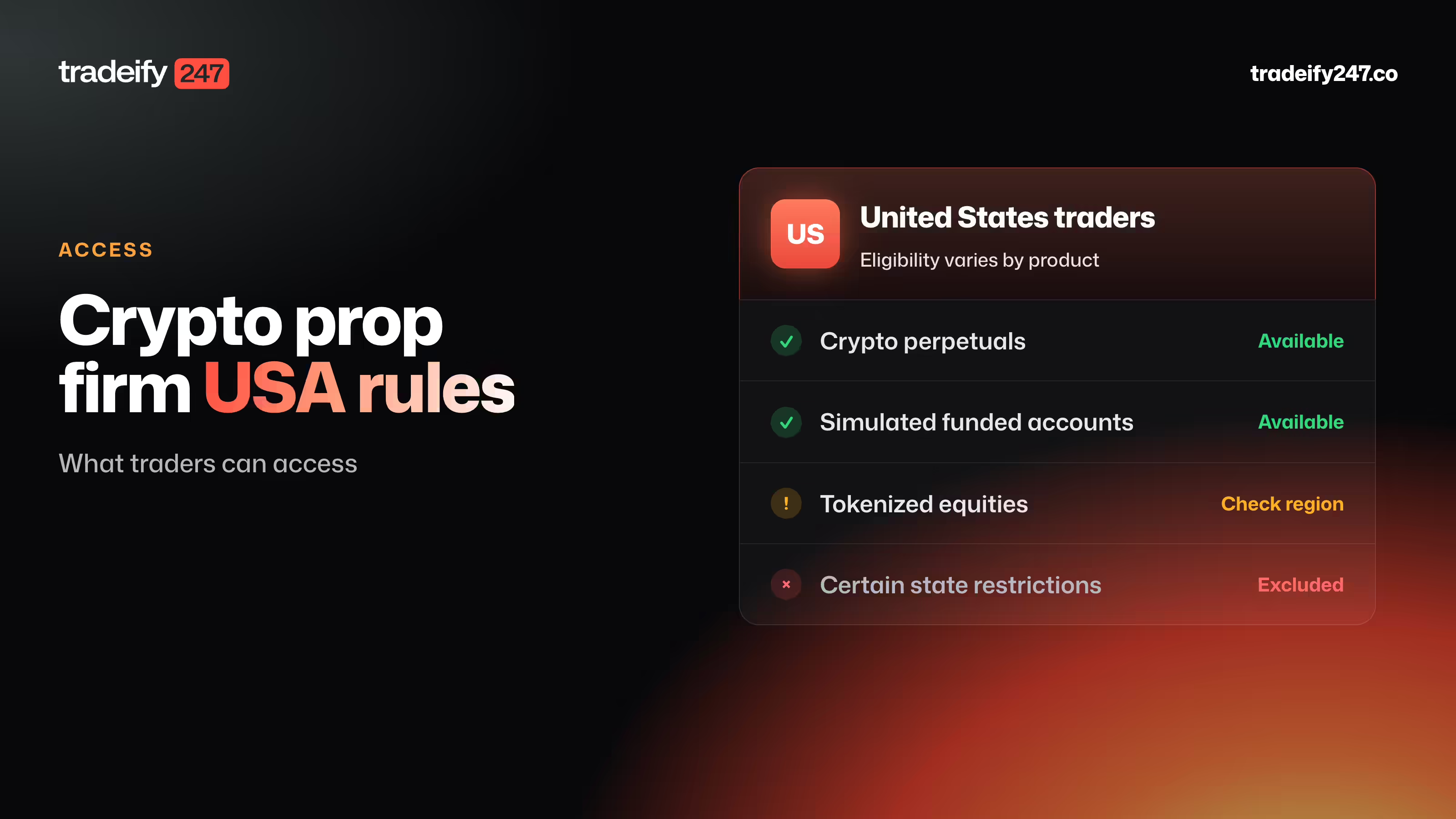
Crypto Prop Firm USA Rules and What Traders Can Access