



Crypto Day Trading Bitcoin vs Altcoins and How Prop Firms Give You an Edge


.svg)

Crypto day trading in 2026 centers on the Bitcoin vs altcoin decision, driven by Bitcoin Dominance cycles. BTC offers tight spreads, deep order books, and 3% to 5% daily moves, while altcoins regularly swing 20% to 50% intraday. This guide walks through core technical indicators (RSI, MACD, Bollinger Bands), risk rules (1% Rule, hard stop-losses, daily loss limits), and how Tradeify247's 1-Step, 2-Step, and Instant Funding paths on DXTrade give day traders up to $600K in capital with an 80/20 split.
The global financial market has undergone a radical transformation with the emergence of decentralized digital assets, leading to a specialized domain known as cryptocurrency day trading. Unlike traditional investment horizons that span years or decades, day trading in the crypto context focuses on the exploitation of intraday volatility, where positions are opened and closed within the same 24-hour cycle to capture high-frequency price fluctuations. This report analyzes the primary dichotomy facing modern market participants: the choice between day trading Bitcoin (BTC), the market's primary store of value and liquidity barometer, and altcoins, a diverse category of alternative assets characterized by high beta and narrative-driven price action. As the industry matures into 2026, the integration of proprietary trading models, such as those offered by Tradeify247, provides undercapitalized but skilled traders with the necessary infrastructure to scale these strategies while managing risk through rigorous mathematical frameworks.
Evolution and Fundamentals of the Digital Asset Market
The transition from the traditional stock market to the digital asset ecosystem necessitates a fundamental recalibration of a trader's understanding of market dynamics. While the New York Stock Exchange and other traditional venues operate within fixed business hours (typically 9:30 AM to 4:00 PM ET on weekdays), the cryptocurrency market functions as a continuous auction system that never closes. This 24/7/365 availability removes the concept of "overnight risk" associated with market gaps but introduces a requirement for constant attention and the potential for news-driven events to impact positions at any hour of the day or night.
Central to these market dynamics is the role of liquidity and daily volume. Liquidity represents the ease with which an asset can be exchanged for cash without significantly impacting its price. In the digital asset sphere, Bitcoin dominates this metric, with deep order books that can absorb institutional-size trades. For day traders on Tradeify247, this distinction is critical: Bitcoin offers tighter spreads and less slippage, while altcoins offer higher percentage moves but with less execution certainty.

Trade Crypto Without Limits
Tradeify is built for crypto traders who want clarity, consistency, and speed — not surprises.


Day Trading Altcoins for High Volatility and Opportunity
Altcoins, encompassing everything from large-cap assets like Ethereum (ETH) and Solana (SOL) to high-beta meme coins, offer a different value proposition: amplified volatility. While Bitcoin might move 3% to 5% in a single day, it is not uncommon for altcoins to experience 20% to 50% price swings within the same timeframe. This volatility is the primary attraction for many traders, as it allows for significant percentage gains without the need for extreme amounts of borrowed capital.
How Bitcoin Dominance (BTC.D) Shapes Altcoin Trading
A sophisticated understanding of altcoin trading requires mastery of Bitcoin Dominance (BTC.D), a metric representing Bitcoin's share of the total crypto market capitalization. It is calculated as Bitcoin's market cap divided by the total cryptocurrency market cap.
Traders use this ratio to identify "Altcoin Seasons," phases in the market cycle where capital rotates from Bitcoin into alternative assets. When Bitcoin's price stabilizes after a major bull run and BTC.D begins to fall, it often signals that investors are hunting for higher returns in riskier altcoins, leading to broad-based rallies across narrative sectors.
Reading BTC Dominance for Altcoin Setups
BTC rising, BTC.D rising. Bitcoin leads; altcoins likely bleed against BTC.
BTC falling, BTC.D rising. Panic mode; altcoins drop faster than BTC.
BTC sideways or consolidating, BTC.D falling. Altcoin Season; high probability for alt rallies.
BTC rising, BTC.D falling. Euphoria; speculative capital flooding into alts.
Altcoin Narrative Categories in 2026
By 2026, the altcoin market has bifurcated into several distinct sub-sectors, each with its own liquidity profile and volatility drivers:
Large-caps (ETH, SOL). Often considered "blue-chip" altcoins, these assets possess high liquidity and are the foundation for Decentralized Finance (DeFi) and Non-Fungible Token (NFT) ecosystems.
Artificial Intelligence (AI) tokens. Projects that integrate blockchain with AI agents or decentralized compute power. These tokens often react to news from the broader tech sector, such as NVIDIA earnings or OpenAI announcements.
Real-World Assets (RWA). The tokenization of traditional financial instruments like bonds, real estate, and private equity. RWA tokens often offer lower volatility but are driven by institutional adoption news from firms like BlackRock.
Meme coins (DOGE, SHIB, PEPE). Purely sentiment-driven assets that rely on community virality and social media hype. These are the most volatile assets and are favored by high-risk momentum traders.
Crypto vs Traditional Stocks for Day Traders
The fundamental distinction between crypto and stocks lies in the nature of the asset and the regulatory environment. Stocks represent equity in a company, where value is a reflection of future cash flows, earnings growth, and broader GDP trends. In contrast, cryptocurrencies are digital assets that derive value from network utility, scarcity, and speculative demand.
The volatility profiles of these markets are vastly different. Traditional "chip stocks" on the New York Stock Exchange are subject to price bands and "circuit breakers" that halt trading during extreme moves to prevent panic selling. The crypto market lacks such centralized intervention, leading to price action that is often described as "pure" demand and supply, but also inherently more dangerous for the undisciplined.
NYSE Stocks vs Crypto Exchanges
Market maturity. Stocks are highly mature and regulated. Crypto is emerging and in an early-to-middle stage.
Ownership stake. Stocks confer legal equity. Crypto confers utility or governance tokens.
Transaction costs. Stocks vary by commissions and taxes. Crypto costs come from spreads and exchange fees.
Information flow. Stocks rely on regulated disclosures. Crypto relies on social media and on-chain data.
Liquidity concentration. Stocks are centralized under NBBO. Crypto is fragmented across CEXs and DEXs.
Top Technical Indicators and Strategies for Crypto Day Trading
To handle the rapid price swings of digital assets, day traders rely on a combination of technical indicators and disciplined execution strategies.
Relative Strength Index (RSI) for Crypto Traders
The RSI is a momentum oscillator that measures the speed and change of price movements on a scale of 0 to 100. In 2026, traders emphasize RSI divergence (where the price makes a new high, but the RSI makes a lower high) as a critical signal for potential trend reversals.
Moving Average Convergence Divergence (MACD) in Crypto Day Trading
The MACD is used to identify shifts in momentum before they are fully realized in price action. A "golden cross" in the MACD (where the MACD line crosses above the signal line) below the zero line is often viewed as a high-probability entry for an upcoming bullish impulse.
Bollinger Bands for Crypto Volatility
Bollinger Bands consist of a middle simple moving average and two outer bands representing standard deviations of price. The upper band is the SMA plus a multiple of the standard deviation, and the lower band is the SMA minus a multiple of the standard deviation. A "Bollinger Squeeze" occurs when the bands contract tightly, indicating a period of low volatility that is almost always followed by an explosive move in either direction.
Execution Strategies for Crypto Day Traders
Scalping. This strategy focuses on profiting from minor price changes over very short timeframes (seconds to minutes). Success in scalping requires ultra-low latency and assets with deep liquidity to avoid the erosive effects of slippage.
Arbitrage. Exploiting price differences of the same asset across different exchanges. For instance, if BTC is trading at a premium on a Korean exchange compared to a US exchange, an arbitrageur will buy in the US and sell in Korea to capture the "spread".
Algorithmic trading. The use of bots to execute trades based on predefined rules. Bots can monitor the market 24/7, removing the human element of fatigue and emotion, which is particularly beneficial in a market that never sleeps.
The conversation happens live
Blog comments are too slow for crypto. Join 12,000+ traders in our Discord to discuss this article, share charts, and debate the market in real-time.
Join Discord
Risk Management for Crypto Day Traders
The psychological pressure of day trading crypto is unparalleled. The human brain is evolutionarily wired for "loss aversion," where the pain of losing money is perceived as twice as intense as the pleasure of gaining an equivalent amount. This can lead to catastrophic decision-making, such as "revenge trading" after a drawdown or refusing to close a losing position in the hope of a rebound.
Handling the $500 to $350 Drawdown Scenario
A common test of a trader's emotional resilience is their reaction to a rapid 30% drawdown. If a $500 position drops to $350 in 10 minutes, an impulsive trader might panic-sell at the bottom or double down without a strategy. A professional trader, however, treats this as a data point within their historical "Maximum Drawdown" parameters. If the move breaches their predefined stop-loss, they exit without hesitation, preserving capital for the next opportunity.
Position Sizing and Capital Allocation for Crypto Traders
Risk management necessitates that no single trade should jeopardize the entire account. The "1% Rule" (risking only 1% of total account equity on any single trade) ensures that a trader can survive a long losing streak. Position sizing must also account for the volatility of the asset; a position in a meme coin should be significantly smaller than a position in Bitcoin to maintain the same dollar-risk profile.
Core Risk Management Protocols
Hard stop-loss. Limits the maximum loss per trade automatically.
Daily loss limit. Prevents emotional "tilting" after a series of losses.
Position sizing. Ensures survival across various asset classes.
Diversification. Spreads risk across uncorrelated narratives (e.g., AI vs RWA).

Keep Reading
See all
Are Tokenized Stocks Safe and What Risks to Check First
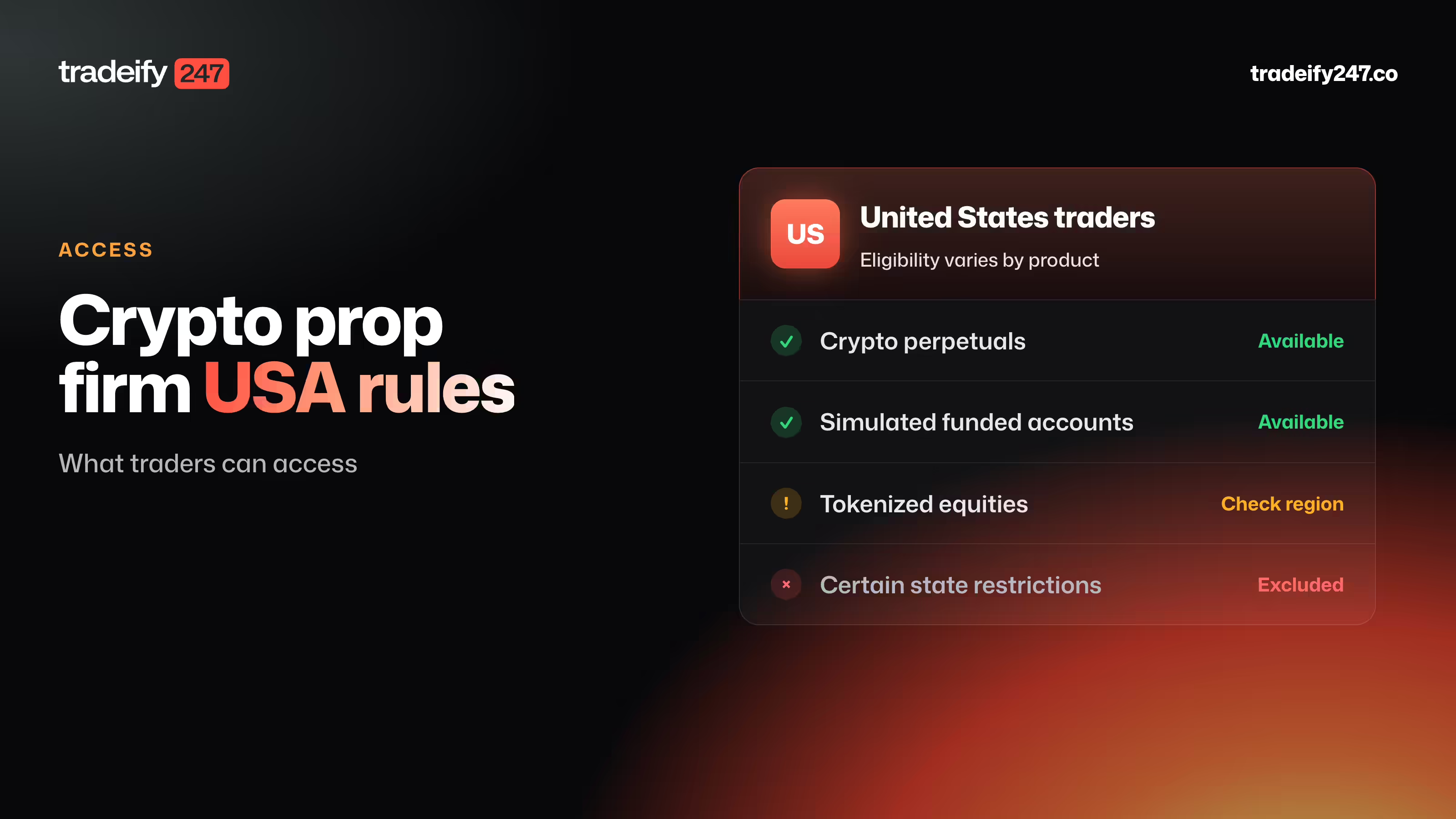
Crypto Prop Firm USA Rules and What Traders Can Access