


Crypto Bot Trading in 2026 and How to Get Started


.svg)

TL;DR Cryptocurrency trading bots automate the execution of predetermined strategies 24/7, removing human emotion and latency from trade management. Core bot types include DCA bots for accumulation, Grid Trading bots for range-bound markets, and Arbitrage bots for cross-exchange pricing discrepancies. Professional bot architecture requires a layered stack of market data ingestion, a signal generator (e.g., EMA crossovers, RSI divergence), a risk management layer for position sizing and circuit breakers, and an execution engine communicating via REST/WebSocket APIs. For prop traders on Tradeify247, cloud platforms like Cryptohopper and Bitsgap offer rapid deployment, while custom Python/Node.js bots provide unlimited flexibility for proprietary strategies, provided they are deployed within the firm's compliance rules against HFT, latency arbitrage, and cross-account hedging.
Crypto Bot Trading in 2026: How Automated Strategies Work
In 2026, the digital asset market is characterized by high-frequency volatility and decentralized global liquidity. For individual participants, the 24/7 nature of the market presents a fundamental challenge: it is physically impossible for a human to monitor price action across all trading sessions, time zones, and asset pairs simultaneously. The solution, for a growing segment of sophisticated retail and proprietary traders, is automation through the use of algorithmic trading bots.
This guide examines the mechanics, strategies, and risk management protocols required to deploy a crypto trading bot effectively. For traders operating within a proprietary trading environment like Tradeify247, understanding the distinction between retail automation and compliance-grade algorithmic execution is critical. While many retail traders associate trading bots with get-rich-quick schemes or unregulated signal groups, the reality in 2026 is that automated trading has matured into a vital component of professional trading infrastructure.
What is a Crypto Trading Bot
A crypto trading bot is a software program designed to automatically execute buy and sell orders on cryptocurrency exchanges based on a predefined set of rules and algorithmic logic. The core function of a bot is to replace the manual, emotional, and time-constrained actions of a human trader with a precise, data-driven, and tireless automated system.
Think of a trading bot as a digital employee. You provide it with a strategy (using an API key), and it executes that strategy without requiring sleep, without experiencing panic or greed, and with a reaction time measured in milliseconds. The bot connects to a cryptocurrency exchange via an Application Programming Interface (API), which allows it to read real-time market data and execute trades on your behalf.
It is crucial to understand that a trading bot does not possess market intuition. It cannot predict black swan events or interpret ambiguous news headlines. It is a tool for execution, not a substitute for a sound trading strategy. The effectiveness of a bot is a direct function of the quality of the strategy it automates and the robustness of its risk controls.
Types of Crypto Trading Bots
In the professional 2026 trading landscape, bots have diversified into specialized categories. Understanding the specific function of each type is the first step in designing a profitable automated system.
DCA Bots for Accumulation
Dollar-Cost Averaging bots are the most straightforward and widely adopted tools. An investor sets a schedule (e.g., buy $100 of Bitcoin every Monday at 10:00 AM UTC) or a price deviation parameter (e.g., buy after every 2% dip). The bot executes this strategy indefinitely, smoothing out the volatility of entry prices over months and years.
For professional traders at Tradeify247, a DCA bot can be a useful vehicle for building a core position in an asset without trying to time the bottom. While many DCA bots are used for passive accumulation, the same technology can be configured for more aggressive dip-buying strategies during periods of high volatility, provided strict risk limits are placed on total exposure.
Grid Trading Bots for Sideways Markets
Grid trading is a strategy designed to profit from market volatility within a predefined price range. The bot places a ladder of buy and sell orders at incremental price levels above and below a set midpoint. When the price oscillates, the bot automatically buys low and sells high within that grid.
For example, if Bitcoin is trading at $70,000, a trader might set a grid between $65,000 and $75,000 with 50 grid levels. As the price moves up and down, the bot captures small profits on each movement. The primary risk of a grid bot is that the price breaks out of the grid entirely. In a strong uptrend, the bot will execute all its sell orders, leaving the trader without exposure. In a strong downtrend, the bot continues buying, potentially using all capital allocated to the strategy.
Professional traders at Tradeify247 often use grid strategies during known periods of market consolidation. When on-chain data and technical indicators suggest a range-bound market, grid bots can provide consistent, small-scale returns while consuming minimal management time.
Arbitrage Bots for Price Inefficiencies
Arbitrage bots exploit price differences for the same asset across different exchanges. If Bitcoin is trading at $70,000 on Binance and $70,150 on Coinbase, a sophisticated arbitrage bot can execute a simultaneous buy on one exchange and sell on the other, capturing a risk-free spread.
While seemingly simple in theory, profitable arbitrage in 2026 is an advanced, institutional-grade field. The profit margins have compressed significantly as the market has matured. Execution now requires ultra-low latency, colocation servers, and access to deep liquidity pools to overcome the costs of withdrawal fees and network latency.
It is critical to note that for prop firm traders such as those at Tradeify247, HFT (High-Frequency Trading) and latency-based arbitrage bots are generally prohibited because they exploit platform mechanics rather than market direction. Funded traders must operate within the firm's specific execution policies.
How to Build a Crypto Trading Bot
The architecture of a functional trading bot involves more than just a Python script that fires buy orders. A professional system requires a robust stack with multiple integrated components.
The Core Components of a Trading Bot
- Market Data Layer. The bot must ingest a real-time stream of price data. This typically comes via WebSocket feeds from exchanges, which provide live order book depth, ticker updates, and trade history.
- Signal Generator. This is the brain of the bot. It processes market data through a set of programmed trading strategies. For example, a signal might be "EMA 50 crossed above EMA 200" combined with "RSI is less than 60."
- Risk Management Layer. This is the most critical component for a prop trader. Before any signal is sent to execution, it is filtered by a risk layer. This layer checks: Does this trade exceed the max allowed position size? Would a stop-out at this price exceed the daily loss limit? Is the total exposure within acceptable parameters?
- Execution Engine. This layer translates the generated signal and the approved risk parameters into a formatted API call to the exchange (e.g., "Place a limit order for 0.5 BTC at $69,950 with a stop-loss at $69,500").

Trade Crypto Without Limits
Tradeify is built for crypto traders who want clarity, consistency, and speed — not surprises.


Best Platforms for Crypto Trading Bots
The platform you choose dictates the tools you have available. The landscape in 2026 is split between no-code cloud platforms and custom API-based development environments.
Cloud-Based Bots for Beginners
Cloud-based platforms are the entry point for traders who do not want to write code. These platforms connect to exchanges via API and provide a visual interface for dragging and dropping trading strategies.
- Cryptohopper. A dominant player in the algorithmic cloud space with strong support for major exchanges. It includes a marketplace where users can copy pre-built strategies and signals.
- Bitsgap. Known for its integrated arbitrage and grid bot features, combining manual terminal trading with automated bots in a single interface.
- 3Commas. A platform that bridges manual and automated trading, allowing traders to build bots with conditional take-profit and trailing stop-loss orders.
For a funded trader, cloud bots offer speed of deployment and ease of use. However, they come with subscription fees and may have limitations on the complexity of risk management protocols that professional firms require.
Exchange-Native Bots
Many of the world's top exchanges now offer native automated trading tools through simple copy-and-paste interfaces. The exchange-native approach often provides the fastest execution, as the bot operates on the same servers as the order book, reducing latency. The code is usually open-source and customizable, enabling deep flexibility.
Custom API Development for Professional Traders
For traders who have a truly unique edge (e.g., a proprietary indicator or a complex statistical arbitrage model), a custom API bot is the only viable path. This requires programming skills, typically in Python or Node.js, to build a standalone script that communicates directly with the exchange's REST and WebSocket endpoints.
The advantage of a custom bot is unlimited flexibility. You can code any risk rule, any indicator, and any execution logic. Professional Tradeify247 traders might use a custom bot to run a multi-asset sector rotation strategy, simultaneously assessing momentum across dozens of pairs and reallocating capital according to a strict volatility-weighted algorithm.
Managing Risk With a Trading Bot
For a proprietary trader, the purpose of a trading bot is to generate consistent, rule-based profits without violating the drawdown limits of the funded account. This requires an embedded risk layer that functions as an automated guardian of the trading account.
Automated Position Sizing
A bot can use a dynamic Kelly Criterion-based model to calculate the optimal contract size for every trade based on the current account balance and the distance to the invalidation level. If the bot determines that a standard 1% risk position would require five contracts, but the trader has set a maximum of three, the risk layer overrides the signal and reduces the size. This ensures the bot cannot override prudent risk limits.
Hard-Coded Circuit Breakers
This is the single most important line of code for a prop trader. The circuit breaker monitors the account's profit and loss in real time. If a preset loss threshold (e.g., -$2,000 for a $100,000 account within a single session) is breached, the bot immediately cancels all open orders, closes all positions, and disconnects from the exchange. This prevents emotional decision-making from turning a bad day into a blown account.
Surviving Flash Crashes and Black Swans
Automated bots can struggle during extreme market events due to failed API calls and slippage. The bot's risk layer should have a "slippage detector" that compares the expected fill price to the actual fill price. If slippage exceeds a certain percentage, the bot halts and alerts the trader, preventing catastrophic losses from executing orders into thin liquidity.
The conversation happens live
Blog comments are too slow for crypto. Join 12,000+ traders in our Discord to discuss this article, share charts, and debate the market in real-time.
Join Discord
Exchange and Prop Firm Compatibility
Not all trading bots are compatible with all prop firm environments. For a funded trader, the selection of a bot is constrained by both the exchange and the firm's operational policies.
Exchange API Integration
A trading bot interfaces with an exchange through API keys. An API key is a digital pass that allows the bot to access the exchange's trading functionality. It is standard practice to never enable the "withdrawal" permission on an API key used for a trading bot, limiting the key's access to only trading and market data. This ensures that even if the bot server is compromised, your funds cannot be withdrawn.
For traders on the Tradeify247 platform, the execution environment is the DXtrade platform. When evaluating a bot, the first question is whether it supports a DXtrade integration.
Tradeify247's Bot Policy
Tradeify247 supports the use of automated trading tools under a clear set of compliance rules. These rules are designed to distinguish between legitimate algorithmic trading and prohibited exploitative activity.
Under Tradeify's policy, traders may use bots that execute strategies based on market analysis, including DCA, grid, and trend-following systems. Bots must be under personal ownership, meaning the trader created or licensed the strategy and is not simply a participant in a managed fund or copy-trade pool where signals are generated by a third party.
Prohibited activities include HFT, tick latency strategies, multi-account arbitrage, and any form of cross-account hedging. The fundamental principle is that the trader must be the source of the strategic edge. The bot is a tool for executing that edge with speed and discipline, not a substitute for it.
Tax Implications and Record Keeping
Automated trading can generate thousands of transactions across a financial year. Every single one of these transactions is potentially a taxable event. For a funded trader, professional-grade record keeping is not optional.
Automating Your Tax Records
Professional trading bots should be configured to log every transaction to a database or CSV file in real-time. The log must include the asset, the quantity, the timestamp, the fiat value at the time of sale (for cost basis calculations), and the associated fees. These logs can be exported to specialized crypto tax software that processes the data into a compliant tax report.
Prop Trader Profit Reporting
When trading with a funded account on Tradeify247, it is important to note that your taxable profit is the payout you receive from the firm, not the notional value of the trades you executed. The firm provides documentation for these payouts. You should keep these records alongside your trading logs to accurately report your income in your jurisdiction.
How to Get Started with Crypto Bot Trading
For a proprietary trader looking to automate their edge, the path to implementation follows a structured roadmap.
Choose Your Tool
If you have a valid, manually tested strategy, choose a tool that lets you deploy it efficiently. For rapid deployment with low technical overhead, consider cloud platforms like Cryptohopper or Bitsgap. For maximum strategic flexibility and the ability to code unique risk parameters, pursue a custom Python or Node.js implementation.
Test Thoroughly Before Going Live
Never deploy capital to an untested bot. Conduct extensive backtesting against historical data to see how the strategy would have performed, but be aware of overfitting and survivorship bias. Then, run the bot in simulation mode against real-time market data for a minimum of two to four weeks to ensure it handles volatility, news events, and execution as expected. Only then deploy it with small, real, risk-controlled capital.
Final Thoughts on Crypto Bot Trading
Algorithmic trading bots have moved from a niche tool for tech-savvy traders to a core component of the professional crypto trading stack. They offer a solution to the core challenges of the 2026 market: high speed, 24/7 operations, and the psychology of fear and greed.
For the funded trader on Tradeify247, a bot is not a shortcut to wealth. It is a tool for enforcing discipline. A properly configured bot with a hard-coded circuit breaker does not revenge trade, it does not move a stop-loss lower to avoid getting stopped out, and it does not FOMO into a pump. It simply executes the plan, 24 hours a day.
The traders who succeed in the era of automation are not those with the most technical skills but those who can merge a high-quality trading strategy with the precision of automated execution and the ironclad risk rules of a prop firm environment.
Disclaimer: This article is for educational purposes only and does not constitute financial advice or an endorsement of any specific platform. Always check a platform's terms of service before connecting automated software. Crypto trading involves substantial risk of loss and is not suitable for all investors.

Keep Reading
See all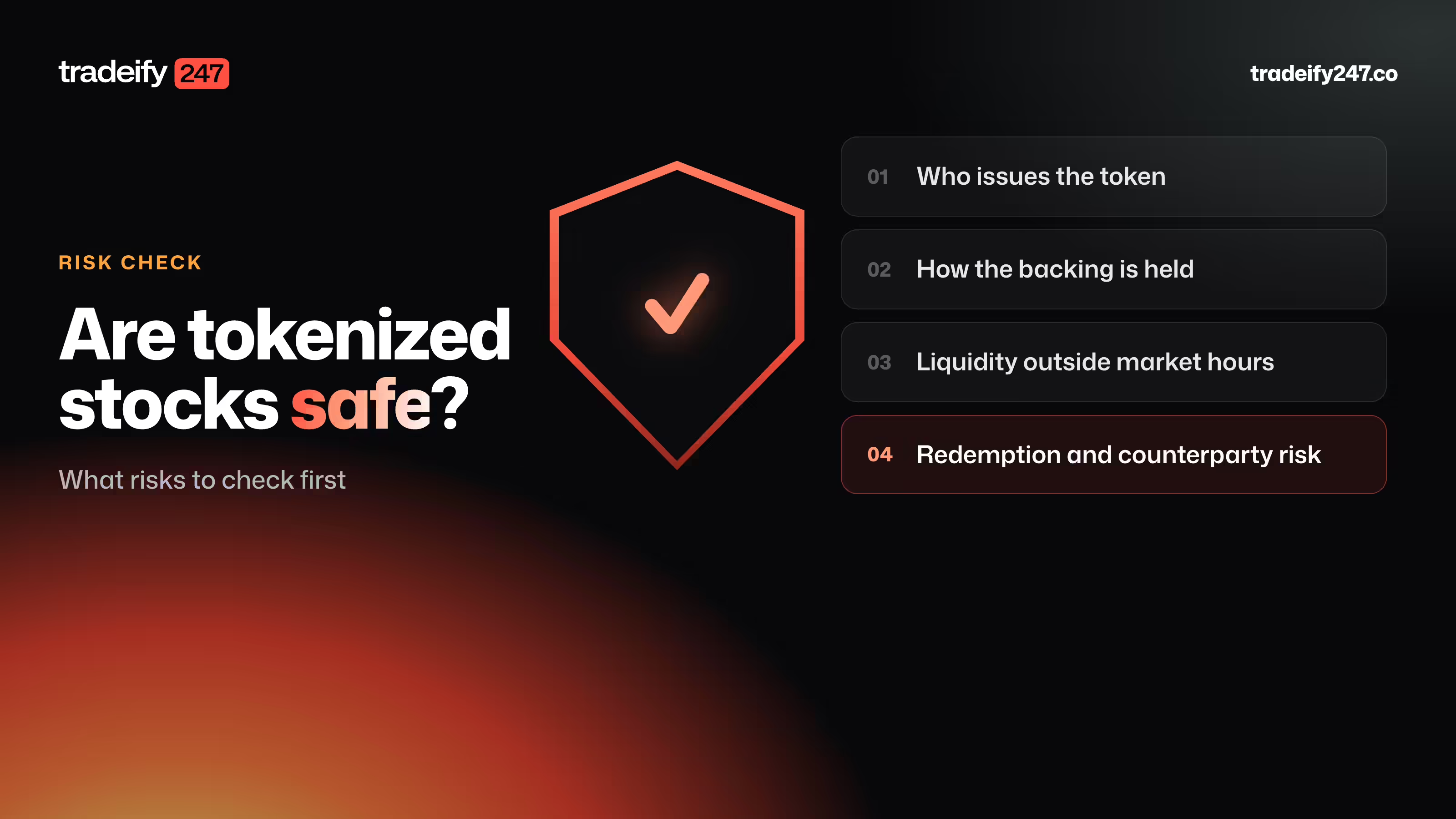
Are Tokenized Stocks Safe and What Risks to Check First
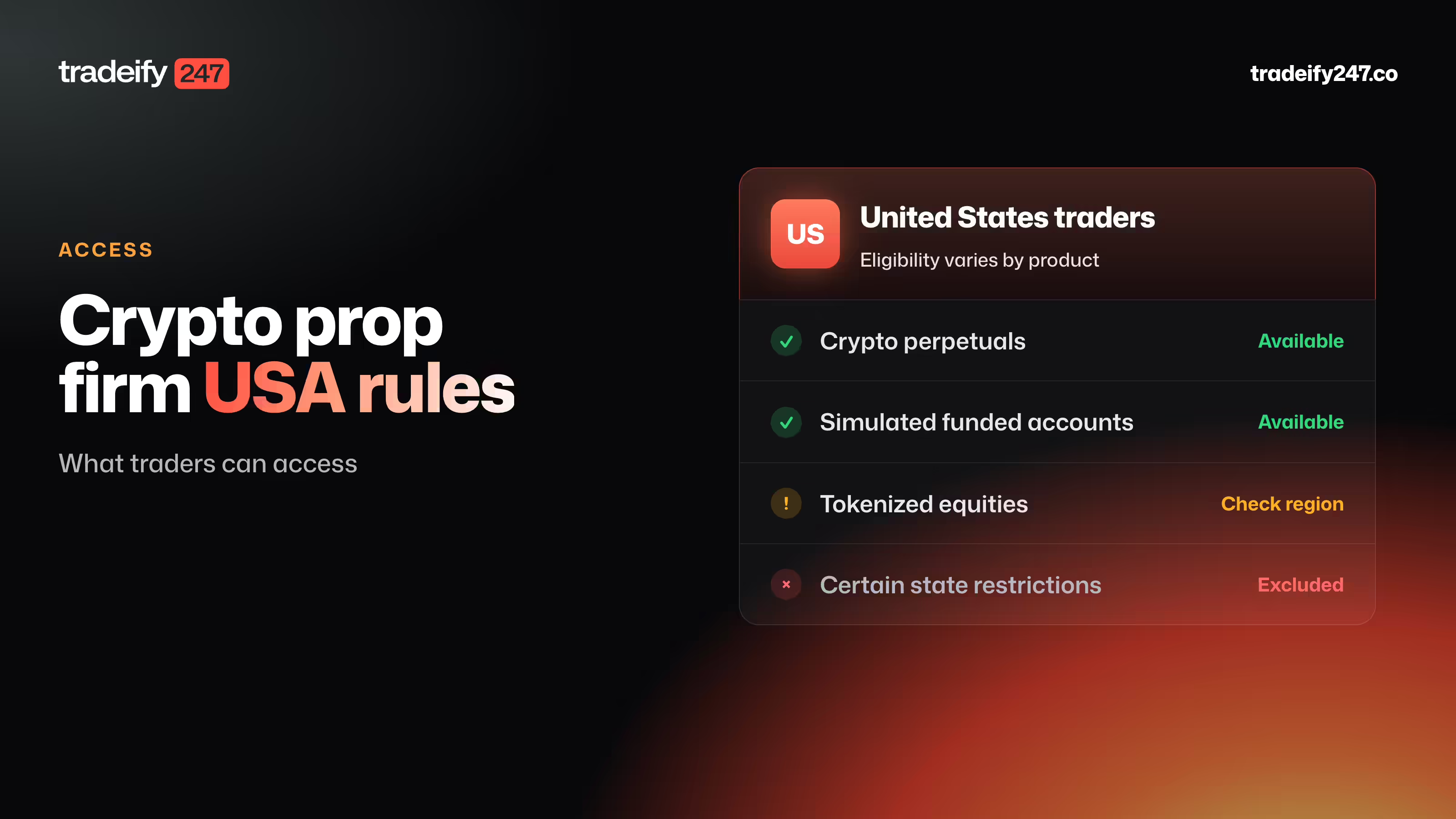
Crypto Prop Firm USA Rules and What Traders Can Access